Kartra vs HubSpot: CRM and Marketing Fit
Choosing between Kartra and HubSpot depends on what your team actually needs to run: sales-team crm workflows versus digital marketing funnels. This guide compares the complete customer journey, operational trade-offs, and a practical evaluation process without claiming hands-on testing.
Quick comparison and decision
Consider Kartra if your main challenge is coordinating acquisition pages, email follow-up, payment and delivery of a digital offer. Consider HubSpot if its specialized strengths align more closely with your operating model. Neither choice is universally better. Write down your three non-negotiable workflows and test them before subscribing.
What each platform is designed to solve
HubSpot organizes CRM-centered marketing, sales and service workflows across product hubs. Kartra emphasizes marketing funnels and digital-offer delivery. This is a comparison between a cross-functional customer platform and a campaign-oriented selling system.
Compare the complete workflow
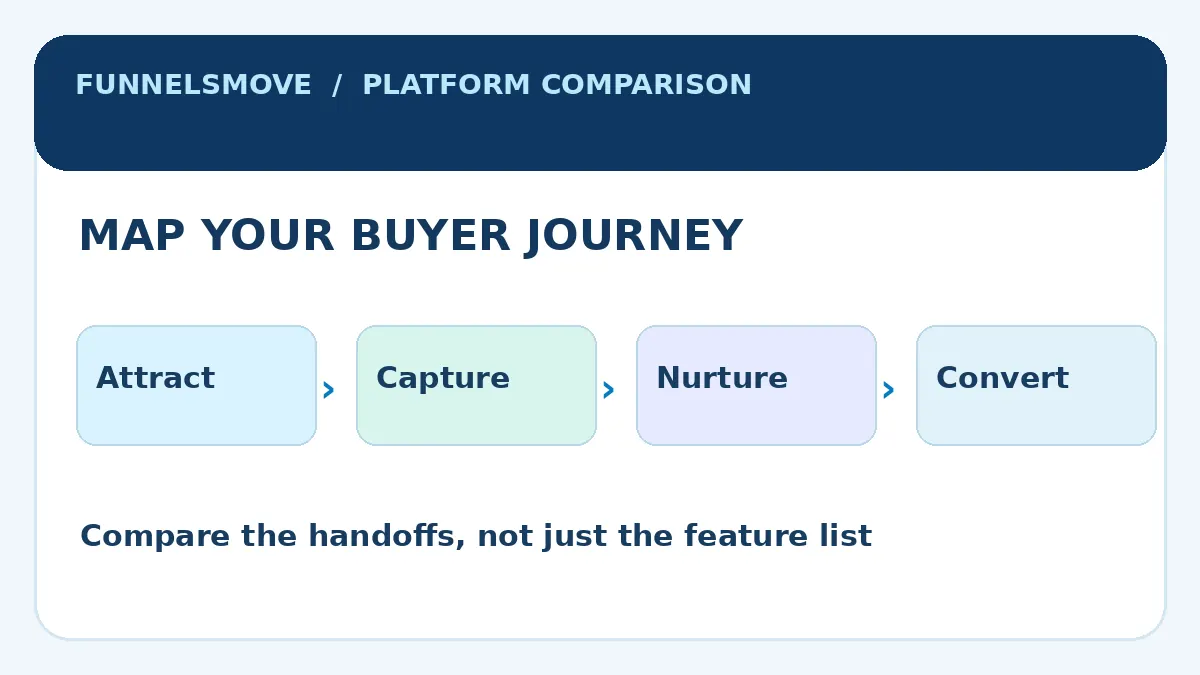
Map the journey from anonymous visitor to qualified lead, deal, customer and support request. Determine whether multiple teams must share a customer record or whether one small team mainly needs a working funnel and fulfillment process.
CRM and sales-team operations
Test contacts, companies, deals, pipelines, assignments and handoffs. HubSpot is especially relevant to evaluation when sales and service teams require shared records. A creator with direct checkout may place less value on a full sales CRM.
Marketing automation and lead nurturing
Compare form capture, email segmentation, lead scoring, campaign reporting and automated handoffs. Verify which HubSpot hub and subscription tier includes the workflow you need; do not assume all features are in a starter plan.
Content, landing pages and campaigns
Publish one campaign page and evaluate forms, branding, SEO settings, reporting and content updates. Determine whether your content strategy requires a broad CMS and sales integration or mostly focused acquisition pages.
Pricing and seat-dependent complexity
Build a total-cost worksheet including the correct hub, seats, contact tiers, onboarding, integrations and training. Pricing can change and optional products can alter the result, so use official quotes for the exact configuration rather than an unverified headline figure.
Which business fits which approach
HubSpot deserves a close look when marketing, sales and service must coordinate through CRM. Kartra deserves a look when the business primarily sells digital offers using pages, sequences and checkout. Evaluate the operating model, not the logos.
How to compare total costs
Do not compare advertised monthly prices in isolation. List the subscription tier, number of contacts, email volume, staff access, payment processing, external integrations and expected support. Request or review current official plan documentation before purchase. A lower subscription can be more expensive when it requires extra tools or repeated manual work.
For Kartra-specific plan considerations, read our Kartra pricing guide. Treat all prices as subject to change and check the vendor’s checkout before committing.
A realistic evaluation checklist
- Write one real customer scenario with the required data and outcome.
- Build the same landing page and lead-capture flow in both products.
- Check consent, segmentation, unsubscribe and follow-up behavior.
- Test the sale or sales-team handoff, including failure handling.
- Review mobile pages, permissions, exports and documentation.
- Record plan limits, recurring costs and owner maintenance time.
Use a small controlled test with non-sensitive sample data. Do not assume a vendor demo proves that your particular integrations or workflows will operate as expected.
When neither platform is the right choice
If your business primarily needs a specialist commerce catalog, a complex editorial CMS, or enterprise-grade custom integration, a different category of product may fit better. The best tool is the one that supports your core work with manageable risk, not the one with the longest feature list.
Team permissions and governance
When marketing, sales and service share customer records, permission design and process ownership matter. Document who can edit properties, build automations and access sensitive contact information. A smaller funnel operation may have simpler governance requirements but still needs secure account management.
Implementation and onboarding
Estimate the work to define lifecycle stages, migrate data, configure forms, map ownership and train users. Compare this with launching a single sales journey. Implementation cost and staff adoption can matter more than small differences in advertised subscriptions.
Verdict: decide by operational fit
Choose the platform that handles the most important end-to-end journey with the fewest fragile handoffs. Prioritize maintainability, customer data control and actual delivery requirements over feature counts. Revisit the decision as your business grows and new needs become concrete.
Explore the Kartra platform overview, compare other Kartra alternatives, and read the Kartra versus ActiveCampaign comparison for another view of automation-led purchasing decisions.
Sources and verification
Reviewed October 30, 2026. Confirm product capabilities and plan restrictions on the official Kartra website and the official HubSpot website. Vendor documentation describes offered capabilities but does not independently establish reliability or performance in your business.
Explore Kartra for your workflow
Review Kartra’s current features, plan terms and suitability for your offer before deciding.
Explore Kartra’s official website