Simvoly Review: Features, Pros, Limits and Fit
This Simvoly review evaluates the platform by workflow and documented capabilities rather than treating a long feature list as proof that it fits every business.
Simvoly review summary
Simvoly is a credible all-in-one option for businesses that want websites and conversion funnels in the same platform, with native ecommerce, CRM, email automation, courses and communities. Its strongest strategic appeal is consolidation: the public website and focused sales journeys do not need to live in unrelated builders.
Our assessment is based on current public product documentation and pricing, not hands-on claims we cannot substantiate. Simvoly’s official materials describe a visual builder, funnel A/B testing, ecommerce and checkout tools, CRM, marketing automation, courses, communities, appointments, video hosting and separate white-label capabilities.
The trade-off is the same one that applies to many all-in-one systems: breadth is useful only when the included tools are deep enough for your particular workflow.
Builder and day-to-day workflow
The platform’s website builder uses drag-and-drop editing and templates. Simvoly positions websites and funnels as connected parts of the same system, so a normal site can coexist with campaign-specific funnel steps.
That model is operationally attractive. You can keep brand pages, lead-generation pages and selling flows close together instead of managing separate publishing systems. Funnel-specific capabilities include A/B testing and analytics, while the broader builder handles standard website navigation.
Ease of use is still subjective. Before committing, use the trial to reproduce one real page, one form and one checkout journey from your business. That test reveals more than generic claims about simplicity.
A practical framework for evaluating Simvoly
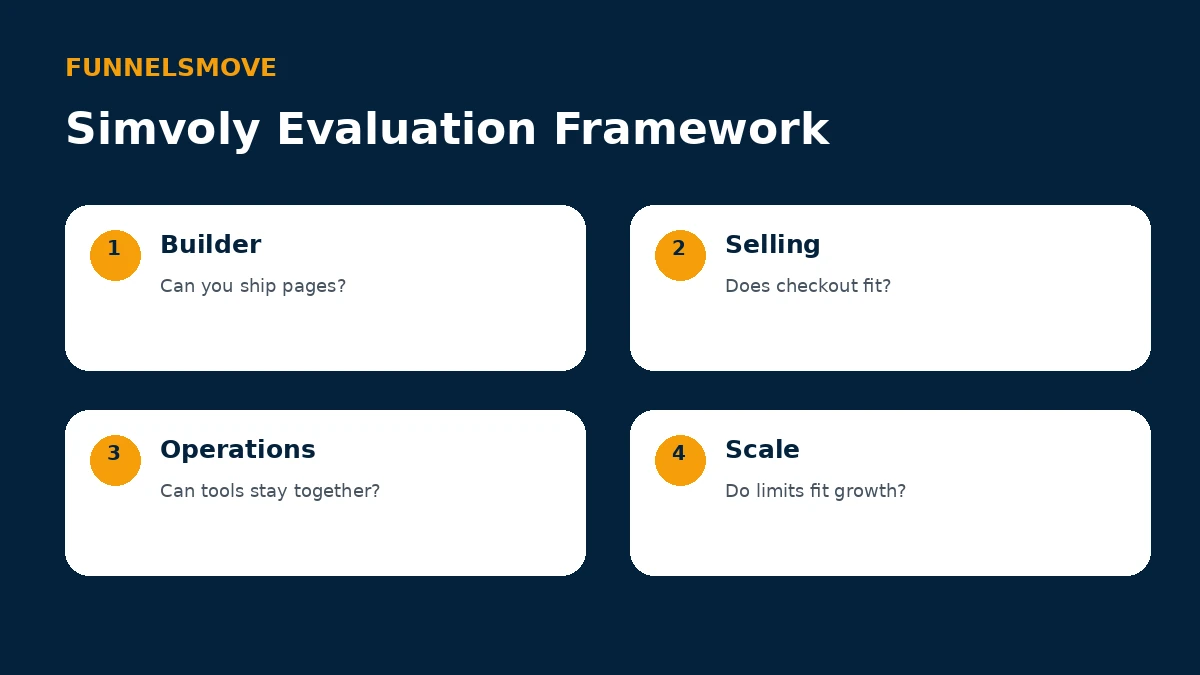
Evaluate four layers: whether the builder lets your team publish efficiently, whether the selling workflow matches your offers, whether native CRM and marketing reduce tool handoffs, and whether plan limits remain sensible as you grow.
This prevents an all-in-one platform from winning merely because it has more checkboxes. A feature you cannot use effectively is not operational value.
Funnels, ecommerce and checkout
Simvoly’s funnel builder supports A/B testing, custom checkouts, analytics and sales-oriented steps. Its ecommerce product also supports stores, products, subscriptions and recurring payments, bump offers and one-click upsells or downsells.
That mix can suit creators selling digital products, service businesses collecting payments and smaller merchants that want campaigns and storefronts together. It also reduces the need to bolt a checkout tool onto a separate site builder.
Businesses with complicated fulfillment, inventory, tax or marketplace requirements should test those workflows directly. The presence of ecommerce does not automatically make an all-in-one builder equivalent to a specialist commerce platform.
CRM, email and automation
The native CRM tracks leads and members, form submissions, activity and custom properties. Simvoly also offers email marketing and automation flows, with marketing subscriber allowances and paid capacity additions reflected in current pricing.
For a small team, this can eliminate several integrations. A visitor can submit a form, become a CRM contact and enter follow-up inside the same ecosystem.
For larger marketing operations, compare segmentation, deliverability requirements, workflow complexity, reporting and subscriber economics with a dedicated email platform before consolidating.
Where Simvoly stands out
The first strength is structural: websites and funnels are not treated as mutually exclusive products. The second is breadth—selling, CRM, marketing, communities and courses can connect to those pages. The third is the agency path: Simvoly offers separate white-label plans for organizations that want to resell a branded platform.
Current standard pricing also begins below many funnel-first competitors, although plan limits differ substantially and sticker price alone is not a fair platform comparison. Use the Simvoly pricing guide to compare the actual resources you need.
Limitations and questions to test
All-in-one breadth can become a limitation when you need specialist depth. Teams with sophisticated ecommerce, enterprise CRM, advanced development workflows or highly specialized marketing automation should verify each requirement rather than assuming the integrated tool is enough.
Plan limits matter as well. Websites, funnels, domains, bandwidth, marketing subscribers and other resources vary by tier. White-label pricing is a separate product structure, so agencies should not model reseller economics from the standard plans.
Finally, vendor marketing claims about conversion or performance should not substitute for your own measurement. Build a representative funnel during the trial and measure your own page behavior and workflow.
Who should consider Simvoly?
Simvoly is a strong candidate for a creator, consultant, service business or small ecommerce operation that wants to reduce the number of systems involved in publishing, lead capture and selling. Agencies may also find the white-label path strategically important.
It is less obviously suited to organizations whose requirements are dominated by one enterprise-grade specialist system. The more unusual your CRM, commerce or front-end needs, the more carefully you should test migration assumptions.
If your decision is primarily funnel-driven, compare it directly with ClickFunnels rather than assuming the two products are interchangeable.
Simvoly review verdict
Simvoly’s value proposition is coherent: combine websites and funnels, then connect selling, CRM and marketing around them. That makes it more than a page builder without requiring every customer to adopt a large external stack.
The best way to evaluate it is to build one complete customer journey during the trial—from page to form or checkout to follow-up. If that workflow feels simpler and covers your requirements, the platform’s breadth becomes a genuine advantage.
Simvoly for different business models
For a consultant or service business, the combination of a normal website, lead funnels, forms, CRM and appointments can be attractive because the path from discovery to inquiry stays relatively compact. The key test is whether the CRM and scheduling workflow is sufficient for the sales process after a lead arrives.
For a creator, the relevant stack is different: landing pages, checkout, recurring payments, email, courses and communities matter more than appointment operations. Simvoly covers those categories, but creators should test content delivery and subscriber economics with their expected audience size.
For ecommerce, evaluate catalog and operational complexity. Funnel upsells can be valuable for focused offers, while a store supports broader browsing. A business with complex fulfillment or inventory rules should verify those details before treating Simvoly as a replacement for a specialist commerce platform.
Agencies have an additional decision because Simvoly sells a separate white-label platform. Standard-plan satisfaction does not automatically prove the reseller economics work; branding, client management, project allowances and support responsibilities need their own analysis.
What we would verify before committing
First, verify every resource limit that can become expensive to change later: websites, funnels, domains, bandwidth, marketing subscribers, administrators and any ecommerce requirements. Use current pricing rather than an old review because the plan structure can change.
Second, test the least forgiving workflow in your business. If that is a subscription checkout, build it. If it is a multi-step lead qualification flow, reproduce it. If it is course access after purchase, follow the experience as a student. The hardest workflow is a better test than a generic homepage.
Third, inspect reporting and data access. Determine which conversion, sales and contact information you need weekly and whether it is easy to retrieve. If another system must consume the data, confirm the integration or API path before migration.
Finally, test support with a real implementation question during the trial. Documentation and responsiveness become more important after the site is live, when a workaround can affect customers.
SEO, performance and ownership considerations
A visual builder can make publishing easier, but SEO still depends on content quality, information architecture, metadata, crawlability, internal linking and performance. Do not choose a platform because a template is labeled SEO-friendly and assume the work is complete.
For a content-heavy business, test how efficiently editors can manage titles, descriptions, headings, image alternatives, canonical behavior and redirects. Also inspect how the site behaves on mobile and under realistic media weight.
Ownership is operational as well as technical. Keep copies of important copy, images, product data and customer exports. Document domains and third-party integrations so the business is not dependent on one person remembering how the system was assembled.
These considerations are not unique weaknesses of Simvoly. They are part of responsible evaluation for any hosted all-in-one platform.
Review conclusion by decision type
If your main problem is tool fragmentation, Simvoly deserves a serious trial because consolidation is central to its design. The value is strongest when websites, funnels, CRM, selling and follow-up genuinely need to interact.
If your main problem is a highly specialized requirement, start with that requirement instead. A dedicated ecommerce, CRM or marketing platform may justify extra integrations when its depth materially improves operations.
If you are comparing funnel platforms, do not rely on historical articles that describe either Simvoly or ClickFunnels as they existed years ago. Both product sets have expanded, and current pricing and limits matter.
The most defensible buying process is simple: define a real customer journey, reproduce it during the trial, price the required capacity and document the compromises. That produces a decision based on your business rather than a generic score.
Frequently asked evaluation questions
Is Simvoly only a website builder? No. Its current product scope extends into funnels, ecommerce, CRM, marketing automation, courses, communities, appointments and video. The website builder is an important foundation, but evaluating only that feature misses much of the platform.
Is Simvoly only for agencies? No. Standard website-and-funnel plans are offered separately from the white-label product. Agencies are an important audience because of the reseller platform, while creators and small businesses can use the regular plans without operating a white-label service.
Can Simvoly replace every marketing tool? That depends on your requirements. Consolidation is one of its strengths, but specialist tools may remain appropriate for complex ecommerce, enterprise CRM, advanced analytics or unusually sophisticated automation.
Should you migrate immediately after a good trial? Usually the safer approach is to document the tested workflow, verify current plan limits and migrate in stages. A successful demo proves feasibility; it does not automatically prove that every historical page, contact and automation should move at once.
Explore Simvoly
Review the current platform, trial and plan details directly before deciding whether it fits your workflow.