Simvoly Pricing: Plans, Costs and How to Choose
Simvoly’s standard pricing currently spans four website-and-funnel tiers, with separate white-label plans and optional capacity add-ons that should be evaluated independently.

Simvoly pricing at a glance
As of September 27, 2026, Simvoly’s official pricing page lists Starter at $12/month billed annually or $18 month-to-month, Business at $29/$36, Premium at $39/$49 and Elite at $79/$97. Simvoly advertises a 14-day free trial. Prices and limits can change, so verify the checkout before purchasing.
The tiers are not just different payment levels. They vary in websites, funnels, domain connections, bandwidth and other capabilities. The lowest advertised price is therefore not automatically the cheapest plan for a specific business.
White-label agency pricing is separate. Do not compare a standard Simvoly plan with a white-label reseller tier as though they were the same product.
Starter, Business, Premium and Elite
Starter is the entry website tier. The current table lists one website, one domain connection, unlimited pages and 20GB of bandwidth, but no included funnels in the plan table. It is therefore better understood as an entry website option than a full funnel package.
Business adds five funnels, six domain connections and 60GB of bandwidth. Premium increases that to ten funnels, eleven domain connections and 100GB, while Elite lists five websites, unlimited funnels, unlimited domain connections and 200GB.
The right tier depends on resources, not the label. Count the sites, funnels and domains you actually need and leave room for realistic growth.
Four questions before choosing a plan
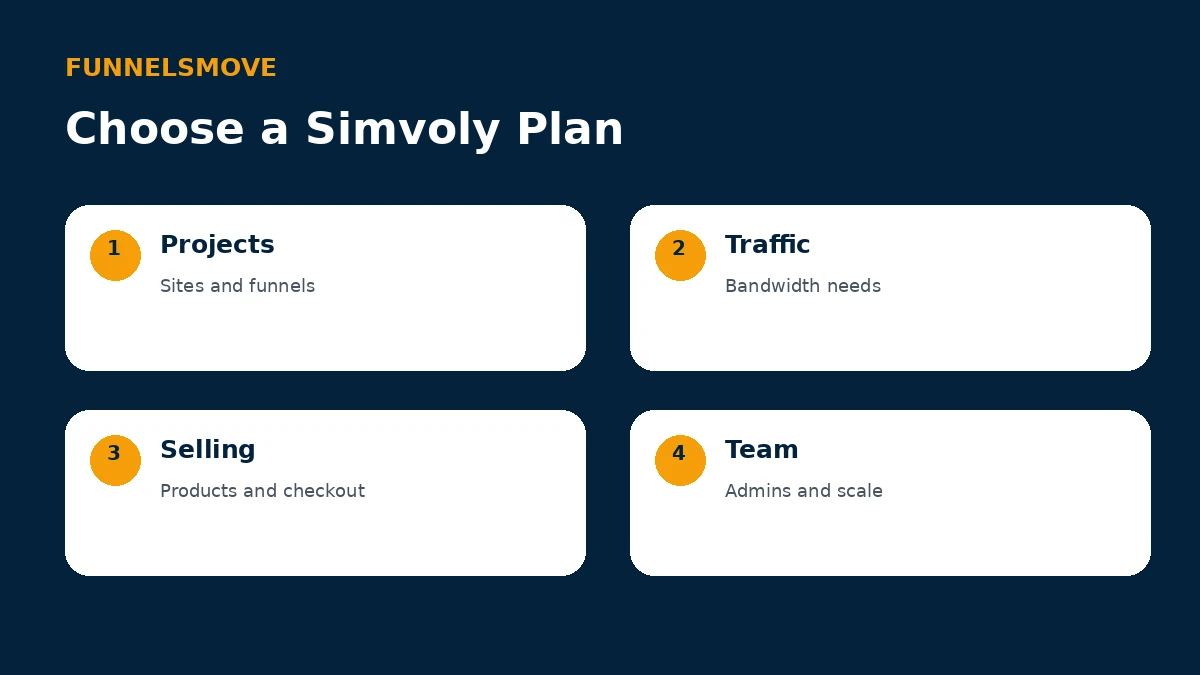
Start with projects: how many websites and funnels will you operate? Then consider traffic and bandwidth, selling requirements, and the people who need administrative access. Those constraints are more useful than choosing a tier based on price alone.
Also model marketing-subscriber costs if email is part of your stack. Simvoly publishes subscriber add-ons separately, so a growing list can change total operating cost.
When Starter makes sense
Starter can fit a small informational website or early project that does not require the included funnel allocation shown on higher tiers. It keeps the entry cost low while providing the core hosted builder.
If your primary reason for choosing Simvoly is sales funnels, inspect Business or above rather than buying Starter simply because it is cheapest. A plan that omits the resource you need is not a bargain.
When Business makes sense
Business is the first current tier in the official table that includes five funnels. That makes it a more natural starting point for a small business that wants a normal website plus several focused campaigns.
The plan also raises domain connections and bandwidth. Those limits matter if you operate multiple branded destinations or expect more traffic.
When Elite makes sense
Elite is the highest standard tier shown in the current pricing table. It lists five websites, unlimited funnels and domain connections, and 200GB of bandwidth.
“Unlimited” should always be read in the context of the provider’s terms and other plan resources. If your business has unusually heavy traffic or operational requirements, confirm those assumptions directly with Simvoly.
Email and other add-on costs
Simvoly publishes marketing-subscriber add-ons separately, beginning with additional subscriber capacity and scaling upward. White-label projects also have their own project tiers and add-ons.
That means total cost can differ from the headline website-plan price. Build a simple cost model around your real subscriber count, number of projects and selling requirements before comparing Simvoly with another platform.
Standard plans vs white-label pricing
Simvoly’s current white-label pricing lists WL Basic, WL Advanced and WL Ultimate separately from the standard website-and-funnel plans. These tiers are designed for agencies or SaaS operators that want the platform under their own brand.
If you are buying Simvoly for your own business, standard pricing is usually the relevant comparison. If you intend to resell branded projects, model the white-label platform and per-project economics separately.
Is Simvoly worth the price?
Price only becomes value when the platform replaces tools you would otherwise pay for and still meets your requirements. Simvoly can potentially combine a site builder, funnels, ecommerce, CRM and marketing, but the savings depend on which of those tools you would genuinely use.
Compare total operating cost, migration effort and feature fit—not just the first monthly number. Our Simvoly review covers the broader workflow, while Simvoly vs ClickFunnels examines a funnel-focused alternative.
Bottom line on Simvoly pricing
Simvoly’s current standard plans offer a relatively low entry point, but meaningful funnel use begins higher in the table and resource limits vary by tier. Business, Premium and Elite progressively expand funnel, domain and bandwidth capacity.
Choose by workload first and price second. Confirm current pricing immediately before purchase because plan names, limits and promotions can change.
Example plan-selection scenarios
A brochure-style business website with modest traffic may find Starter sufficient if it does not need the included funnel allocations of higher tiers. The moment funnels become central, Business is the more relevant comparison because the current plan table includes five funnels.
A creator running several campaigns might compare Business and Premium based on funnel count, domains, bandwidth, products and marketing capacity. The cheaper tier is only economical if its limits do not create immediate add-on or migration pressure.
An operator managing multiple sites should pay close attention to website allowances. Elite’s current five-website allocation changes the economics for someone who would otherwise need separate projects or accounts.
These are examples, not prescriptions. Simvoly can change plan details, and individual requirements vary. Recalculate from the current pricing page before subscribing.
Annual versus monthly billing
Annual billing lowers the advertised effective monthly price on the current standard plans. That discount can be meaningful, but annual commitment makes the most sense after you have validated the workflow and expected resource usage.
Month-to-month billing costs more but can reduce commitment risk during an early implementation. A business still proving its funnel architecture may value flexibility more than the first-year discount.
When comparing with another platform, use the same billing basis. Comparing Simvoly’s annual effective price with a competitor’s month-to-month price exaggerates the difference.
Also separate recurring platform cost from migration, design, email capacity, integrations and staff time. Total cost of ownership is broader than subscription price.
Pricing mistakes to avoid
Do not choose Starter because it is the first price shown if your project depends on funnels. Do not assume unlimited pages means unlimited traffic, websites, funnels or domains. Each resource should be checked independently.
Do not treat white-label pricing as an upgrade path for a normal business without understanding its reseller purpose. It is a different operating model with project economics and branding capabilities.
Do not use an old pricing screenshot as a contract. Vendors change tiers, promotions and limits. Record the date of your comparison and verify the checkout before committing.
Finally, avoid optimizing for the smallest possible plan. A tier that constantly requires workarounds can cost more in staff time than the subscription difference.
Explore Simvoly
Review the current platform, trial and plan details directly before deciding whether it fits your workflow.