Simvoly vs ClickFunnels: Features, Funnels and Fit
Simvoly and ClickFunnels now overlap across funnels, websites, ecommerce, CRM, email and memberships, but they approach the all-in-one problem from different starting points.
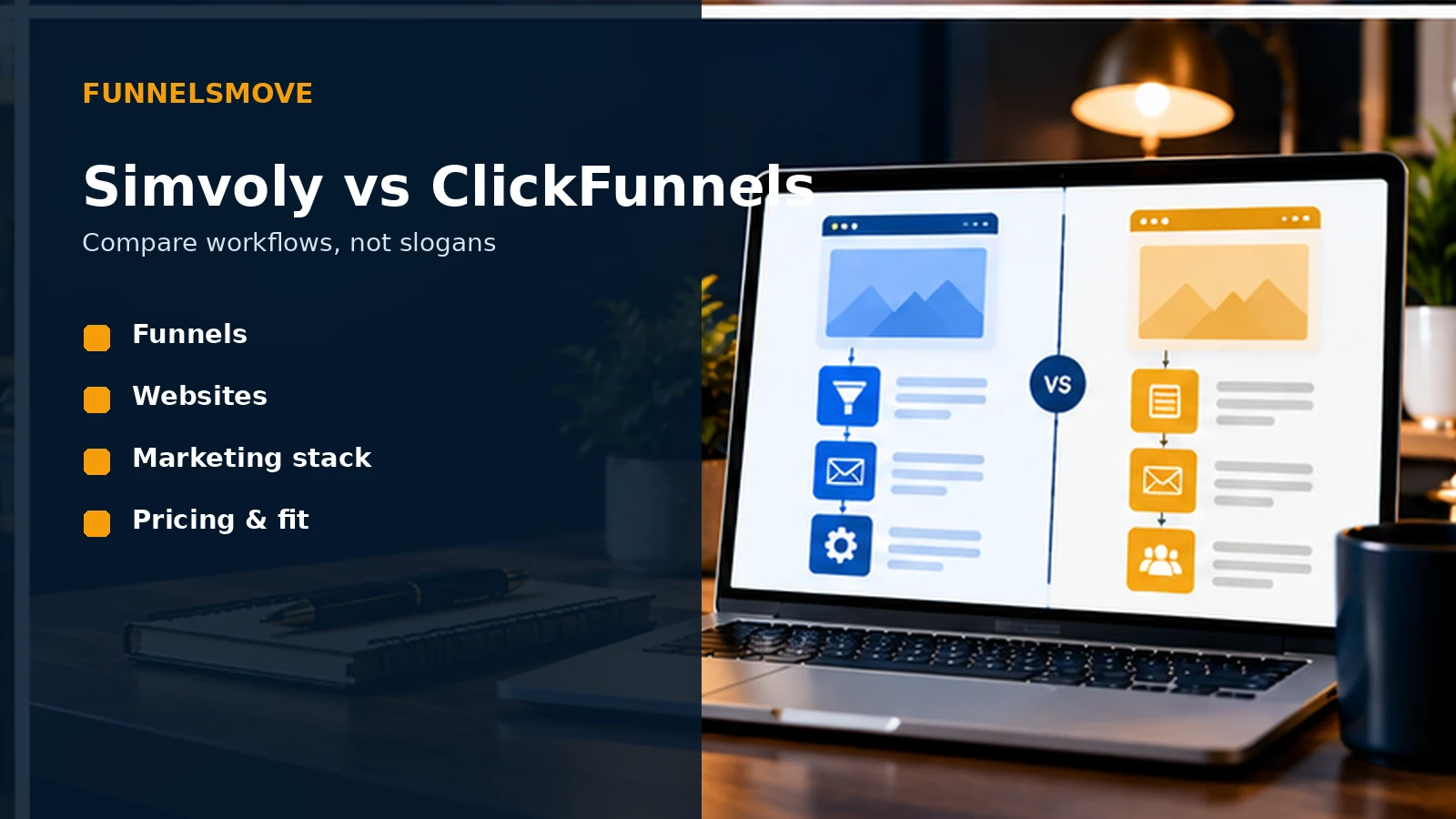
Simvoly vs ClickFunnels at a glance
Simvoly combines a website-builder foundation with funnels and a broad business stack, while ClickFunnels remains explicitly funnel-first even as its current platform has expanded into websites, stores, CRM, email, courses and communities. The overlap is much greater than it was several years ago.
That means the decision should not be reduced to “website builder versus funnel builder.” Both can now support multi-step sales journeys, selling and customer follow-up. The more useful comparison is how each platform structures those workflows, what resources its plans include and which operating model feels natural to your team.
This comparison uses current official product and pricing information as of September 27, 2026. It does not reproduce either vendor’s self-declared superiority claims as independent conclusions.
Funnel building and conversion workflows
ClickFunnels’ current product is still organized around the funnel mindset. Its official feature set includes sales funnels, a drag-and-drop editor, Smart Checkout, A/B testing, landing pages, countdown funnels and related conversion tools.
Simvoly also provides a funnel builder with A/B testing, custom checkouts, analytics, bump offers and one-click upsells or downsells. The difference is context: Simvoly emphasizes funnels working alongside conventional websites in the same ecosystem.
If your team thinks primarily in funnel stages and campaign flows, ClickFunnels’ product language and organization may feel more direct. If you want campaigns to sit beside a traditional multi-page site, Simvoly’s combined site-and-funnel model deserves attention.
A better way to compare the platforms
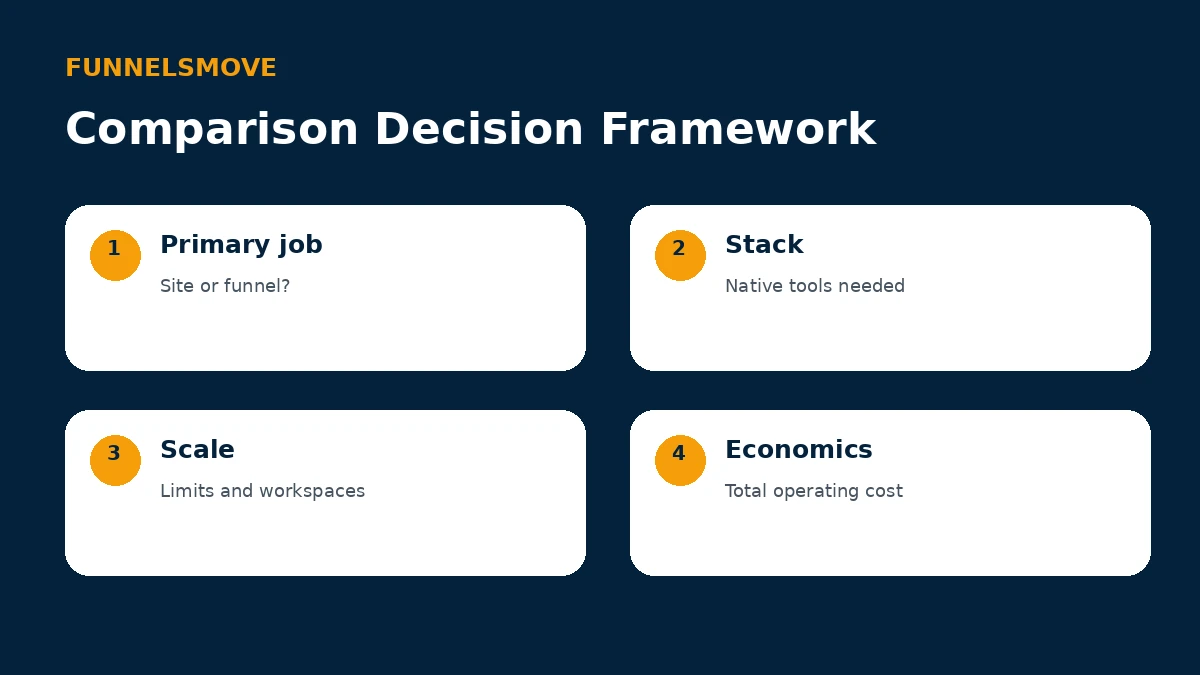
Use four questions: what is the primary job, which native tools must stay together, what scale limits matter, and what is the total operating cost? This avoids declaring a winner based on a single feature or headline price.
Build the same representative customer journey in each trial if possible. A landing page, form, checkout and follow-up sequence will expose workflow differences that feature tables cannot.
Websites and page building
Simvoly explicitly markets a drag-and-drop website builder with templates, hosted sites and funnels in the same platform. Standard plan resources are expressed partly in websites, funnels, domains and bandwidth.
ClickFunnels now includes website and site-building capabilities alongside funnels. Its current platform also includes landing pages and content-oriented pages, so older comparisons that describe ClickFunnels as unable to build broader web experiences are outdated.
The decision is therefore about emphasis and workflow rather than basic availability. Review navigation, reusable design, content management and publishing processes against the kind of site you actually intend to maintain.
Ecommerce and checkout
Both platforms support selling. Simvoly combines storefront ecommerce with funnel-specific checkouts, recurring payments, bump offers and upsells. ClickFunnels offers Smart Checkout, Store Funnels, products, collections and funnel-driven selling features.
A creator with a small product catalog may be comfortable in either system. A merchant should test product management, variants, shipping, tax, subscriptions and fulfillment requirements rather than assuming the word “store” means identical ecommerce depth.
CRM, email and automation
Simvoly includes CRM profiles, activity, form submissions, custom properties and segmentation, plus email campaigns and automation flows. Marketing subscriber capacity can affect its total cost.
ClickFunnels’ current platform includes CRM/opportunity features, appointments, email, automations, messaging and related apps. Its pricing tiers include contact and email allowances, with higher tiers expanding those limits.
For both products, map the complete lead lifecycle. The right platform is the one whose native CRM and automation cover your real process without forcing awkward workarounds or unnecessary integrations.
Courses, memberships and communities
Simvoly’s current product scope includes courses and communities alongside its websites and funnels. ClickFunnels also offers courses, membership sites, communities and a customer center for delivering purchased content.
If education is central to your business, compare lesson organization, access control, community experience and reporting directly. The fact that both have a course feature does not mean their learning workflows are identical.
Pricing comparison
Simvoly’s current standard annual-billing prices are advertised at $12/month for Starter, $29 for Business, $39 for Premium and $79 for Elite, with higher month-to-month rates. The included resources vary substantially, and Starter is not the equivalent of a full ClickFunnels funnel plan.
ClickFunnels currently lists Launch at $97/month, Scale at $197 and Optimize at $297 when billed monthly; its annual pricing page shows lower effective monthly rates, and it also offers a higher annual-only Dominate tier. Current plans include unlimited funnels as a limited-time item while varying workspaces, contacts, email volume, courses, domains and support.
Simvoly has the lower headline entry price, but a fair comparison must match the resources and functions your business needs. If one platform replaces additional tools or supports the workflow more efficiently, headline price alone can be misleading.
Agency and white-label considerations
Simvoly has a distinct white-label product aimed at agencies, marketers and SaaS founders. It supports branded platform experiences and separate white-label pricing, making reseller strategy a major part of its positioning.
ClickFunnels supports multiple workspaces on higher plans and a broad marketing stack, but Simvoly’s current public positioning puts considerably more emphasis on operating a platform under your own brand. Agencies specifically seeking white-label resale should evaluate that product separately from Simvoly’s standard tiers.
How to choose between Simvoly and ClickFunnels
Consider Simvoly when a conventional website plus funnels is central to your architecture, you value a lower-cost standard entry point, or the separate white-label path matters. Consider ClickFunnels when your organization is strongly funnel-first and its current funnel-centered ecosystem and app structure better match how you operate.
Those are fit considerations, not universal rankings. Both platforms now cover enough adjacent territory that a short trial using your own offer is more informative than relying on old feature comparisons.
For deeper context, see our Simvoly platform guide, Simvoly review, Simvoly pricing guide, and existing ClickFunnels review.
Bottom line
Simvoly and ClickFunnels are both broad marketing-and-selling platforms in 2026. Simvoly approaches the problem through tightly combined websites and funnels with a notable white-label path; ClickFunnels approaches it through a funnel-first operating model that now extends into sites, stores, CRM, email and learning products.
Choose based on the customer journey you need to build, the native tools you will actually use and the plan resources required to operate it.
Simvoly vs ClickFunnels for creators and coaches
Creators often need a chain that starts with an opt-in, continues through email, sells a course or membership and then delivers access. Both platforms now cover much of that chain, so the decision is less about whether the features exist and more about how you prefer to assemble and operate them.
ClickFunnels’ funnel-first organization may appeal to a business whose marketing calendar is built around offers and campaigns. Simvoly may appeal when the creator also wants a conventional website to remain a central content and brand destination alongside those funnels.
Course and community features should be tested from the learner’s perspective. Build a sample lesson, configure access, make a test purchase and inspect the member experience on mobile. Feature names do not reveal the day-to-day experience.
Email limits, contacts and plan allowances also affect creator economics. Model your expected audience size rather than comparing only the base subscription.
Simvoly vs ClickFunnels for agencies
An agency evaluating these products has two separate questions: what should power the agency’s own marketing, and what should be delivered to clients. Those are not necessarily the same answer.
Simvoly explicitly sells a white-label platform with custom branding and reseller-oriented project structures. That can matter to an agency that wants clients to log into an environment carrying the agency’s brand. Standard Simvoly pricing should not be used to model that business.
ClickFunnels’ higher tiers provide multiple workspaces and team capacity, which can support multiple business contexts, but its public positioning is different from Simvoly’s white-label reseller proposition. Evaluate branding, permissions, client billing and handoff requirements directly.
For either platform, the operational burden matters. A profitable client stack needs repeatable templates, clear ownership, reliable support and predictable resource costs—not merely the ability to create another funnel.
Migration and switching costs
Switching builders affects more than page appearance. Domains, URLs, forms, tracking, products, customer access, email automations and CRM records may all need a migration plan. A lower subscription does not automatically offset a difficult transition.
If you already use ClickFunnels successfully, identify the concrete problem Simvoly would solve before migrating. If you already use Simvoly, do the same before moving to ClickFunnels. Avoid platform changes driven only by novelty.
Rebuild one representative funnel before committing. Compare editing time, mobile adjustments, checkout configuration, analytics, follow-up and team handoff. Document any missing feature that requires an external tool.
For SEO-sensitive sites, map redirects and metadata before changing domains or URLs. A funnel migration and a website migration carry different search risks.
A neutral decision checklist
Choose the workflow you need to support over the next twelve months. Count websites, funnels, domains, contacts, email volume, courses and team members. Then map each requirement to the current plan tables.
Decide whether the conventional website or the funnel is the center of your architecture. Neither answer is inherently better, but it can make one platform’s mental model easier for your team.
List any non-negotiable integrations, API needs, custom-code requirements and reporting outputs. Test them before migration rather than assuming a higher plan solves every edge case.
Finally, compare total cost on the same billing period and include external tools you can actually remove. The platform with the lower sticker price is not necessarily the lower-cost operating system for your business.
Feature overlap that makes old comparisons misleading
Older comparisons often framed Simvoly as a website builder with funnels and ClickFunnels as almost exclusively a funnel builder. That framing is no longer sufficient. ClickFunnels’ current site lists stores, CRM, email, automations, courses, communities, appointments and site tools in addition to funnels.
Simvoly has also expanded beyond pages and funnels. Its current product materials cover CRM, marketing automation, ecommerce, courses, communities, appointments, quizzes and video hosting, while its white-label platform targets agencies and SaaS operators.
Because both vendors have broadened, a modern comparison should focus on implementation quality and operating model. Ask how quickly your team can create the same campaign, how customer data moves through the system, and what happens after a sale. Those questions reveal differences that a binary feature checklist hides.
Plan design is another source of false equivalence. Simvoly standard tiers are constrained through resources such as sites, funnels, domains and bandwidth. ClickFunnels tiers use workspaces, contacts, email volume, courses, domains and team members among their limits. Comparing one row without mapping the whole workload can produce the wrong conclusion.
Support and learning resources should also be tested rather than inferred from marketing language. During a trial, ask a real implementation question and see whether the documentation and support path help your team solve it. The best platform is one your operators can maintain after the launch excitement fades.
Explore Simvoly
Review the current platform, trial and plan details directly before deciding whether it fits your workflow.