ClickFunnels Review: Who It Fits, What It Costs, and When to Skip It
A research-based review for coaches, creators and small online businesses deciding whether an integrated funnel platform is worth the cost and complexity.
ClickFunnels review: the short answer
ClickFunnels is a strong fit when your business depends on a deliberate multi-step sales journey and you want funnels, checkout, email, automation and product delivery in one platform. It is a weaker fit when you only need a landing page, are still validating what to sell, or already have a stable stack you do not want to replace.
The platform’s value is therefore less about any single feature than about consolidation. ClickFunnels currently presents funnels, a drag-and-drop editor, checkout, A/B testing, email, automation, courses, community, store, CRM-related tools and other apps inside one environment. That breadth can remove handoffs between separate tools, but it also means buyers should judge the platform against their complete operating workflow rather than against a low-cost page builder.
This review is based on desk research, primarily ClickFunnels’ current official product and pricing pages. FunnelsMove has not claimed hands-on testing, benchmarked conversion rates, or access to private customer data.
What is ClickFunnels, exactly?
ClickFunnels is software for building and operating conversion-focused customer journeys. A funnel typically guides a visitor through a sequence such as opt-in, offer, checkout and follow-up rather than presenting a broad menu of unrelated pages.
In 2026, ClickFunnels goes beyond funnel pages: its official product site presents website, store, CRM, email, courses, community and related apps alongside its funnel builder. That is why it is better evaluated as a funnel-centered business platform than as a single landing-page tool.
Is ClickFunnels legitimate? Yes—the product and affiliate program are actively documented by ClickFunnels. That does not mean it is automatically a good purchase. “Legitimate” and “right for your workflow” are separate questions, which the fit sections below address.
If you already know you want to implement it, continue with our beginner ClickFunnels setup guide.
What ClickFunnels includes in 2026
ClickFunnels’ current product positioning is broader than the classic idea of a funnel builder. Its official site lists sales funnels and landing pages alongside checkout, email marketing, automations, courses, communities, stores, customer management and analytics-oriented capabilities. The company also highlights A/B testing and a visual editor for building funnel steps.
For a small business, that matters because the usual funnel is not just a page. A working customer journey can include a traffic source, opt-in, sales page, booking or checkout, follow-up email, product access and later retention. If each step lives in a different service, the business also owns the integrations, duplicated contact records and troubleshooting between them.
ClickFunnels can reduce that fragmentation. The trade-off is platform dependence: the more of the workflow you consolidate, the more important it becomes to understand data export, limits, support, migration effort and what happens if you later change tools.
Source note: Capabilities were checked against ClickFunnels’ official product pages on August 31, 2026. Product features can change, so verify any must-have capability before purchase.
What ClickFunnels costs
As of August 31, 2026, ClickFunnels’ official pricing page lists Launch at $97 per month, Scale at $197 per month, and Optimize at $297 per month. The pricing page also shows lower effective monthly figures when those plans are billed annually, and ClickFunnels support documentation lists annual totals of $970, $1,970 and $2,970 respectively. An annual-only Dominate plan is listed at $5,997.
Those numbers should be treated as a snapshot, not a promise about future billing. Trial terms, annual discounts, usage limits and promotional offers can change. The better question is whether the tier you would actually need replaces enough software or operational work to justify its total cost.
For example, a business that would otherwise pay separately for a page builder, email platform, checkout workflow and course delivery may compare ClickFunnels against the combined stack. A business that already has those systems working well should instead count migration time, retraining and any duplicated subscriptions during the transition.
Source note: Pricing checked against ClickFunnels’ official pricing page and 2026 pricing support documentation on August 31, 2026.
Where ClickFunnels is strongest
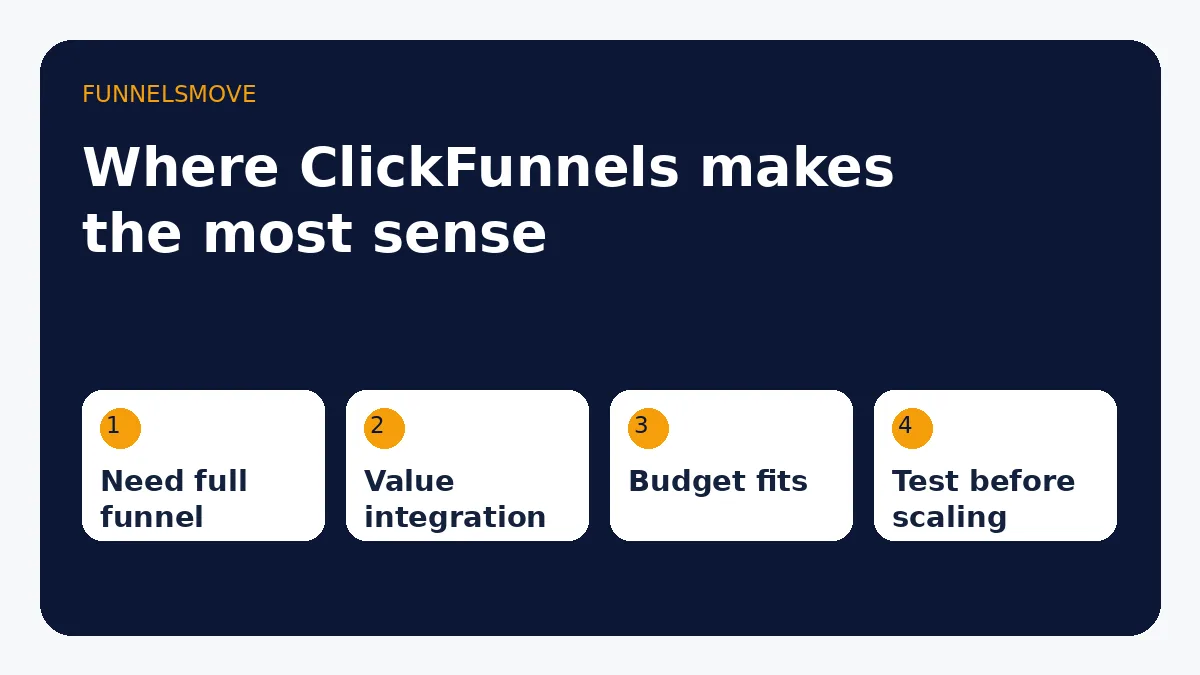
ClickFunnels makes the most sense when the funnel itself is central to how the business acquires and converts customers. A coach selling a discovery call or program, a creator selling a course, or a small online business using a lead magnet followed by an offer can all benefit from having the sequence designed as one connected system.
1. Multi-step selling journeys
If you need an opt-in, sales page, checkout, upsell or follow-up sequence, a funnel-centered tool can make the customer journey easier to see and manage. This is different from publishing isolated pages and hoping integrations create a coherent experience.
2. Consolidation
The platform becomes more compelling when you would actively use several included capabilities. Consolidation can reduce login sprawl and some integration points. It does not eliminate operational work, but it can move more of that work into one interface.
3. Offer-focused businesses
ClickFunnels is designed around moving a visitor toward a defined action. That orientation can be useful for businesses with a clear offer and measurable conversion path. It is less valuable when the business model is mainly editorial publishing, a broad catalog store with specialized commerce requirements, or a complex enterprise CRM process.
Where ClickFunnels is weaker
The biggest weakness is not that ClickFunnels lacks features; it is that many buyers can easily purchase more platform than their current business needs. A pre-revenue creator who only needs an email capture page may get more learning value from a simpler or cheaper tool while validating demand.
There is also a migration cost to consolidation. Rebuilding pages, moving contacts, reproducing automations, checking tracking, reconnecting domains and retraining a team all consume time. If your current systems are stable, that transition must create a meaningful business benefit rather than merely a tidier software list.
Finally, specialist tools can be deeper in their own categories. A course-first business may prioritize the learning experience and student operations. An agency may prioritize multi-client CRM workflows and white-labeling. A performance marketing team may prioritize specialized landing-page experimentation. ClickFunnels can overlap with all of these needs without necessarily being the best specialist for each one.
Who should choose ClickFunnels
ClickFunnels is easiest to justify for a business with a validated offer, a clear customer journey and enough recurring activity to benefit from an integrated workflow. The best candidate can describe exactly how leads arrive, what happens after the first conversion, how payment or booking works, and what customers receive next.
| Situation | Fit | Why |
|---|---|---|
| Validated coaching or consulting offer | Strong | Multi-step lead, booking, sales and follow-up flows can live together. |
| Course creator who cares heavily about funnels | Potentially strong | Sales and delivery can be connected, but compare the student experience with course-first platforms. |
| Small online business replacing several tools | Strong if consolidation is real | Value improves when several existing subscriptions or integrations can genuinely be retired. |
| Pre-revenue idea validation | Often weak | A lower-cost setup may preserve cash while demand is uncertain. |
| Business needing only one simple landing page | Weak | Most of the platform may go unused. |
When to skip ClickFunnels
Skip or postpone ClickFunnels if the subscription would force you to overbuild before you have evidence that the offer converts. The right time to add software is when it removes a real bottleneck, not when it creates a more impressive diagram.
You should also compare alternatives if one requirement dominates the buying decision. If agency client management is the core problem, evaluate agency-oriented CRM platforms. If student experience is the core problem, compare course-first platforms. If landing-page experimentation is the only gap in an otherwise mature stack, a specialist landing-page platform may be cleaner.
Our ClickFunnels alternatives guide organizes those choices by the constraint you are trying to solve, while the sales funnel software buyer’s guide provides a platform-neutral selection framework.
A practical decision framework
Before starting a trial, write down the workflow you expect the platform to own. Include the traffic source, first conversion, nurture, primary offer, checkout or booking step, delivery, upsell if relevant, and post-purchase communication. Then label each step “must have,” “useful,” or “not needed.”
Next, calculate the cost of your realistic ClickFunnels tier against the tools it could replace. Include migration labor and any services you would keep. Finally, identify your exit risks: which data you need to preserve, which domains are involved, and how difficult it would be to move later.
- Can you explain the funnel on one page?
- Do you need several of ClickFunnels’ integrated capabilities now?
- Does the required tier fit current cash flow?
- Would consolidation remove meaningful operational friction?
- Have you compared a specialist alternative for your most important requirement?
If most answers are yes, ClickFunnels deserves a serious evaluation. If the answers are mostly “not yet,” the better decision may be to simplify your funnel before upgrading your software.
Migration and implementation considerations
A platform can look like a strong fit on paper and still fail during implementation. Before moving an existing funnel, inventory the current domains, forms, tracking, email sequences, payment connections, course access rules and integrations. Decide which assets must be rebuilt and which can remain outside ClickFunnels.
Run the migration in a controlled order. Build and test the core conversion path first, then reconnect follow-up and delivery. Check mobile layouts, form submissions, payment flows, confirmation messages and access permissions before sending meaningful traffic. Keep the old system available until the new path has been verified.
For a new business, the implementation risk is different: overbuilding. Start with the smallest funnel that can produce a real customer signal. A lead page, offer page and checkout or booking step may be enough. Add upsells, segmentation and complex automation after evidence shows where they are useful.
What to test during a trial
Use a trial to reproduce your real workflow rather than explore every menu. Build one representative funnel, connect the domain or a test subdomain, create the actual form or checkout step, send a test follow-up, and verify the customer handoff. Note where the platform saves steps and where it creates new ones.
If multiple people will maintain the system, ask the least technical operator to complete a routine change. A platform that only one specialist can safely edit may create a different kind of dependency than the integrations it replaces.
Bottom line
ClickFunnels is not automatically the best funnel platform, but it is a credible integrated option for businesses that actually operate a multi-step selling journey. Its broad feature set is most valuable when consolidation reduces real complexity. Its cost is hardest to defend when the buyer is still validating an offer or needs only a small portion of the platform.
Use the ClickFunnels pricing guide to compare current plan economics, or see ClickFunnels for coaches and ClickFunnels for course creators for more specific workflows.
Primary sources
For the time-sensitive product and price statements in this review, see the ClickFunnels product site (opens in a new tab), ClickFunnels pricing page (opens in a new tab), and ClickFunnels 2.0 pricing support article (opens in a new tab). These are merchant-controlled sources, so FunnelsMove uses them to verify what ClickFunnels currently offers—not as independent evidence that the product will improve a reader’s results.
For a deeper implementation path, see ClickFunnels and Shopify workflow.
For a deeper implementation path, see ClickFunnels email marketing guide.
For a deeper implementation path, see routine ClickFunnels funnel management.
For the implementation details, see ClickFunnels payments.
For the implementation details, see ClickFunnels products and checkout.
Agencies and consultants should also see ClickFunnels for client work for workspace boundaries, permissions, onboarding, and handoff.
If you already know the platform fits, the ClickFunnels traffic acquisition guide covers organic, paid, partner, and email distribution.
For offer strategy, see what to sell with ClickFunnels, including services, digital products, physical products, subscriptions, and realistic funnel economics.
If template availability matters to your evaluation, read the ClickFunnels templates guide before choosing a plan.
For a concrete campaign workflow, see how the platform handles a ClickFunnels webinar funnel.
If landing-page capability is central to your decision, see the ClickFunnels landing page guide.
If courses and creator-business operations are a major requirement, compare Kajabi vs ClickFunnels directly.
Related comparison: ClickFunnels vs Shopify.
Related comparison: SamCart vs ClickFunnels.
Evaluate ClickFunnels against your workflow
Check the current signup flow, plan details and terms before committing. Use your own funnel requirements—not a generic feature list—as the decision standard.
Explore ClickFunnels (opens in a new tab)