Sales Funnel Software: A Buyer’s Guide for Small Businesses
A platform-neutral framework for choosing software around the customer journey you actually operate—not the longest feature list.
What sales funnel software actually does
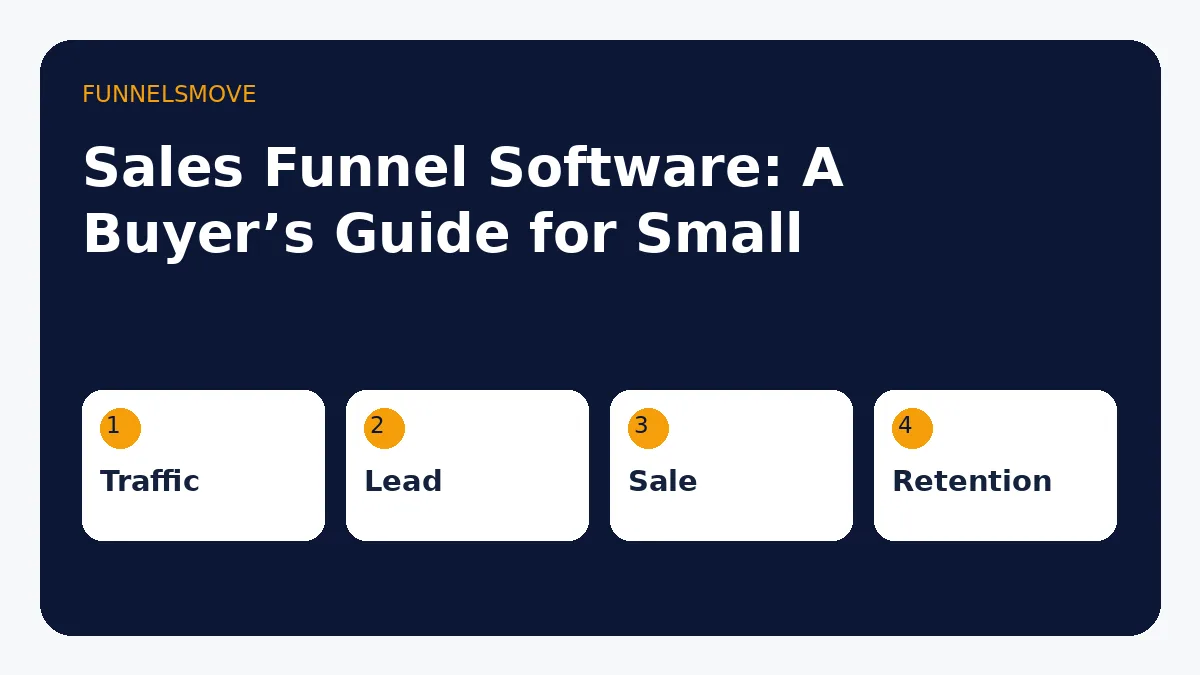
Sales funnel software helps a business move a prospect through a defined sequence of actions, such as visiting a landing page, joining an email list, booking a call, purchasing an offer and receiving follow-up. Some platforms focus narrowly on pages. Others combine pages with checkout, email, automation, CRM, courses or ecommerce.
The right category depends on your operating model. A local consultant booking calls does not need the same stack as a course creator, ecommerce brand or agency. Before comparing vendors, define the journey and the systems already involved.
Map the funnel before shopping for software
Draw the journey from first touch to successful customer outcome. Include the traffic source, first conversion, nurture, sales step, payment or booking, delivery and follow-up. Then mark which steps already work and where leads are currently getting lost.
This prevents software from becoming a substitute for strategy. If you do not know the offer, audience or next action, a more advanced platform will usually add configuration rather than clarity.
For a simple model you can use before this exercise, see our sales funnel for small business guide.
The capabilities worth comparing
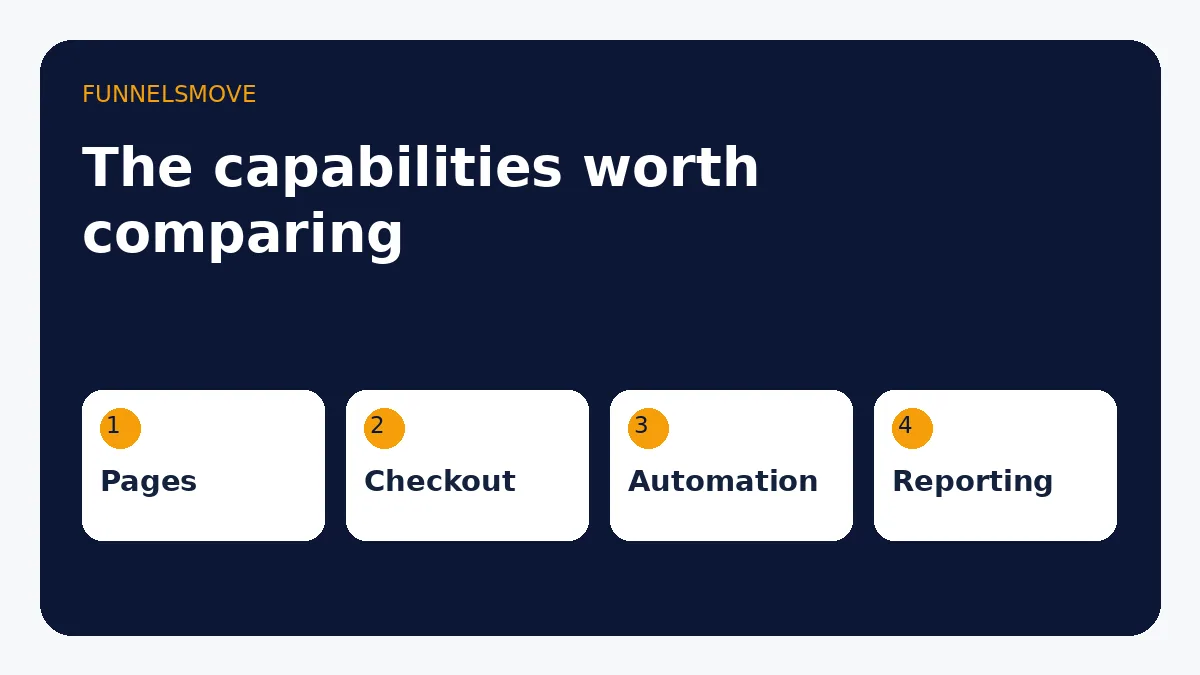
Most small businesses should evaluate page building, forms, checkout or booking, email and automation, integrations, analytics, product delivery, data export, support and total cost. Give each capability a weight based on how central it is to revenue.
A feature that appears on every vendor page can still vary dramatically in depth. “Email” might mean broadcasts in one system and sophisticated automation in another. “Courses” might be basic gated content or a mature learning experience. Test the workflow, not the label.
All-in-one versus specialist tools
An all-in-one platform reduces the number of systems you connect. This can simplify contact data, automation and page-to-checkout workflows. It can also increase platform dependence and make a later migration more involved.
A specialist stack lets you choose stronger individual tools and replace one layer without moving the rest. The cost is integration ownership: someone must monitor connectors, data mapping and failures between systems.
Neither architecture is universally better. Choose the one your team can operate reliably.
How to compare total cost
Compare the full stack, not a single subscription. Add page building, email, automation, checkout, course delivery, connector services and any extra hosting or analytics you actually require. Then add migration and maintenance time.
A $97 integrated platform can be economical if it replaces several active subscriptions. The same $97 can be expensive if you only need one landing page and keep the rest of your stack unchanged.
Our ClickFunnels pricing guide demonstrates this total-stack approach with a current platform example.
Portability and switching risk
Ask what you can export: contacts, orders, page content, course materials and analytics. Record where your domain and payment processor live. Prefer architectures that do not trap critical business assets in a format you cannot reasonably move.
You do not need a perfect exit plan, but you should know the cost of changing direction. The more of your business one platform owns, the more important this becomes.
A practical scoring matrix
| Criterion | Weight | Question |
|---|---|---|
| Workflow coverage | High | Can it handle every critical step without awkward workarounds? |
| Ease of operation | High | Can the actual team build, troubleshoot and maintain it? |
| Total cost | High | What is the real monthly and annual stack cost? |
| Integrations | Medium–High | Does it connect reliably to systems you are keeping? |
| Portability | Medium | Can you export important business data? |
| Growth limits | Medium | Will realistic growth force a sudden tier jump? |
| Specialist depth | Variable | Does your business depend on one category where a specialist is materially better? |
Score only after testing the hardest workflow. A vendor demo can make every platform look easy when it avoids your exact edge cases.
Where ClickFunnels fits
ClickFunnels represents the funnel-centered all-in-one approach. Its current platform combines funnels and landing pages with checkout, email, automations, courses, community, store and other tools. It is worth comparing when you want several of those capabilities connected inside one system.
It is less compelling when you only need one narrow capability or already have mature systems you do not want to replace. See the ClickFunnels review for a decision-first assessment and the alternatives guide for different operating models.
Common mistakes to avoid
Do not mistake more steps for a better funnel. Every page, automation branch and tool should have a clear job. Avoid copying a template without adapting it to your offer, measuring only top-of-funnel traffic, or changing multiple variables at once when performance is unclear.
Also avoid choosing software around hypothetical future requirements. Build for the next credible stage of the business, leave sensible headroom, and keep critical data portable. The simplest system that reliably supports the customer journey is usually easier to improve than a complex stack built in anticipation of growth that has not happened yet.
Questions to answer before you buy
- What is the exact funnel from traffic source to customer outcome?
- Which steps are broken today?
- Which existing systems must remain?
- Which three capabilities are genuinely critical?
- What is the total monthly stack cost after migration?
- Can important data be exported?
- Who will own the platform operationally?
- What growth limit are you most likely to hit first?
If you cannot answer those questions yet, delay the vendor comparison and simplify the customer journey first.
Product-source note
ClickFunnels is used here only as an example of the integrated platform model. Its current feature breadth was checked against the ClickFunnels product site (opens in a new tab) on August 31, 2026. The buyer framework itself is platform-neutral.
Evaluate ClickFunnels against your workflow
Check the current signup flow, plan details and terms before committing. Use your own funnel requirements—not a generic feature list—as the decision standard.
Explore ClickFunnels (opens in a new tab)For another all-in-one funnel option, see the Systeme.io platform overview.
Simvoly as a website-and-funnel option
Our Simvoly platform guide explains how its websites, funnels, ecommerce, CRM and marketing tools fit together.