ClickFunnels Alternatives: Choose by Use Case, Not Feature Count
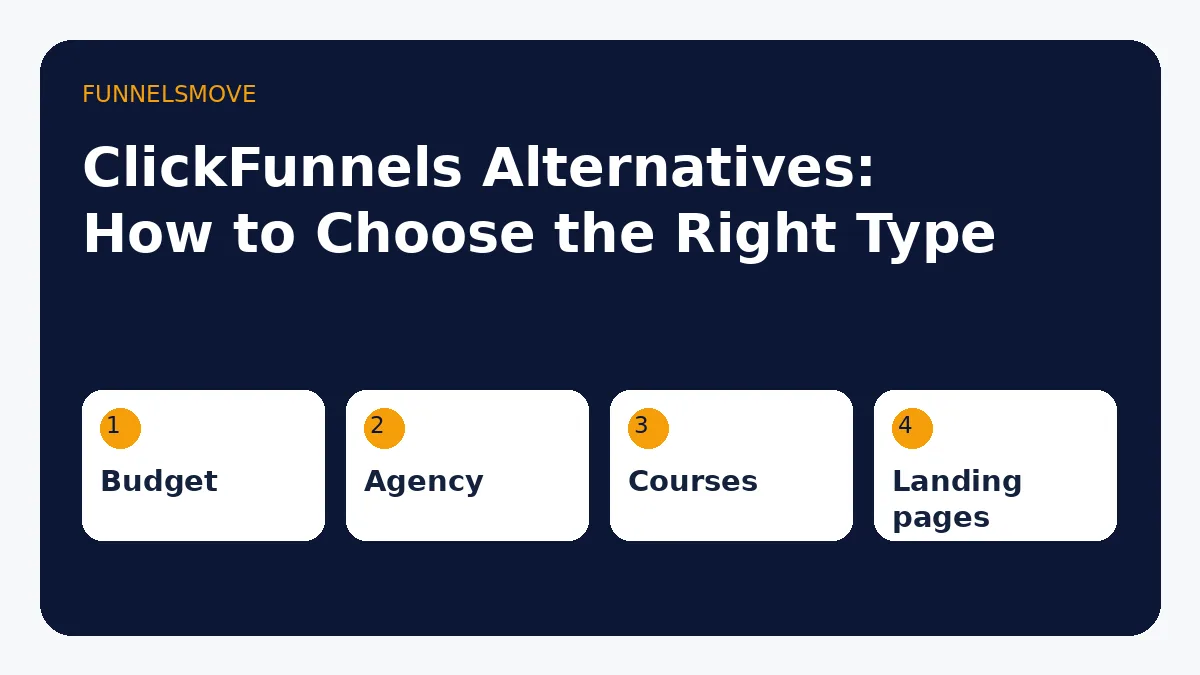
The right alternative depends on why ClickFunnels is a poor fit. Start with the constraint—budget, agency operations, course delivery, or landing-page specialization.
The best ClickFunnels alternative depends on the job
There is no single “best ClickFunnels alternative” because businesses leave or avoid ClickFunnels for different reasons. A solo creator trying to spend less has a different problem from an agency managing client accounts. A course business may care most about the student experience, while a paid-media team may already have email and checkout systems and only need landing-page experimentation.
The fastest way to make a useful shortlist is to name the constraint first. In this guide, we compare representative alternatives by operating model rather than pretending that a longer feature table creates a better answer.
| Main need | Platforms worth comparing | Reason |
|---|---|---|
| Lower-cost all-in-one start | systeme.io | Permanent free plan and broad marketing toolkit |
| Agency and CRM operations | HighLevel | Agency-oriented client, CRM and communication workflows |
| Course-first knowledge business | Kajabi | Course, community and creator-business orientation |
| Landing-page specialization | Leadpages, Unbounce, Instapage | Focused page building, testing and campaign workflows |
| Integrated funnel operating system | ClickFunnels | Funnels, checkout and adjacent marketing/delivery tools in one environment |
What are the best ClickFunnels alternatives?
There is no single best replacement. For the use cases already evaluated in this guide, systeme.io is the first comparison for a budget-conscious start, HighLevel for agency/CRM operations, Kajabi for a course-first knowledge business, and Leadpages, Unbounce or Instapage when landing pages and conversion workflows are the narrower priority.
The right comparison begins with the reason you would replace ClickFunnels. If the constraint is price, compare total stack cost. If it is course delivery, compare the student experience. If it is agency operations, compare client-account workflows. A feature-count contest obscures those differences.
First decide why ClickFunnels is not a fit
Before comparing vendors, write one sentence that explains the reason you are looking elsewhere. Good examples are “we need to validate the offer for less than $100 per month,” “we manage many client accounts,” “the course experience is more important than funnel depth,” or “our existing stack works and we only need better landing pages.”
That sentence becomes your evaluation filter. If a platform does not solve the named constraint, it is not a useful alternative even if it has hundreds of features.
Also separate a temporary constraint from a permanent one. A startup may be budget-sensitive today but need advanced automation later. An agency’s multi-client operating model, by contrast, is structural. The more structural the requirement, the more weight it deserves.
Budget-focused alternative: systeme.io
systeme.io is the clearest comparison when cost is the main objection to ClickFunnels. Its official pricing materials advertise a permanent free plan and combine sales funnels, email marketing, websites, automation, courses, communities and affiliate-program tools in one platform.
That makes it useful for an early-stage operator who wants to learn the mechanics of a funnel without committing to ClickFunnels’ $97 monthly entry price. The free tier has limits, so the decision is not simply “free versus paid.” Compare contact allowances, funnel steps, automation limits, custom domains and any feature that is essential to your workflow.
systeme.io can also remain a paid alternative as a business grows. The important comparison is whether its editor, automation model, checkout, delivery experience and integrations are sufficient for your business—not whether the feature names appear on both websites.
Source note: systeme.io’s current public pricing and positioning were checked on August 31, 2026. The company lists a permanent free plan and paid tiers; verify current limits before choosing a plan.
Agency-focused alternative: HighLevel
HighLevel is commonly evaluated by agencies because its operating model extends beyond a single owner-managed funnel. Agency buyers often care about client accounts, CRM pipelines, messaging, appointment workflows, reusable configurations, reporting and white-label or resale options.
That is a different center of gravity from ClickFunnels. ClickFunnels is funnel-first; an agency platform is more likely to make the client relationship and CRM operation the central object. If your revenue comes from managing marketing systems for many clients, that difference can outweigh a direct feature-by-feature comparison.
A solo creator should be cautious about choosing an agency-oriented platform simply because it appears powerful. Extra account structure and CRM depth can become overhead when the actual business only needs one straightforward sales journey.
When evaluating HighLevel or another agency platform, test sub-account administration, permissions, messaging costs, CRM usability, client handoff, reporting and how much work is required to create a clean funnel experience.
Course-first alternative: Kajabi
Kajabi is a logical comparison when the product is knowledge: courses, coaching, communities or memberships. The distinction is not that ClickFunnels lacks courses—ClickFunnels currently includes course and community capabilities. The question is which part of the business deserves to shape the software decision.
If the sales funnel is the hard problem, ClickFunnels may still be attractive. If the student experience, content organization, creator operations and ongoing member relationship dominate the business, a course-first platform can be a better fit.
Course creators should evaluate the full journey: lead capture, launch or evergreen sales flow, checkout, onboarding, lesson experience, community, email segmentation, student progress, support and renewal or upsell paths. The best platform is the one that handles the highest-value parts of that journey with the least operational friction.
For a deeper workflow comparison, see our ClickFunnels for course creators guide.
Landing-page alternative: Leadpages
Leadpages is worth comparing when your business already has email, CRM, checkout and delivery systems but needs a focused way to build and test landing pages. Its current product materials emphasize unlimited pages on paid plans, hosting, A/B testing, conversion analytics, integrations and AI-assisted page creation.
This specialist approach can reduce migration risk. Instead of replacing the whole stack, you add or replace only the page layer. That can be valuable for mature businesses with established systems downstream from the landing page.
The trade-off is integration ownership. A specialized page tool still needs to pass leads or purchases to the rest of your stack. Make sure the resulting system is simpler in practice, not only cheaper on the pricing page.
Source note: Leadpages’ current plan and product information was checked against its official support and product pages on August 31, 2026.
Landing-page optimization alternative: Unbounce
Unbounce is another specialist option, with a strong emphasis on landing pages, testing and optimization. Its current pricing page ranges from a starter tier with a small page/traffic allowance to higher tiers with unlimited pages, A/B testing and additional optimization capabilities.
Unbounce is particularly relevant when the marketing team thinks in campaigns and experiments rather than end-to-end business operations. If you already have a CRM, email platform and checkout stack you trust, moving only the landing-page layer may be more rational than consolidating everything.
As with any specialist tool, check traffic limits, domain allowances, user seats, testing features, integration requirements and whether the visual or code workflow suits the team that will actually maintain the pages.
Source note: Unbounce’s public pricing and landing-page product information was checked on August 31, 2026.
Where Instapage belongs in the comparison
Instapage is generally considered alongside specialist landing-page and paid-campaign tools rather than as a complete ClickFunnels replacement. It is most relevant when landing-page production, experimentation, personalization or ad-to-page workflows are the primary requirement.
That means it can be a strong alternative for a team with a mature marketing stack and a narrow page optimization problem, but a weak substitute for a small business that wants one platform to handle funnels, email, checkout and product delivery.
When a specialist platform does not replace the rest of the stack, include integration and operational costs in the comparison. The cheapest page subscription can still create the most expensive workflow if the data handoffs are fragile.
When ClickFunnels is still the better choice
ClickFunnels remains a strong comparison point when you want the funnel to be the operating center. If your core journey is opt-in → nurture → offer → checkout → upsell → delivery, keeping those steps together can be more valuable than selecting a separate “best” tool for each one.
It is also easier to justify when the business would otherwise maintain several subscriptions and connectors. Consolidation can reduce some integration failures and speed up iteration because the person building the funnel does not need to coordinate as many systems.
Read our ClickFunnels review for the complete fit analysis and ClickFunnels pricing guide for current plan economics.
A six-step alternative selection process
- Name the constraint. Budget, agency operations, course delivery, landing-page optimization or another specific requirement.
- Map the current journey. Document traffic, lead capture, nurture, sales, payment, delivery and retention.
- Mark systems you refuse to replace. This prevents an “all-in-one” evaluation from becoming an unnecessary migration project.
- Shortlist by operating model. Compare no more than two or three platforms that genuinely solve the main constraint.
- Test the hardest workflow first. Do not spend a trial polishing a homepage. Reproduce the automation, checkout, course or client workflow most likely to fail.
- Compare total switching cost. Include subscriptions, migration labor, data movement, training, integrations and the risk of running two stacks during transition.
This process is intentionally more demanding than reading a feature table. It is also much more likely to produce a durable decision.
How to compare migration risk
Migration risk is often the hidden difference between two otherwise attractive platforms. List every asset that would move: domains, landing pages, forms, contacts, tags, automations, order records, course content, downloadable files, tracking scripts and payment connections. Then mark which assets can be exported cleanly and which must be rebuilt.
A cheaper alternative can become expensive if the migration requires weeks of manual rebuilding or breaks a reliable sales process. Conversely, staying with an expensive platform can be irrational if the business uses only a small slice of it and the move is simple.
For existing businesses, test the candidate with one real funnel or campaign before planning a full migration. Reproduce the hardest automation and the most important conversion path. That reveals operational friction much faster than a broad tour of the feature menu.
Comparison criteria that matter more than feature count
Use a weighted scorecard rather than checking boxes. Give the highest weights to capabilities directly tied to revenue or customer delivery. Lower the weight of features you are unlikely to use in the next year.
| Criterion | What to test | Why it matters |
|---|---|---|
| Core workflow | Build the actual lead-to-sale path | Shows whether the platform fits the business model |
| Automation | Reproduce the hardest trigger and branch | Exposes limits hidden by simple demos |
| Checkout/booking | Test the real conversion action | Directly affects revenue operations |
| Delivery | Test customer access and onboarding | Protects the post-purchase experience |
| Integrations | Connect systems that will remain | Determines ongoing maintenance burden |
| Portability | Review export options and ownership | Reduces future switching risk |
| Total cost | Model software plus migration and maintenance | Prevents false savings |
This approach makes the result explainable. If one platform wins, you can point to the requirements that created the result rather than relying on a generic “best overall” label.
A note on switching from an all-in-one platform
Leaving an all-in-one platform often means deciding whether to replace it with another suite or deliberately split the stack. Replacing one suite with another can reduce the number of migrations, but it may reproduce the same platform-dependence trade-off. Splitting the stack can improve specialist depth and portability, but someone must own the integrations.
Use your reason for switching to decide the architecture. If the problem is price, a lower-cost suite may be enough. If the problem is that one specialist capability is weak, keep the rest of the stack stable and replace only that layer where possible. If the problem is operational complexity, count integration work as heavily as subscription cost.
Do not migrate solely because another platform is popular in your peer group. Your existing conversion data, customer experience and team competence have value. A move should solve a documented constraint and have a measurable definition of success.
ClickFunnels alternatives: final recommendation
If price is the main blocker, start by comparing systeme.io. If multi-client agency operations define the business, compare HighLevel. If the student or member experience is the center of the business, compare Kajabi. If you already have a good stack and only need campaign pages, compare Leadpages, Unbounce and Instapage.
If none of those constraints dominates and you want funnels, checkout, follow-up and delivery in one environment, ClickFunnels remains a reasonable candidate. The right decision is the platform whose operating model matches your business—not the one with the longest list of overlapping features.
Document the reason for your final choice so the decision can be revisited when your business model, team or constraints change.
Sources used for current positioning
Current public positioning and plan information was checked against official vendor pages, including ClickFunnels pricing page (opens in a new tab), systeme.io pricing (opens in a new tab), Leadpages pricing support (opens in a new tab), and Unbounce pricing (opens in a new tab). Vendor pages describe their own products; our use-case conclusions are editorial analysis rather than vendor endorsements.
Before migrating to an alternative, follow the ClickFunnels cancellation and account-management checklist so billing, data, and access are handled deliberately.
If your main use case is client delivery, compare alternatives alongside the ClickFunnels agency workflow guide.
For a direct creator-platform comparison, read Kajabi vs ClickFunnels rather than treating Kajabi as just another generic alternative.
For businesses that need a broader CRM and agency-automation operating model rather than a funnel-first stack, see the HighLevel (GoHighLevel) platform guide.
Dedicated ClickFunnels comparisons
For a deeper buyer decision, compare ClickFunnels directly with ClickFunnels vs Shopify; SamCart vs ClickFunnels; ClickFunnels vs Leadpages; Unbounce vs ClickFunnels.
Related: ClickFunnels vs GetResponse.
Related: ThriveCart vs ClickFunnels.
Related: ConvertKit vs ClickFunnels.
Related: ClickFunnels vs ActiveCampaign.
Evaluate ClickFunnels against your workflow
Check the current signup flow, plan details and terms before committing. Use your own funnel requirements—not a generic feature list—as the decision standard.
Explore ClickFunnels (opens in a new tab)For a direct cross-platform decision, see HighLevel vs ClickFunnels.
Considering the lower-cost all-in-one route? See our Systeme.io platform overview and Systeme.io vs ClickFunnels comparison.
Considering Simvoly?
See our Simvoly vs ClickFunnels comparison for a current feature, pricing and workflow comparison.
Related platform research
See our Best Kartra Alternatives: Compare Your Options for another relevant option.