Sales Funnel for Small Business: A Simple 4-Stage Model
A practical funnel you can sketch on one page before buying software or adding more marketing channels.
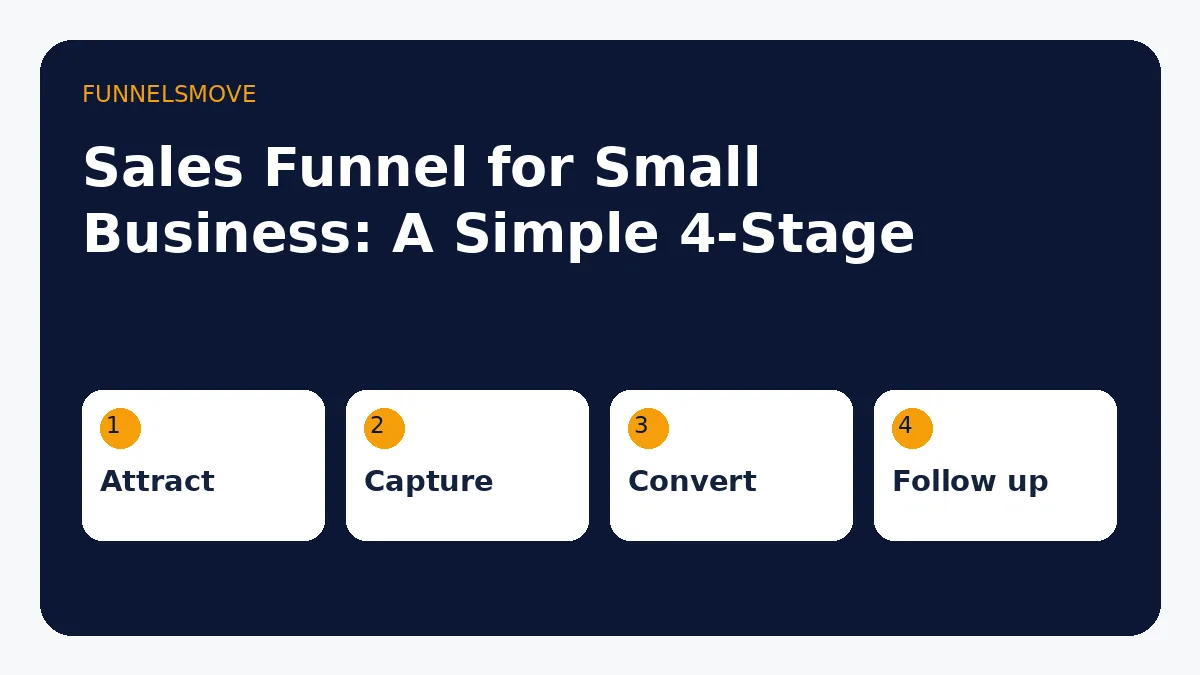
The simple small-business funnel
A useful small-business sales funnel has four stages: attract, capture, convert and retain. You do not need a dozen pages or an elaborate automation map to start. You need a clear next action at each stage and a way to measure whether prospects are moving forward.
The funnel can support services, coaching, digital products or many local and online business models. The details change, but the logic is stable: earn attention, gain permission to continue the conversation, make the offer easy to understand, then deliver enough value that customers stay, return or refer others.
Stage 1: attract the right visitor
Attraction is not simply “get more traffic.” The goal is to reach people who have the problem your offer solves. Channels may include search, referrals, social content, partnerships, email, events or paid advertising.
Choose one or two channels you can operate consistently. For each, define the message and destination. A focused article or landing page usually creates a better measurement loop than sending every visitor to a generic homepage.
Stage 2: capture a useful next step
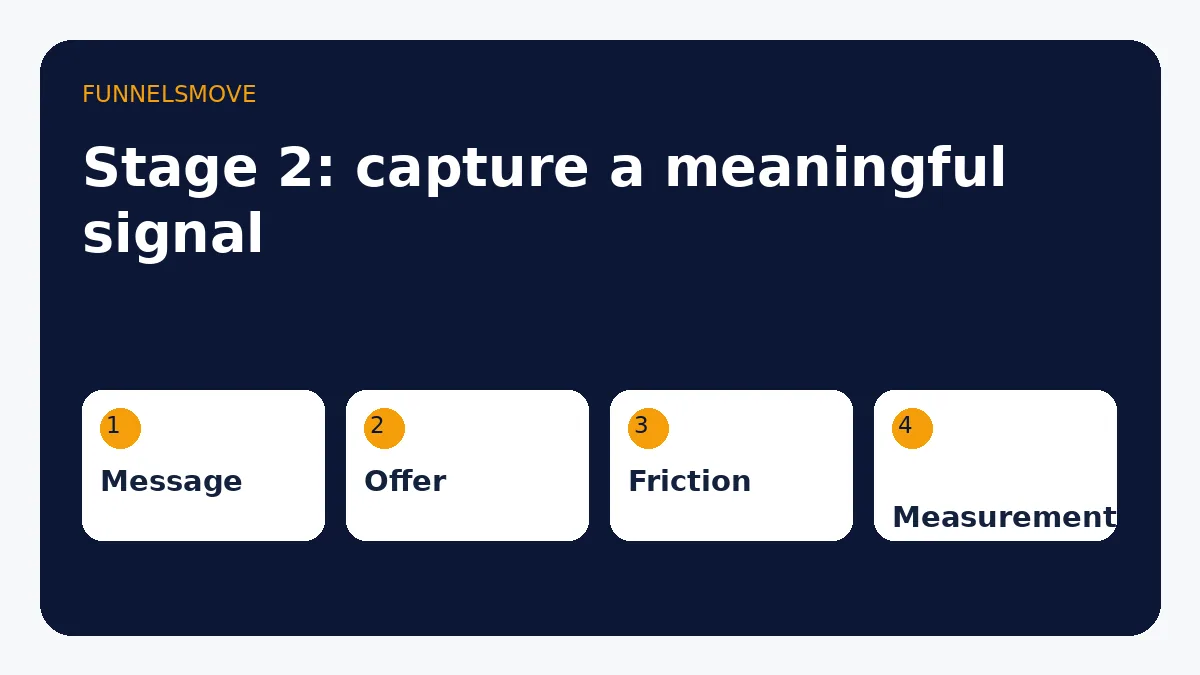
The capture stage converts anonymous attention into a relationship you can continue. That might be an email opt-in, consultation booking, quote request, trial, product view or direct purchase depending on the business.
Ask for the smallest commitment that naturally advances the decision. A high-ticket consulting offer may need a qualification form and call. A low-cost digital product may go directly to checkout. The funnel should reflect buying risk rather than forcing every prospect through the same pattern.
Stage 3: convert with clarity
Conversion requires the offer, evidence, price or next step to be understandable. Remove unnecessary decisions. Explain who the offer is for, the problem it addresses, what is included, relevant limitations, and what happens after the buyer acts.
For services, conversion may be a booked call rather than payment. For courses or products, it may be checkout. The goal is not maximum pressure; it is a clear path for the right buyer and a graceful exit for someone who is not a fit.
Stage 4: retain and learn
The funnel does not end at purchase. Onboarding, delivery, support, renewal, repeat purchase and referral all shape the economics of acquisition. A business that ignores retention is forced to replace every customer with new traffic.
Track the questions customers ask after buying. Those questions often reveal unclear promises, onboarding gaps or opportunities for better education before purchase.
Measure one metric per stage first
| Stage | Primary question | Starter metric |
|---|---|---|
| Attract | Are qualified people reaching the destination? | Relevant visits or leads by channel |
| Capture | Do visitors take the intended next step? | Opt-in / booking / lead conversion rate |
| Convert | Do qualified leads become customers? | Sales or booked-call close rate |
| Retain | Do customers stay, repurchase or refer? | Repeat purchase, renewal or referral rate |
Add more metrics only when they help explain a decision. Dashboards full of numbers can hide the simple question: where are people getting stuck?
When software becomes useful
Use software when it removes a real bottleneck: slow page changes, disconnected lead data, manual follow-up, checkout friction or scattered delivery. Do not buy an all-in-one platform because a template makes the funnel look sophisticated.
Our sales funnel software buyer’s guide shows how to choose between integrated and specialist tools. If you are specifically evaluating ClickFunnels, see the ClickFunnels review.
Common mistakes to avoid
Do not mistake more steps for a better funnel. Every page, automation branch and tool should have a clear job. Avoid copying a template without adapting it to your offer, measuring only top-of-funnel traffic, or changing multiple variables at once when performance is unclear.
Also avoid choosing software around hypothetical future requirements. Build for the next credible stage of the business, leave sensible headroom, and keep critical data portable. The simplest system that reliably supports the customer journey is usually easier to improve than a complex stack built in anticipation of growth that has not happened yet.
How to improve the funnel over time
Improve one stage at a time. If qualified traffic is weak, changing checkout copy will not solve the real problem. If many relevant visitors reach the offer but few take the next step, investigate clarity, fit, proof and friction before adding more traffic.
Keep a simple change log with the date, hypothesis, change and result. Small businesses rarely need a sophisticated experimentation program to benefit from disciplined iteration. They do need enough stability to tell whether a change helped.
A one-page funnel worksheet
- Audience: Who has the problem?
- Traffic: Where will they first see you?
- Capture: What is the next small commitment?
- Offer: What do you sell and for whom?
- Conversion: What exact action completes the sale or booking?
- Delivery: What happens immediately afterward?
- Retention: What creates the next useful interaction?
- Metric: Which number tells you whether each stage is working?
Build this version before adding upsells, complex segmentation or multiple branches. Complexity should be earned by evidence.
Once the funnel is ready, use the traffic-to-funnel acquisition guide to choose organic, partner, email, social, or paid channels and measure the full path.
Before adding more funnel steps, decide what the business can sell sustainably with the ClickFunnels offer-selection guide.
Related: ClickFunnels for real-estate lead funnels.
Related: ClickFunnels funnel examples by goal.
Evaluate ClickFunnels against your workflow
Check the current signup flow, plan details and terms before committing. Use your own funnel requirements—not a generic feature list—as the decision standard.
Explore ClickFunnels (opens in a new tab)What is a sales funnel in ClickFunnels?
A sales funnel in ClickFunnels is the software implementation of the customer journey described in this guide. Instead of treating “ClickFunnels” and “sales funnel” as synonyms, separate the strategy from the tool: the funnel is the sequence of decisions and actions a prospect takes; ClickFunnels is one platform that can build and connect the pages, checkout, email, automation and delivery steps used in that sequence.
For a small service business, the strategy might be search or referral → focused landing page → lead form → follow-up → consultation. In ClickFunnels, those stages can be represented by funnel pages and connected workflows. For a direct-response product, the sequence might be sales page → checkout → order confirmation → follow-up. The software should reflect the path you already chose, not determine the offer for you.
If you want the product-specific implementation steps, continue with how to use ClickFunnels. If you are still deciding whether ClickFunnels is the right platform, read the ClickFunnels review rather than turning this general strategy page into a product review.
Example: a local service funnel in ClickFunnels
Suppose a small consulting firm wants qualified discovery calls. The strategy starts with one audience problem and a useful lead-in. A search visitor lands on a focused page, requests a diagnostic checklist, receives a short follow-up sequence, and is invited to book a call only after the firm has explained who the service fits. In ClickFunnels, those strategic stages can be implemented as pages plus an email workflow and a booking handoff.
The important point is that the software does not determine the funnel logic. If the firm learns that prospects are already high-intent and do not need a lead magnet, the better funnel may be a direct service page → qualification form → calendar. The ClickFunnels implementation should change when the customer journey changes.
Example: a small digital-product funnel
A creator selling a focused digital product may use content → sales page → checkout → confirmation → onboarding email. If the offer is simple and the audience is warm, adding a webinar, quiz and long nurture sequence may reduce clarity rather than improve results. Start with the minimum path that answers the buyer’s questions and delivers the product correctly.
When ClickFunnels is more software than the business needs
If a small business only needs one basic landing page and a contact form, a full funnel platform may be unnecessary. Compare the total stack cost and operational burden against the actual journey. Our sales funnel software buyer’s guide gives a vendor-neutral framework for that decision.
How to know whether the funnel needs another step
Add a step only when it resolves a real decision barrier or operational requirement. A lead magnet can earn permission to follow up when the purchase requires education. A qualification form can protect a consultant’s calendar. An upsell can present a complementary offer after a purchase. But each added step also creates another place for a prospect to leave, another page to maintain and another automation to test.
Measure the funnel by the business outcome, not by how many pages it contains. A two-step path that consistently creates qualified customers is a better funnel than an elaborate sequence that exists mainly because the software makes it easy to build one.
Keep the strategy portable
Your funnel should still make sense when described without software names. Write it as “traffic → landing page → qualification → call” or “content → offer → checkout → onboarding.” If that sequence is clear, you can implement it in ClickFunnels or compare another platform without redesigning the business logic from scratch. This also reduces lock-in because the customer journey belongs to the business, not to a particular page builder.
For owners evaluating ClickFunnels specifically, this separation is useful: judge the platform on how well it supports the chosen journey, the integrations you need, and the total operating cost. Do not let a long feature list turn into unnecessary funnel steps.
That portability also makes future software changes less disruptive because the strategy remains documented independently of the implementation.
Keep that map current.
Related platform research
See our Kartra Platform: Features, Funnels and Fit for another relevant option.