ClickFunnels for Coaches: A Practical Funnel Blueprint
How to decide whether ClickFunnels fits a coaching business, and how to design the funnel before you start building pages.
Is ClickFunnels a good fit for coaches?
ClickFunnels can be a good fit for coaches who use a repeatable funnel to generate leads, qualify prospects, book calls or sell a program, and follow up in one connected workflow. It is less compelling for a coach who gets almost all business through referrals and only needs a simple website and calendar.
The platform’s current product includes funnels, landing pages, email, automations, appointments-related capabilities, checkout and course/community tools. That breadth can support both marketing and delivery, but the decision should begin with your actual coaching sales process.
Choose the coaching sales model first
Coaching funnels vary by price and commitment. A lower-cost self-serve program can move directly from content to checkout. A high-ticket engagement may need an application, qualification step and consultation before any payment.
Write down the buyer’s risk and the questions they need answered. The funnel should create the right amount of trust and qualification—not force every coaching offer through the same webinar or call script.
A simple coaching funnel blueprint
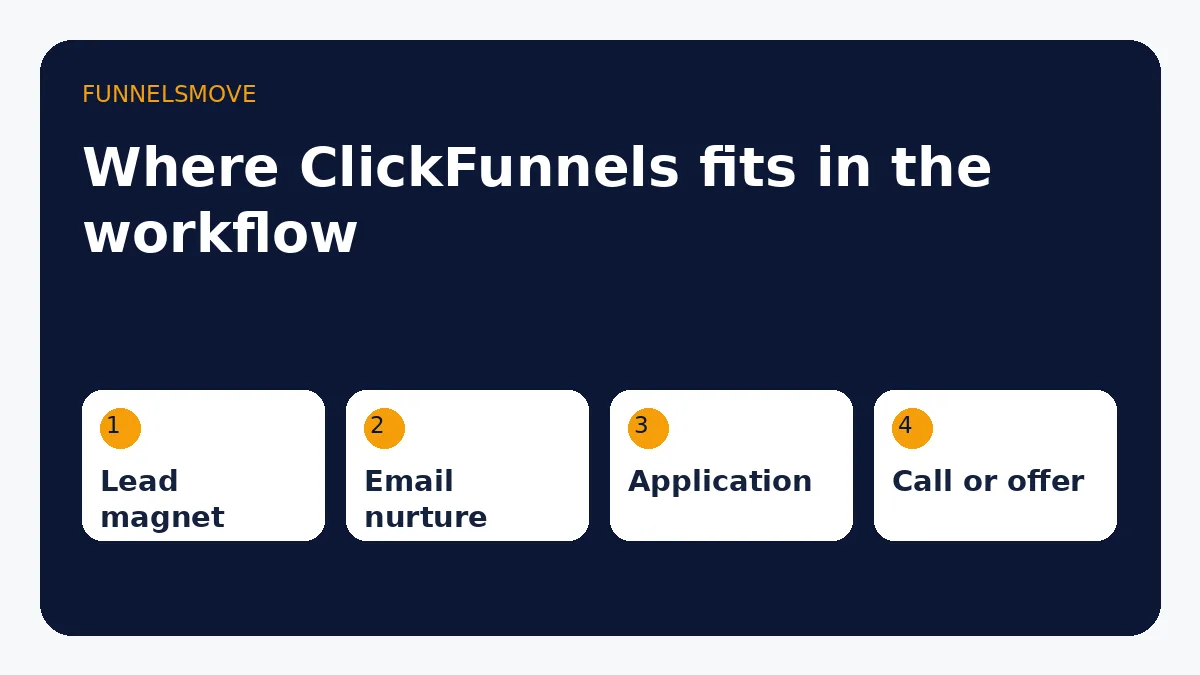
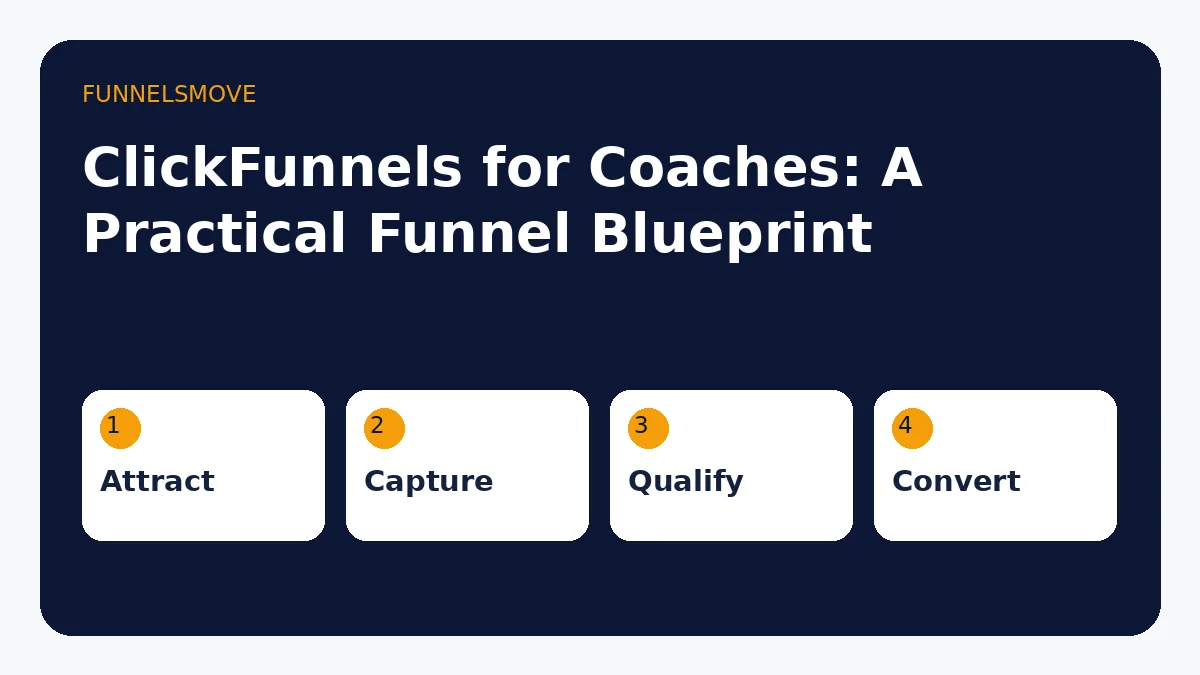
For many coaches, a practical sequence is: targeted content or ad → focused landing page → lead magnet or application → follow-up → booking or offer page → payment → onboarding. Each step should answer one decision and move the right prospect forward.
If the offer is established, ClickFunnels can centralize much of this flow. If the offer is still changing weekly, keep the funnel simpler so you can learn faster without rebuilding a large automation system.
Lead capture and qualification
Use lead capture to learn enough to continue the conversation, not to collect data for its own sake. For a consultation funnel, a short application can help identify fit before a call. For a group program or lower-priced offer, an email opt-in followed by educational content may be sufficient.
Qualification criteria should be related to the service you actually provide. Avoid manipulative scarcity or questions that imply guaranteed results. A useful form sets expectations for both the coach and prospect.
Booking and sales conversations
If a call is part of the sales process, the funnel should prepare the prospect before they reach the calendar. Explain the purpose of the call, who it is for, what information to bring and what happens afterward.
That makes the appointment more useful and reduces the temptation to use the funnel as pressure. The sales call can then focus on diagnosis and fit rather than repeating basic information from the page.
Follow-up without over-automation
Email and automation are most useful when they reinforce the next logical step: deliver the promised resource, confirm a booking, answer common objections or provide onboarding instructions. Automation becomes counterproductive when it creates repetitive messages that ignore the prospect’s actual state.
Start with a small sequence and add branches only when your data shows a meaningful need. The goal is a dependable customer journey, not the most elaborate workflow.
Can ClickFunnels deliver the coaching product?
For coaching businesses that include courses, communities, downloads or other digital resources, ClickFunnels’ current product includes course and community capabilities and a customer center for accessing digital products. That can reduce the need for a separate delivery system.
However, if the learning or community experience is the main differentiator of your offer, compare a course-first platform before consolidating. Delivery quality matters more than having one login.
Source note: ClickFunnels product capabilities were checked against official product pages on August 31, 2026.
Cost and plan fit for a coaching business
ClickFunnels currently starts at $97 per month on monthly billing. A solo coach should compare that price with the systems it would replace: page builder, email, booking, checkout and delivery. If most of those systems remain, ClickFunnels may be additive rather than consolidating.
Use the ClickFunnels pricing guide to compare current tiers and the alternatives guide if budget or a specialist workflow is the main constraint.
Common mistakes to avoid
Do not mistake more steps for a better funnel. Every page, automation branch and tool should have a clear job. Avoid copying a template without adapting it to your offer, measuring only top-of-funnel traffic, or changing multiple variables at once when performance is unclear.
Also avoid choosing software around hypothetical future requirements. Build for the next credible stage of the business, leave sensible headroom, and keep critical data portable. The simplest system that reliably supports the customer journey is usually easier to improve than a complex stack built in anticipation of growth that has not happened yet.
Coach funnel checklist
- Define the exact coaching offer and who should not buy it.
- Choose direct checkout or an application/call based on risk and price.
- Use one primary lead-capture path.
- Prepare prospects before a booking.
- Automate confirmations and useful follow-up before complex branching.
- Decide whether course/community delivery belongs in the same platform.
- Measure qualified leads, show rate, close rate and onboarding completion.
Product sources
Current ClickFunnels capabilities referenced in this guide were checked against the ClickFunnels product site (opens in a new tab) and ClickFunnels pricing page (opens in a new tab) on August 31, 2026. Verify any workflow-critical feature or limit against the live product before purchase.
Evaluate ClickFunnels against your workflow
Check the current signup flow, plan details and terms before committing. Use your own funnel requirements—not a generic feature list—as the decision standard.
Explore ClickFunnels (opens in a new tab)