Simvoly: Platform Overview, Features and Fit
Simvoly combines a visual website builder with funnels, ecommerce, CRM, marketing automation, courses, communities and agency-focused white-label options.
What is Simvoly?
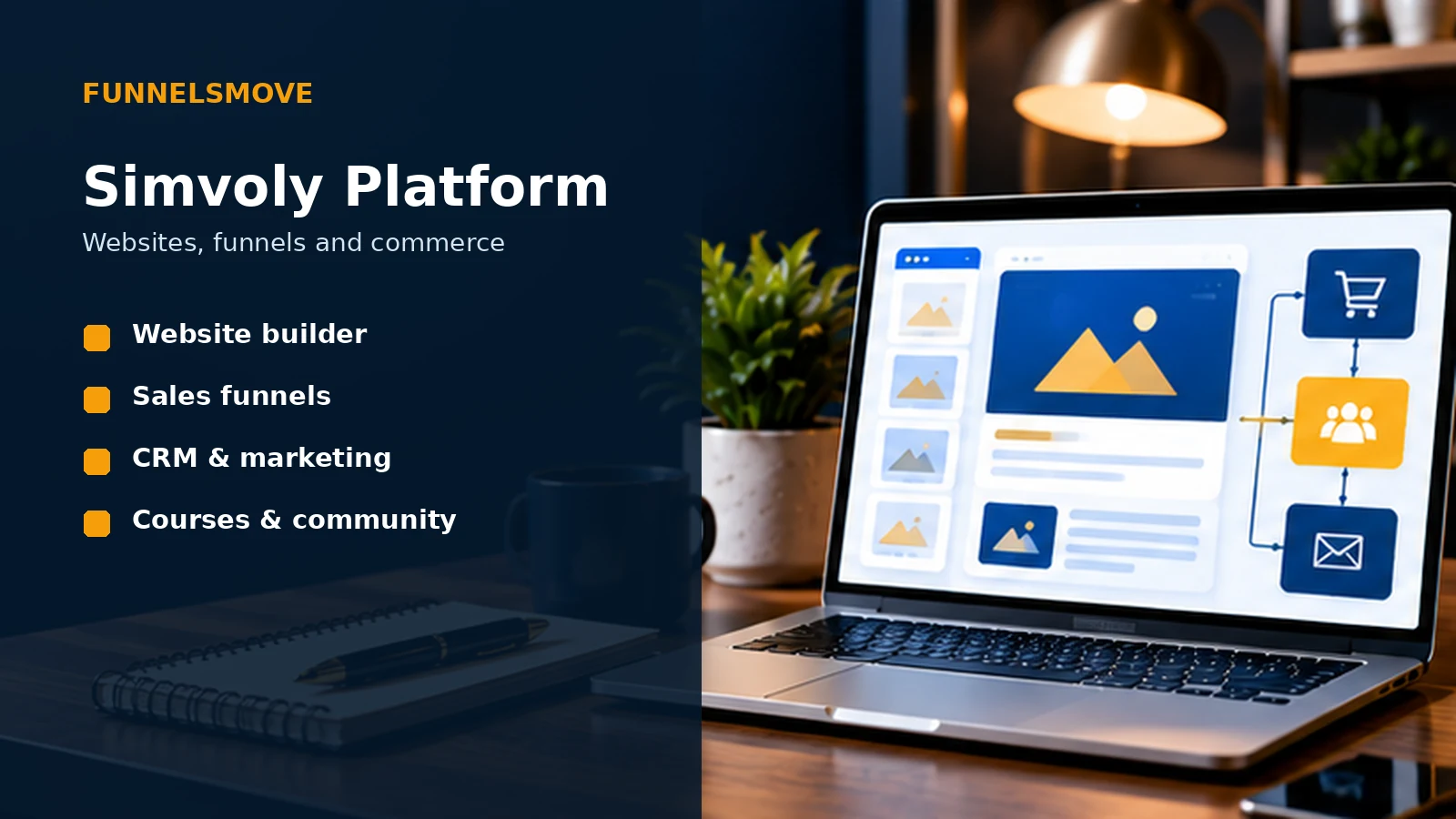
Simvoly is an all-in-one website and funnel platform that combines page building with ecommerce, CRM, marketing, courses, communities and related business tools. Its current product pages emphasize a drag-and-drop builder, websites and funnels working in the same ecosystem, sales tools, email and automation, CRM, appointments and hosted content.
That combination is the main reason to evaluate Simvoly as a platform rather than as a single-purpose page builder. A small business can use a normal navigable website for discovery and content, then connect focused funnels for lead generation or sales without maintaining a separate builder for each job.
Simvoly also has a substantial white-label product for agencies and SaaS operators. That is a separate buying decision from the standard self-serve plans, so this hub focuses first on the regular platform and points to white-label coverage where relevant.
Websites and funnels in one workspace
Simvoly’s builder is designed around visual drag-and-drop editing. The current website-builder materials describe templates, responsive pages, hosted websites and funnels, while the funnel product adds conversion-oriented tools such as A/B testing, custom checkouts, analytics, bump offers and one-click upsells.
The distinction between a website and a funnel is useful. A website usually gives visitors multiple navigation paths; a funnel intentionally narrows the journey toward a lead, registration or purchase. Simvoly’s proposition is that both can share the same platform instead of forcing you to choose one structure for every visitor.
That architecture is particularly relevant for businesses that need an informational site plus campaigns. It is less important if you already have a mature website stack and only need a narrowly specialized funnel tool.
How the Simvoly stack fits together
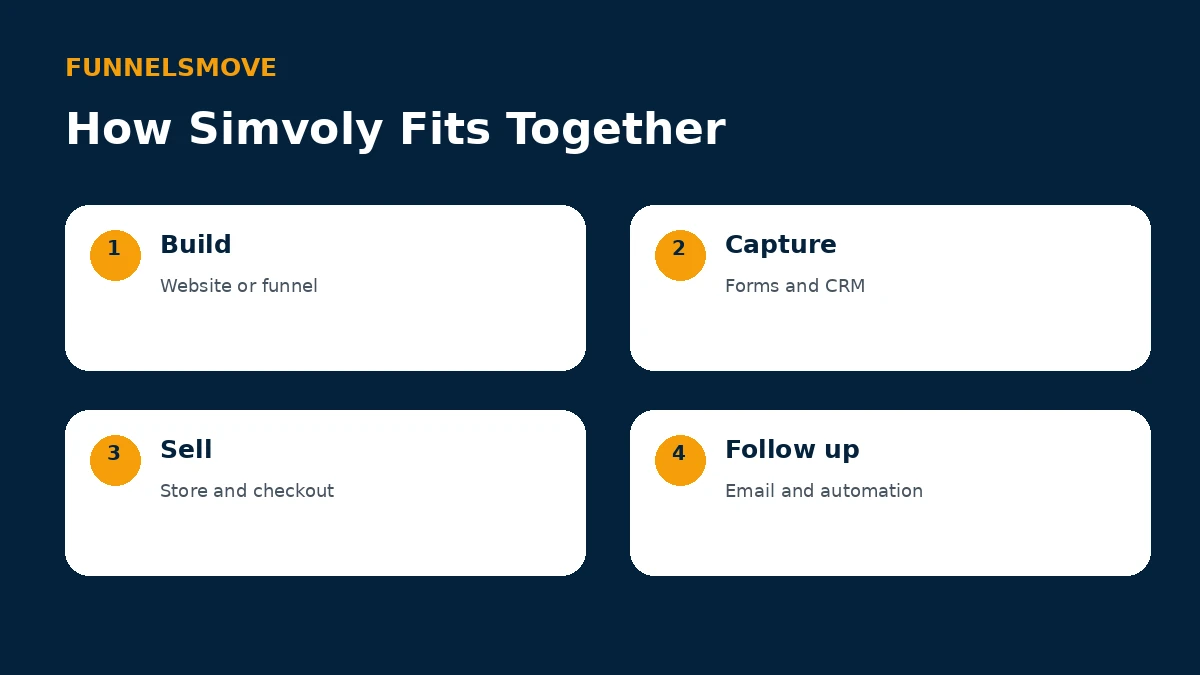
The platform makes the most sense when you evaluate the full customer journey rather than counting isolated features. Build the destination, capture the contact, process the sale and follow up from the same operating environment.
That does not mean every business should consolidate every tool. The benefit depends on whether Simvoly’s native capabilities are deep enough for your workflow. A specialist email, ecommerce or CRM system may still be preferable when that function is unusually complex.
Ecommerce, checkout and recurring sales
Simvoly’s current ecommerce materials support stores as well as sales funnels. The platform describes custom checkout pages, products, subscriptions and recurring payments, bump offers, one-click upsells and downsells, and funnel analytics.
This is a meaningful difference from a basic website builder. A creator can sell a digital offer through a focused funnel, while a merchant can operate a broader storefront. The practical question is whether the product catalog, fulfillment and operational requirements fit Simvoly before you migrate an established store.
For a new business with relatively straightforward products, keeping the storefront, funnel and customer record together can reduce integration work. Complex inventory, logistics or marketplace operations deserve a more detailed ecommerce comparison.
CRM, email and automation
Simvoly includes CRM capabilities for leads and members. Its current CRM pages describe customer profiles, activity history, form submissions, custom properties, segmentation and messaging. Marketing materials also describe email campaigns and automation flows.
The value is continuity: a form submission can become a contact that is segmented and followed up without first synchronizing separate databases. That can simplify operations for small teams.
Email capacity and advanced automation requirements still need to be checked against the plan you choose. Simvoly sells additional marketing-subscriber capacity, so list size is part of total cost rather than an unlimited assumption.
Courses, communities and content
Current Simvoly product pages include community and course-building capabilities alongside websites and funnels. That broadens the platform beyond acquisition: the same business can market an offer and deliver member-facing content after purchase.
This is most useful when the course or community is part of the same customer journey. If learning management is the core product, evaluate lesson organization, learner experience, reporting and community needs in detail rather than choosing solely because the feature exists.
How Simvoly pricing is structured
Simvoly currently lists four standard website-and-funnel tiers: Starter, Business, Premium and Elite. Annual billing is advertised at $12, $29, $39 and $79 per month respectively, while month-to-month prices are higher. Limits differ across websites, funnels, domains, bandwidth, products and other resources.
Pricing changes, so use our Simvoly pricing guide for a dated breakdown and confirm the checkout price directly before purchasing. White-label plans are priced separately and should not be confused with the standard tiers.
Who is Simvoly best suited to?
Simvoly is most compelling for creators, consultants, marketers, small businesses and agencies that value having websites and funnels in the same environment. It can also appeal to teams that want native CRM, selling and marketing functions without assembling a large integration stack.
It may be a weaker fit when one specialist function dominates your requirements—for example, very complex ecommerce operations, enterprise CRM governance or a development-heavy front end. In those cases, compare the specialist system on its own merits.
For funnel-first buyers, our Simvoly vs ClickFunnels comparison examines the different emphasis of the two platforms.
Bottom line
Simvoly is broader than a conventional website builder and more website-centric than many dedicated funnel tools. Its core proposition is consolidation: websites, funnels, selling, CRM and marketing can operate together, with a separate white-label path for agencies.
The right decision depends on your operating model. If reducing tool handoffs matters and the native features cover your needs, Simvoly deserves consideration; if you need best-of-breed depth in a specific function, compare that function carefully before consolidating.
A practical Simvoly setup sequence
Start with architecture before design. Decide which pages belong to the permanent website, which campaigns deserve dedicated funnels, and where a visitor should move between the two. Create the primary navigation and conversion paths only after that map is clear. This reduces the chance that a visually polished site develops duplicate pages or disconnected calls to action.
Next, define the contact lifecycle. List the forms you need, the properties or tags that identify useful segments, and the messages that should follow each meaningful action. Simvoly’s CRM and automation are more useful when the data model is deliberate rather than assembled one form at a time.
Build the selling path last enough that it reflects the real offer but early enough to test it end to end. Create the product, checkout and post-purchase destination, then make a test purchase or use the safest available test process. Verify access, email, CRM status and any automation that should fire.
Finally, establish a maintenance routine. Review plan usage, failed forms, campaign performance, stale offers and integrations on a schedule. Consolidation reduces tool count, but it does not remove the need for operational ownership.
What to test during the free trial
Use the trial as a workflow test, not a design contest. Rebuild one representative page from your current site, including its mobile layout, form, analytics requirements and any custom elements that matter. Note which tasks are faster, which require workarounds and which cannot be reproduced.
Then build one small funnel with a clear conversion event. Test the entry page, form or checkout, thank-you state, CRM record and follow-up. If your business sells recurring access, a course or a physical product, test that specific delivery path rather than a generic demo.
Invite the people who will actually operate the platform. A founder may like the builder while a marketer struggles with campaign organization, or the reverse. Permission, collaboration and handoff requirements are part of product fit.
Before the trial ends, calculate the plan and add-ons required for the tested workflow at your expected scale. That turns a pleasant demo into a more realistic buying decision.
Migration considerations
A migration is more than copying page designs. Inventory domains, redirects, forms, analytics tags, email sequences, products, customer access, SEO metadata and integrations before moving anything. Identify which system is the source of truth for contacts and orders during the transition.
For SEO-sensitive pages, preserve useful URLs where possible and plan redirects when paths must change. Transfer titles, descriptions, headings and structured information deliberately instead of assuming a visual import carries search signals with it.
Email and CRM migration deserves special care. Clean lists before import, preserve consent records where required, and avoid triggering live automations while test data is being loaded. Segment old customers, active prospects and inactive contacts so the new system starts with understandable data.
A phased migration is often safer than a one-day switch. Move a low-risk campaign first, validate the process, then expand. The best migration plan minimizes customer disruption rather than maximizing speed.
Simvoly within the FunnelsMove platform landscape
FunnelsMove covers several all-in-one platforms because similar feature lists can hide different operating philosophies. Simvoly’s distinctive architectural idea is the close relationship between normal websites and conversion funnels, with a substantial white-label offering layered on top.
ClickFunnels is more explicitly organized around funnel-first selling. HighLevel puts heavier emphasis on agency CRM, lead management and client operations. Systeme.io targets a comparatively streamlined all-in-one stack for creators and small online businesses. These descriptions are directional, not rankings.
That context matters because choosing software by the longest feature list usually produces a poor comparison. Start with the workflow that creates revenue or serves customers, then compare the platforms on that workflow. A feature that is central for one business can be irrelevant for another.
As this Simvoly cluster expands, the platform hub should remain the broad orientation page while pricing, comparisons, white-label, integrations and feature guides answer narrower questions. That structure helps readers move from discovery to a specific decision without forcing one article to cover every detail.
Questions to answer before adopting an all-in-one platform
List every system that currently touches the customer journey: website, forms, CRM, email, checkout, courses, community, scheduling and analytics. Mark which handoffs regularly break or require manual work. Those pain points are the strongest candidates for consolidation.
Then separate must-have depth from convenient breadth. A basic built-in CRM may be ideal for a small sales process but insufficient for an organization with complex account hierarchies. Native ecommerce may simplify a focused catalog while falling short for sophisticated logistics. The goal is not to maximize the number of tools replaced; it is to simplify without losing capabilities that matter.
Consider data portability before launch. Decide how often you will export critical contacts, orders and content, and document the third-party services connected to the platform. Hosted software reduces infrastructure work, but the business should still understand where important data lives and how it can be recovered.
Evaluate governance as the team grows. Determine who can publish pages, change products, edit automations and access customer information. A system that feels simple for one founder can become confusing when several people share responsibility unless naming and permission conventions are established.
Finally, define success before migration. Useful measures might include publishing time, lead-response speed, checkout completion, fewer integration failures or reduced software cost. Without a baseline, it is easy to mistake a new interface for an operational improvement.
Internal linking path for the Simvoly cluster
This platform hub should remain the broad entry point. Readers asking whether Simvoly is credible can move to the dedicated review; readers who already understand the product can move directly to pricing; funnel-focused buyers can use the ClickFunnels comparison.
Future white-label, website-builder, funnel-builder, integrations and ecommerce articles should link back here when they need to explain the overall platform. In return, this hub should point to those specialized guides rather than expanding indefinitely.
That separation protects search intent. A pricing page should answer cost and plan questions, a review should evaluate fit, and a comparison should help readers understand product differences. Keeping those jobs distinct reduces internal cannibalisation and makes navigation more useful.
Explore Simvoly
Review the current platform, trial and plan details directly before deciding whether it fits your workflow.