Can ClickFunnels Replace Your Website?
Yes, ClickFunnels can build a website as well as funnels—but whether it should replace your current site depends on what the site needs to accomplish.
Can ClickFunnels replace a website?
For a small business whose website mainly supports offers, lead generation and product delivery, ClickFunnels can cover much of the required experience. Its current Site app is presented as a website builder connected with funnels, courses and products, using a drag-and-drop editor and themes.
When ClickFunnels can be enough
It can make sense when the site is tightly tied to a funnel-based business, you value one platform for pages and offers, and your publishing requirements are modest. A coach with a small set of service pages and a lead-generation funnel is a different case from a large editorial publisher.
When a separate website still makes sense
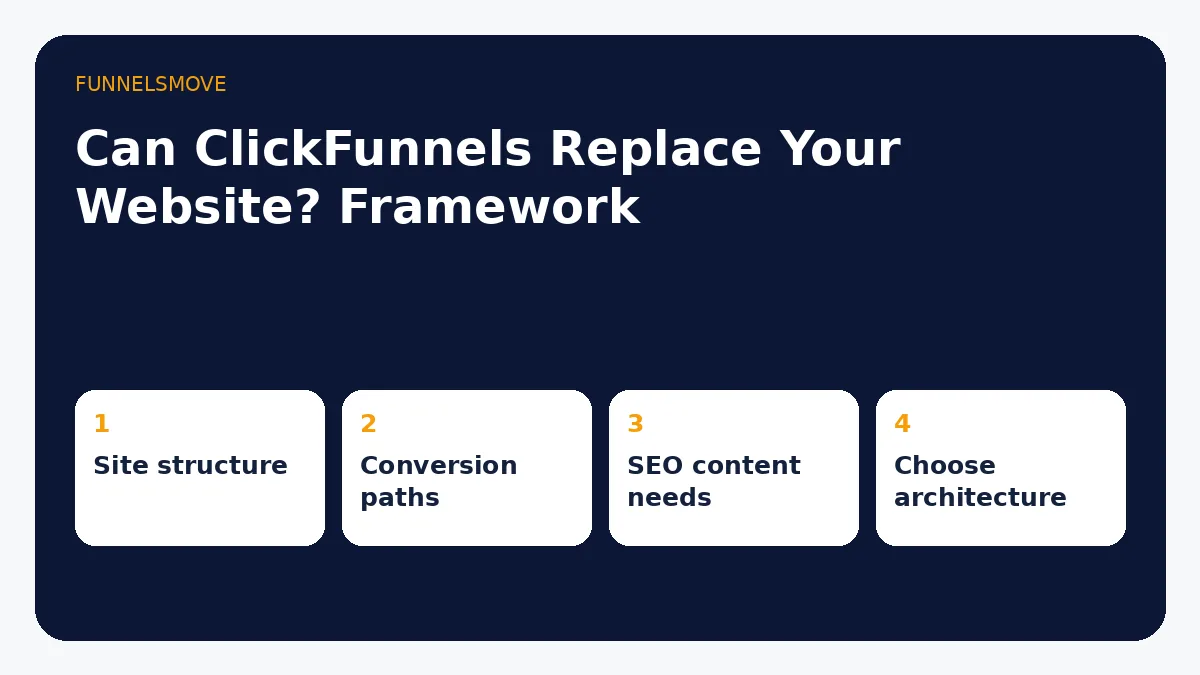
Keep or compare a dedicated website platform when long-form publishing, complex content architecture, specialized CMS workflows, developer control or an established SEO site are central to the business.
Do not migrate a working content site merely to reduce the number of tools. Migration changes URLs, templates, structured data and internal links, so the SEO and operational cost can exceed the convenience benefit.
Do you need a website before using ClickFunnels?
No separate website is inherently required to build a funnel. A funnel can have its own pages and domain setup. But a broader website can still play an important role in brand discovery, evergreen resources, navigation and non-linear browsing.
Website versus funnel: different navigation jobs
A traditional website often lets visitors explore many paths. A funnel intentionally narrows choices around a specific conversion journey. Many businesses benefit from both patterns: a navigable resource site for discovery and focused funnels for campaigns.
What ClickFunnels can and cannot replace
ClickFunnels can cover a focused marketing site when the core job is to present offers, collect leads, sell products or courses, and move visitors into funnels. Its Site app gives businesses a way to create connected pages without maintaining a separate general-purpose CMS.
That does not make it a universal replacement for every website stack. A content-heavy publication, documentation library, complex ecommerce catalog, multilingual editorial operation or site with custom application logic may still need a dedicated CMS or development platform. The useful question is not “Can ClickFunnels make web pages?” but “Does its publishing model match the pages, navigation and content operations this business must maintain?”
SEO, blogging and content-publishing considerations
Search-led websites need more than attractive pages. They need durable URLs, crawlable internal links, useful page titles and descriptions, indexable content, sensible information architecture and a publishing process the team can maintain. ClickFunnels can participate in an SEO strategy, but a business with a large editorial library should compare its content workflow with a dedicated CMS before migrating.
For an existing site, preserve valuable URLs whenever possible. Moving content merely to consolidate tools can create redirect work, broken internal links and lost context. If organic discovery is a major acquisition channel, review the ClickFunnels SEO guide and inventory the current site's indexed pages before choosing a migration path.
A practical website-platform decision framework
| Requirement | ClickFunnels-first approach | Dedicated website or hybrid |
|---|---|---|
| Small offer-led site | Often practical | Optional |
| Funnels, checkout and course delivery | Strong reason to evaluate ClickFunnels | Can coexist |
| Large editorial or SEO library | Evaluate publishing workflow carefully | Often easier to manage |
| Complex navigation or content taxonomy | Possible, but test maintainability | Often a better fit |
| Custom application behavior | Depends on integrations/custom code | Specialist platform may fit better |
If most important pages exist to support one or two offers, consolidation may be sensible. If the website is itself a long-lived content asset, use ClickFunnels where it is strongest—campaigns and conversion paths—without assuming every page must move.
A migration decision checklist
Inventory existing organic traffic, indexed URLs, backlinks, content, forms, analytics, integrations and conversion paths. Identify which must survive the move. If you cannot map redirects and preserve important content, do not treat migration as a simple design project.
How FunnelsMove uses this distinction
FunnelsMove itself is a content-led static website, while ClickFunnels is evaluated as a potential conversion and business platform. That is intentional: the best publishing architecture and the best funnel workflow do not have to be the same system.
Quick decision table
| Need | ClickFunnels-only may fit | Separate site may fit |
|---|---|---|
| Offer-led pages | Yes | Optional |
| Large editorial library | Possible but compare | Often |
| Focused campaigns | Strong fit | Can coexist |
| Complex CMS workflow | Compare carefully | Often |
For the implementation details, see using WordPress with ClickFunnels.
For the implementation details, see ClickFunnels domain and URL setup.
For implementation details, see ClickFunnels branding and favicon.
For search-led publishing decisions, see the ClickFunnels SEO guide before choosing the site builder as your primary content platform.
Standalone campaign pages have a different job from site pages; see the ClickFunnels landing page guide for that workflow.
Evaluate ClickFunnels against your workflow
Verify the current offer, plan limits and terms before subscribing.
Explore ClickFunnels (opens in a new tab)Primary sources
Product facts were rechecked against official ClickFunnels sources on September 17, 2026. Product interfaces and publishing capabilities can change.