ClickFunnels Landing Pages: Build and Optimize
Learn when to use a standalone landing page, how to build one in ClickFunnels, and how to improve clarity, conversion and measurement.
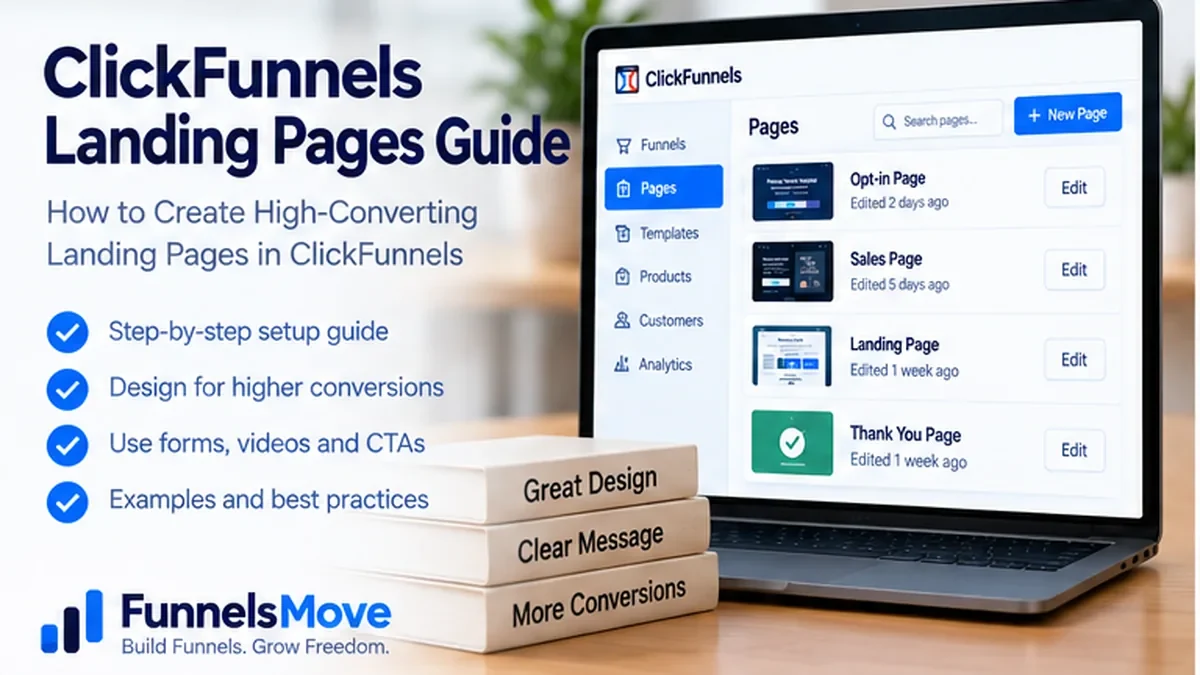
See the parent guide for broader context around this topic.
What is a ClickFunnels landing page?
A ClickFunnels landing page is a standalone page created for a focused marketing purpose such as collecting a lead, confirming an action, promoting an event or directing a visitor to the next step. Current ClickFunnels documentation distinguishes standalone landing pages from multi-step funnels and notes that landing pages are not intended to be the primary way to complete direct product transactions; for product sales, ClickFunnels directs users toward a funnel.
That distinction matters. A landing page can be one component of a broader funnel, but it can also stand alone. If the visitor needs several sequential steps—registration, checkout, upsell and confirmation, for example—a funnel is usually the more appropriate container.
Think of the landing page as a focused decision surface. It should have one primary purpose and enough information for the visitor to make that decision confidently.
How the ClickFunnels landing page builder works
The current ClickFunnels Page Editor can build funnel pages, standalone landing pages, site pages, blog pages, course pages and store pages. It uses sections, rows, columns and elements, with drag-and-drop controls for text, images, videos, buttons, forms and other components.
To create a standalone landing page, the current help documentation points users to the Landing Pages app, then New Landing Page. From there you can browse available templates, set the page name and URL, and use AI instructions where available to generate an initial starting point.
After creation, open the editor, replace placeholder content, configure the form or CTA, check desktop and mobile views, save, preview, and test the final action.
A high-converting landing page starts with message match
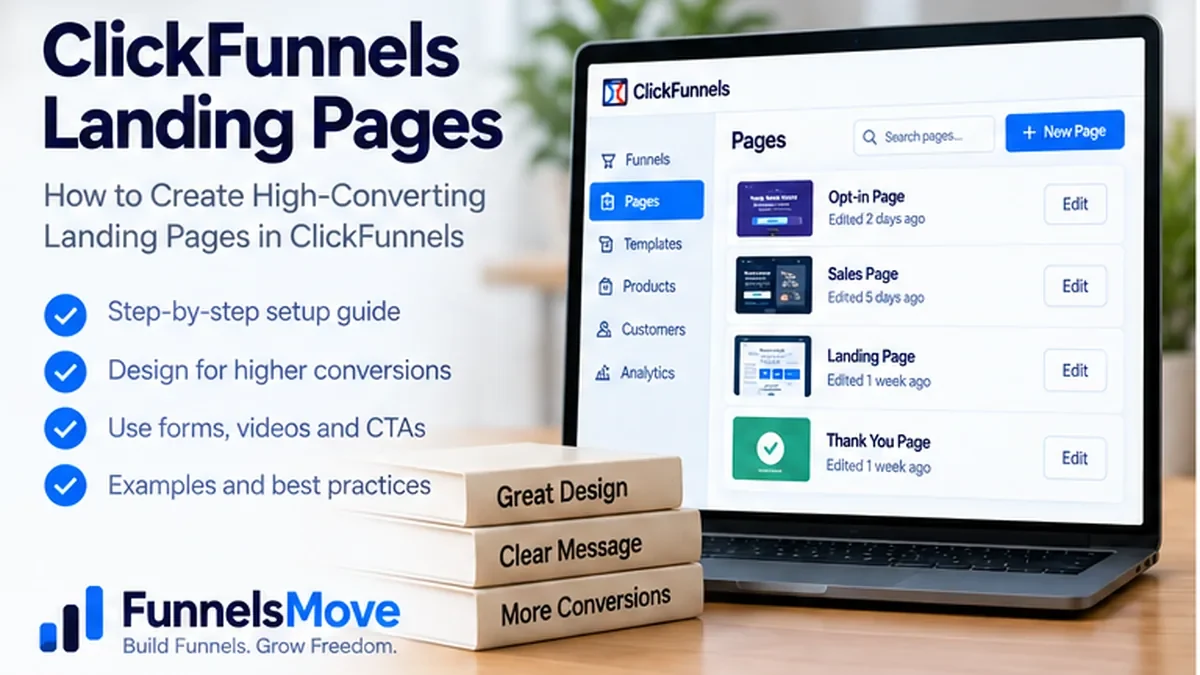
The first screen should confirm that the visitor reached the page they expected. If an ad promises a webinar about improving sales calls, the landing page should not open with a generic company slogan. Repeat the core promise in a specific, credible way and make the next step obvious.
Build the rest of the page around the questions required for that action: what is being offered, who it is for, what the visitor gets, why the claim is believable, what happens after clicking, and what risks or conditions should be understood. More sections are not automatically better; use the amount of content needed for the decision.
Keep the primary CTA visually consistent. Competing navigation, unrelated offers and multiple contradictory buttons can weaken focus.
Using ClickFunnels landing page templates
Templates are useful for accelerating layout, but the layout should follow the campaign rather than dictate it. Preview a template and assess its hierarchy, form placement, mobile behavior and sections before choosing it. Delete blocks that do not help the visitor decide.
Replace generic imagery and proof. If a template contains testimonials, logos or statistics that are not yours, remove them rather than treating them as placeholders that can accidentally reach production.
For reusable components, ClickFunnels can save sections, rows and elements. The ClickFunnels templates guide explains funnel templates, saved content, themes, sharing and Frameworks in more detail.
Build an opt-in landing page
An opt-in page should make the exchange clear: what information you are requesting and what the visitor receives. Ask only for fields that support the next step. An email address may be sufficient for a lead magnet; a qualified consultation may require more information.
Explain what happens after submission. If the visitor will receive email follow-up, set that expectation and provide the necessary privacy information. Test both the form submission and the destination after submission.
Landing page versus sales page in ClickFunnels
People often use “landing page” and “sales page” interchangeably, but ClickFunnels’ current product structure makes a useful operational distinction. A standalone landing page can promote an offer or route a visitor, while a sales process that needs checkout, attached products, order confirmation or post-purchase steps belongs more naturally inside a funnel.
A sales page can still look similar to a landing page: focused headline, offer explanation, proof, objections and CTA. The difference is what happens next and how deeply it connects to the transaction flow.
For checkout implementation, see ClickFunnels products and checkout.
ClickFunnels landing page design principles
Use a clear visual hierarchy: headline, supporting copy, primary CTA, proof, important details and the next CTA. Keep line lengths readable, maintain sufficient contrast, and avoid giant decorative sections that push important information far below the fold.
On mobile, make sure text remains readable without zooming, buttons are easy to tap, forms do not overflow, and embedded media does not create horizontal scrolling. Previewing inside an editor is useful, but also test the published page on real devices where possible.
Keep page speed in mind. Large background videos, multiple widgets, duplicated tracking scripts and uncompressed images can slow the experience.
Useful ClickFunnels landing page patterns
A lead-magnet page can be short: problem, benefit, asset preview and opt-in. A webinar registration page needs the topic, audience, date/time, learning outcomes, presenter context and registration CTA. A consultation page may include who the service is for, qualifying details, proof and a booking or application action.
A product-launch page may need substantially more context: product positioning, benefits, demonstration, proof, price, guarantee terms and a route into checkout. Choose the pattern based on search intent and traffic temperature rather than copying a “best landing page” screenshot.
Write landing page copy around one decision
The headline should communicate the outcome or value proposition without exaggeration. Supporting copy can make the promise more specific, explain who it is for, and address the most important objection. CTA text should describe the action: “Reserve my seat,” “Get the checklist,” or “Book a consultation” is often clearer than a generic “Submit.”
Use proof responsibly. Testimonials should be genuine and representative, and performance claims should have substantiation. Do not create fake scarcity or imply guaranteed outcomes.
Tracking and attribution for landing pages
Before promoting the page, define the conversion event and make sure analytics capture it correctly. Use consistent campaign parameters so you can compare traffic sources. If the page submits a form and then redirects, verify that the success event reflects a real submission rather than a mere button click.
See the ClickFunnels tracking guide for GA4 and related measurement options. If the landing page is part of paid acquisition, connect it to the traffic acquisition guide.
Test landing pages without confusing the result
Start with a clear hypothesis. Test meaningful differences such as the offer, headline, page structure or CTA—not tiny visual changes simply because testing software exists. Keep enough traffic on a version to learn something useful, and avoid declaring a winner from a handful of conversions.
When the page is a funnel step, ClickFunnels supports split testing within funnel steps. The testing guide covers the broader QA and experiment workflow.
ClickFunnels landing page launch checklist
Confirm message match, one primary CTA, accurate offer details, mobile layout, working form or button, privacy links, appropriate tracking, unique page URL, title and sharing settings, compressed images, proof you can substantiate, and a tested post-conversion path.
Use a standalone landing page when one focused action is enough. Use a multi-step funnel when the customer needs sequenced steps or a transaction flow. If you are still deciding whether the page builder itself is sufficient, see the ClickFunnels website builder guide.
Match the landing page to visitor intent
A page for branded search traffic can assume more familiarity than a page for a cold social ad. A page reached from an educational article may need to bridge naturally from the topic into the offer. A page for a warm email list can often move more quickly because the subscriber already knows the business.
This is why copying a high-performing landing page without copying its traffic context often fails. The original page may work because the audience has already seen a webinar, email sequence or product demo. Design the page around what your visitor knows at the moment they arrive.
Forms, buttons and post-conversion experience
Every form field creates a small amount of friction. Ask for data only when it supports qualification, fulfillment or follow-up. For a simple download, name and email may be enough. For a consultation, company size, role or problem details may help route the lead. Make required fields clear and provide useful error messages.
After submission, do not leave the visitor guessing. Use a confirmation page or clear success state that explains the next step, such as checking email, booking a call, joining a webinar or accessing a resource. If the action triggers an automation, test that automation with a real address before launch.
Should a ClickFunnels landing page rank in search?
Some standalone landing pages can be indexable, but not every campaign page should target organic search. Short-lived promotion pages, duplicate variants and thank-you pages often have little search value. If a query needs a detailed explanation, a useful article or guide may be a better search destination, with the landing page serving as the conversion step.
Use the ClickFunnels SEO guide to decide which pages should be part of your long-term search architecture.
Build credibility without cluttering the page
Proof should reduce uncertainty, not decorate the layout. Depending on the offer, useful proof may include accurate testimonials, customer logos you have permission to use, product screenshots, credentials, process explanations, transparent guarantees, or specific examples. Put the strongest relevant proof close to the claim it supports.
Avoid fake review widgets, invented scarcity, unsupported percentages and testimonials that imply typical results when they are exceptional. For regulated or high-stakes categories, review the applicable advertising and disclosure requirements before publishing.
Maintain landing pages after launch
Campaign pages age quickly. Schedule periodic checks for broken links, expired offers, old dates, retired products, incorrect privacy language and tracking scripts that are no longer needed. If the page receives evergreen traffic, recheck screenshots and interface instructions when ClickFunnels changes the editor.
Keep an owner for each live page. A simple inventory of URL, campaign, offer, traffic source and last-review date prevents forgotten pages from remaining public long after the campaign ends.
Connect the page to the rest of the funnel
A landing page should not become an isolated endpoint. Decide where the visitor goes after conversion, which workflow starts, what data is stored, and which sales or delivery process takes over. If a lead submits a consultation form, make sure the booking or qualification step is ready. If they download a resource, make sure the promised asset and follow-up arrive.
This handoff is where many campaigns fail: the page converts, but the downstream experience is unclear or broken. Test the complete journey rather than treating the landing page conversion rate as the only success metric.
Evaluate ClickFunnels for landing pages
Compare the current ClickFunnels features and limits with the workflow you actually need before choosing a plan.
Visit the ClickFunnels signup page (opens in a new tab)Primary product sources
- Create and Manage Landing Pages (opens in a new tab)
- Getting Started with the Page Editor (opens in a new tab)
- Add and Manage Funnel Steps (opens in a new tab)
Product capabilities and plan details were checked against current first-party sources on September 12, 2026. Interfaces, pricing and limits can change, so verify critical details before purchasing or publishing a live funnel.