ClickFunnels vs Leadpages: Which Fits Better?
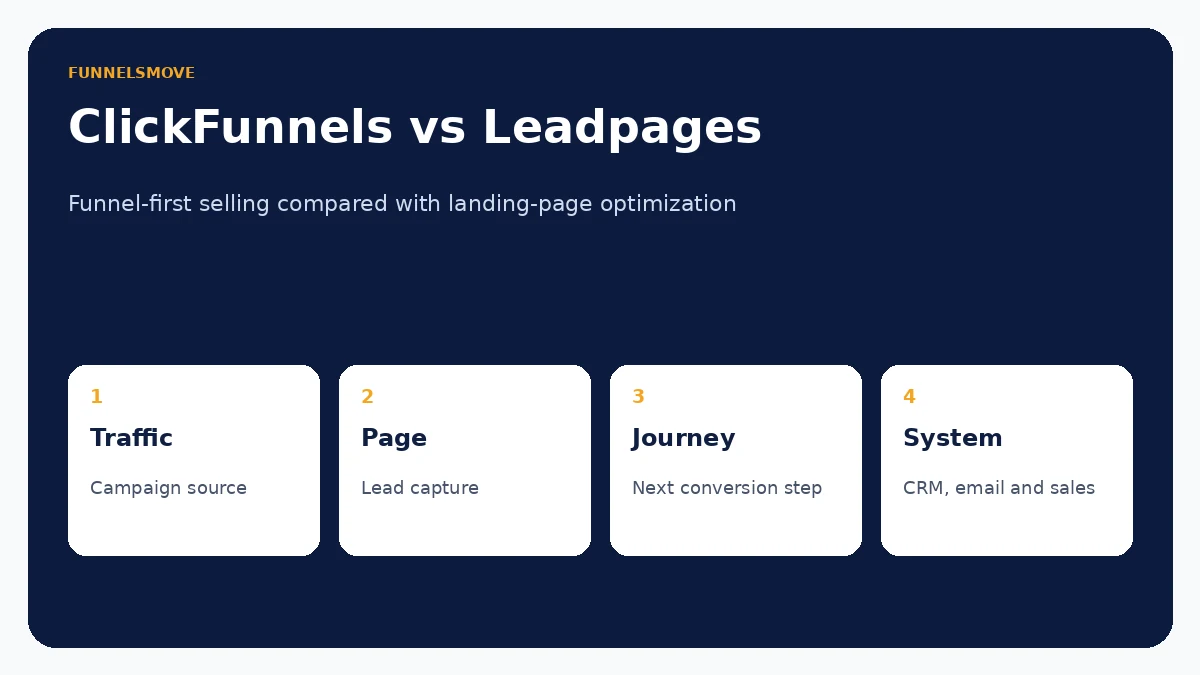
Leadpages is increasingly focused on landing-page publishing and conversion optimization; ClickFunnels is the broader choice when the page must lead into a multi-step selling system.
Start with our ClickFunnels platform guide, ClickFunnels review and ClickFunnels alternatives if you need broader context.
ClickFunnels vs Leadpages: the short answer
Choose Leadpages when your priority is publishing and optimizing landing pages, websites and lead-generation experiences. Choose ClickFunnels when you need those pages to form part of a broader funnel with checkout, upsells, email, courses and structured selling workflows.
Leadpages changed substantially in 2026, so older “Leadpages vs ClickFunnels” comparisons can be misleading. Its current product tiers add AI page creation, A/B testing, personalization, heatmaps and lead intelligence. The decision is no longer “simple page builder versus funnel builder”; it is CRO-focused publishing versus a broader funnel operating system.
Landing-page optimization vs funnel orchestration
Leadpages’ current Grow, Optimize and Scale plans center on unlimited pages, custom domains, testing and increasingly advanced conversion optimization. ClickFunnels centers on funnels, workspaces, contacts, email, courses and stores.
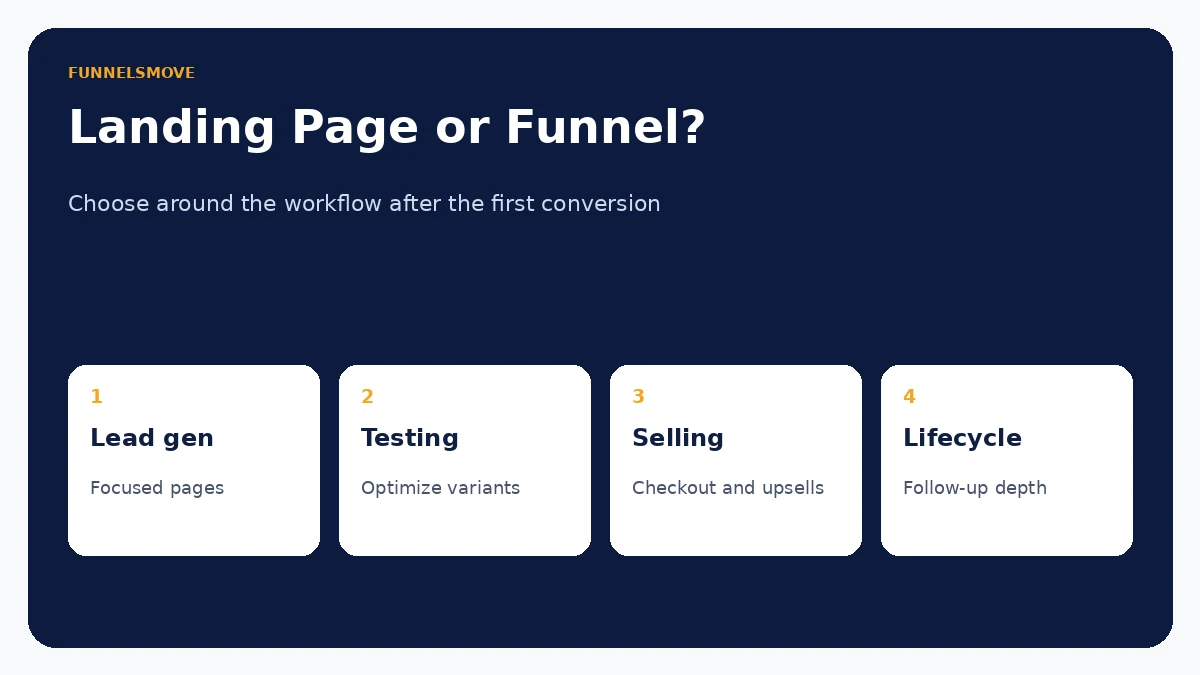
If your marketing team already has a CRM, email platform and checkout, Leadpages can be a focused front-end layer. If you want the page, sales sequence and downstream offer logic managed together, ClickFunnels can reduce integration work.
Landing pages and website publishing
Leadpages Grow currently includes unlimited pages, four custom domains, three blogs and AI page creation. Its separate HTML Pub product also offers lower-cost publishing tiers without the full CRO suite. This gives teams a clear path from publishing into optimization.
ClickFunnels includes unlimited landing pages and site pages on its current plans. The page editor is designed in the context of funnels and business workspaces. For a campaign marketer, that can be useful; for a team that primarily publishes independent landing pages, Leadpages’ product focus may feel more direct.
A/B testing, personalization and CRO
Leadpages now makes conversion optimization a central differentiator. Grow includes manual A/B testing and dynamic text replacement; Optimize adds Smart Traffic, heatmaps and auto-personalization; Scale adds deeper optimization capabilities. Current Leadpages documentation also lists analytics retention and integration limits by tier.
ClickFunnels supports funnel testing and conversion-focused page flows, but teams whose main job is continuous landing-page experimentation should compare the testing workflow itself: traffic allocation, reporting, personalization, heatmaps and how results feed the rest of the marketing stack.
Checkout, offers and upsells
ClickFunnels has the stronger native case when the landing page is only the beginning of a transaction funnel. Products, checkout and offer sequencing can live in the same funnel architecture. That matters for direct-response businesses that optimize not just lead conversion but revenue per visitor.
Leadpages can connect forms and pages to other systems and supports ecommerce-oriented use cases, but it is not positioned as the same kind of end-to-end funnel selling platform. If your checkout already lives elsewhere, that may be an advantage rather than a limitation.
Email, CRM and follow-up
ClickFunnels plans include contact and email allowances, which can consolidate follow-up around the funnel. Leadpages focuses more on collecting and enriching leads and connecting them to other systems through integrations, forms and webhooks.
That means stack preference matters. A team happy with its existing CRM and email automation may prefer a specialized landing-page layer. A small business trying to reduce the number of connected tools may prefer ClickFunnels.
SEO and content considerations
Both can publish indexable pages with custom domains, but neither comparison should reduce SEO to a checkbox. Leadpages currently supports websites and blogs in its main paid plans, while ClickFunnels includes site pages and broader business-building tools.
For content-led SEO, evaluate editorial workflow, taxonomy, internal linking, page performance and how many articles the team expects to manage. A dedicated CMS can still be preferable for large publishing operations, with either platform used for campaign landing pages.
ClickFunnels vs Leadpages pricing
Leadpages currently lists Grow at $99/month, Optimize at $199/month and Scale at $399/month, with lower effective monthly rates on annual billing. A 7-day free trial is advertised. Its separate HTML Pub tiers start lower for publishing-only needs.
ClickFunnels currently sells Launch at $97/month, Scale at $197/month and Optimize at $297/month, with annual billing discounts; Dominate is an annual-only $5,997 plan. The current pricing page lists unlimited funnels as a limited-time inclusion across the plans, while workspaces, team members, contacts, email volume, courses and domains scale by tier. Scale and above list the custom code editor plus webhooks/full API access.
At similar price points, the products buy different things. Leadpages Optimize is paying for CRO capabilities such as Smart Traffic and heatmaps; ClickFunnels Scale is paying for a broader funnel/business stack with more workspaces, contacts, email and developer access. Price the workflow you need, not similarly numbered tiers.
Who should choose Leadpages or ClickFunnels?
| Situation | Better starting point |
|---|---|
| Dedicated landing-page and CRO team | Leadpages |
| Multi-step sales funnel with checkout | ClickFunnels |
| Existing CRM/email/checkout stack | Leadpages may fit cleanly |
| Want to consolidate funnel, email and courses | ClickFunnels |
| Heatmaps/personalization are central | Leadpages Optimize/Scale deserve evaluation |
Ignore old year-stamped comparisons in the keyword cluster when making a 2026 decision. Both products have changed. Evaluate the current plans against a real campaign and the systems already in your stack.
How each platform fits an existing marketing stack
Leadpages is easier to justify when the rest of your marketing stack is already established. A team can use it as the campaign-page and CRO layer while keeping its CRM, email automation, analytics and checkout systems. That modularity reduces the scope of a migration but creates integration boundaries that must be monitored.
ClickFunnels is more compelling when those boundaries are the problem. If leads move through several disconnected tools before a sale, consolidating page flow, contact data, email and checkout can simplify operations. The trade-off is platform concentration: switching later may require moving more business logic.
Before migrating, map forms, hidden fields, tracking parameters, consent language, domains, redirects and automation triggers. Landing pages often look simple while carrying important attribution and routing logic behind the scenes.
Paid traffic, lead generation and optimization maturity
Teams buying substantial paid traffic should evaluate how quickly they can produce variants and learn from them. Leadpages’ current emphasis on testing, dynamic text, heatmaps and personalization is relevant when page-level CRO is a recurring discipline rather than an occasional experiment.
ClickFunnels can also support campaign testing, but its value extends beyond the first conversion. If the business optimizes revenue through a sequence—lead capture, sales page, checkout, upsell and follow-up—the funnel view may be more useful than specializing in the landing page alone.
Low-traffic businesses should be realistic about experimentation. Sophisticated testing features do not create statistical power. At modest traffic levels, offer clarity, message match and qualitative user feedback may matter more than advanced routing algorithms.
A practical comparison test
Build one representative lead-generation campaign in both platforms. Use the same headline, form fields, thank-you action and traffic source. Measure build time, mobile QA, form reliability and how cleanly lead data reaches the next system.
Then extend the test to the next business outcome. If the lead must buy, book or enter a nurture sequence, count the handoffs required. Leadpages may win the page-building test while ClickFunnels wins the end-to-end workflow—or the reverse if your existing stack already handles everything after the form.
Try ClickFunnels against your real workflow
Use a real offer, page flow and checkout during your evaluation. The right platform is the one that removes operational friction after the first conversion—not simply the one with the longest feature list.
Visit ClickFunnels (opens in a new tab)Buyer scenarios: where each platform makes sense
Paid-media team with an established CRM: Leadpages is a strong candidate because page publishing and CRO can remain specialized while the CRM keeps ownership of lifecycle data. Solo course creator: ClickFunnels may be more practical when lead capture, sales pages, checkout, email and course delivery need to live closer together. Agency producing lead-gen pages: compare Leadpages’ optimization workflow with the client-management and broader funnel needs of your delivery model.
Content-led business: neither decision should be made only from landing-page features; evaluate the long-term publishing system separately. High-ticket service business: ClickFunnels becomes more attractive when a lead must move through qualification, nurture, booking and a structured offer. The key is to identify whether the first page is the product you are optimizing or merely the first step in a larger system.
Before you decide: campaign-stack checklist
Count how many landing pages your team publishes each month and how often it runs controlled experiments. If page iteration, personalization, heatmaps and campaign-level learning are routine jobs, Leadpages’ CRO orientation becomes more valuable. If testing is occasional, advanced optimization features may not justify additional complexity.
Next, map the journey after the form. Identify CRM routing, email nurture, appointment booking, sales pages, checkout and upsells. If these already run cleanly in specialized systems, Leadpages can remain a focused front end. If the handoffs are unreliable or expensive to maintain, ClickFunnels’ broader scope may be more attractive.
Finally, consider content and governance. Determine who owns domains, templates, consent language, analytics and brand standards. A marketing team with several specialists may prefer modular tools with clear ownership. A smaller team may value consolidation. Test both products with the same campaign and score not only page quality but the number of operational handoffs.
Frequently asked questions
Is Leadpages only a landing-page builder?
No. Current Leadpages plans include websites, blogs, AI page creation, testing and increasingly sophisticated CRO capabilities. Its center of gravity is still page publishing and optimization rather than the broader end-to-end funnel model used by ClickFunnels.
Which is better for A/B testing?
Leadpages makes testing and CRO a major product focus, with manual testing from Grow and additional optimization features on higher tiers. ClickFunnels supports testing in the context of funnels. Choose based on whether you optimize individual pages or a wider sales sequence.
Which is better for lead generation?
Both can generate leads. Leadpages is attractive when the lead should flow into an existing CRM and automation stack. ClickFunnels is attractive when lead capture is the first step in a larger funnel that the same platform should continue managing.
Can Leadpages handle checkout?
Leadpages supports ecommerce-related workflows and integrations, but it is not positioned as the same end-to-end funnel checkout system as ClickFunnels. If checkout, order bumps and post-purchase offers are central, test the complete transaction path rather than only the landing page.
Are old Leadpages vs ClickFunnels comparisons still useful?
Use them cautiously. The original keyword cluster contains year-specific variants from 2016–2020, but both products have changed materially. Current pricing, plan limits and CRO features should come from current vendor documentation.
Sources checked
Time-sensitive product facts and pricing were reviewed on September 15, 2026.