Unbounce vs ClickFunnels: Which Fits Better?
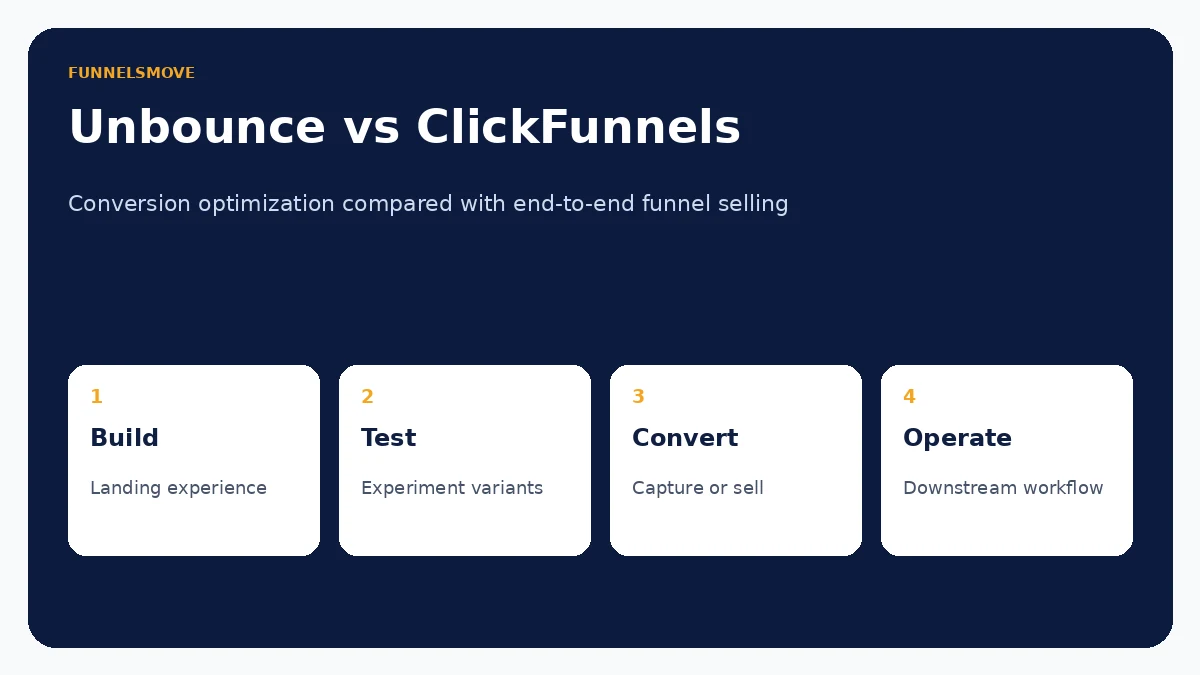
Unbounce is built around landing-page creation and conversion optimization; ClickFunnels is built around a broader sales funnel that can continue through checkout, upsells and follow-up.
Start with our ClickFunnels platform guide, ClickFunnels review and ClickFunnels alternatives if you need broader context.
Unbounce vs ClickFunnels: the short answer
Choose Unbounce when landing-page experimentation and conversion-rate optimization are the primary job. Choose ClickFunnels when landing pages need to connect directly to a larger selling sequence with checkout, upsells, email and other funnel steps.
Unbounce’s 2026 pricing structure makes the distinction unusually clear: lower tiers focus on page creation, while Experiment and Optimize add A/B testing and deeper optimization. ClickFunnels packages page creation inside a broader business and funnel system.
CRO platform vs funnel platform
Unbounce is designed for marketers and agencies launching landing pages, forms, popups and experiments. Its current plans scale by traffic, root domains, users and optimization capability. ClickFunnels scales more around workspaces, contacts, email volume, courses and business assets.
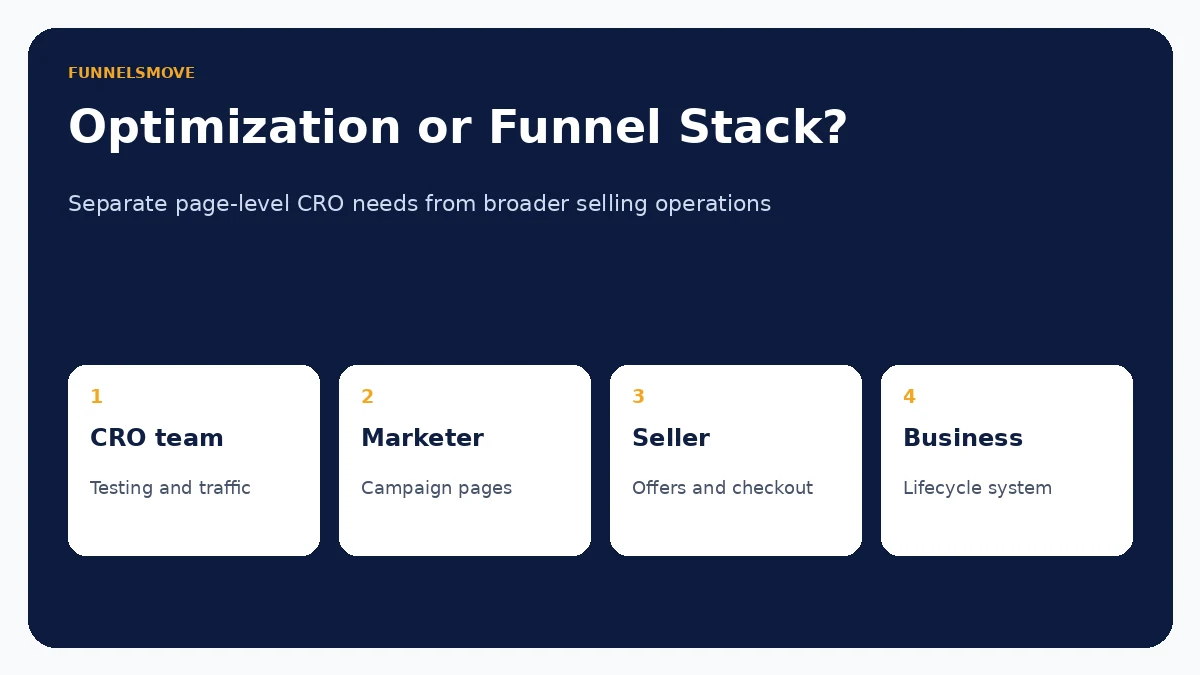
The difference affects ownership. A performance-marketing team may want Unbounce to hand leads into an established CRM. A founder-led business may prefer ClickFunnels to own more of the journey from click to purchase.
Landing-page building and campaign speed
Unbounce currently includes drag-and-drop page building, templates and hosted landing pages. Build adds unlimited pages, custom scripts/pixels, popups, sticky bars, multi-step forms and custom code/styling. These features make it suitable for teams producing many campaign pages without changing their main website.
ClickFunnels also provides landing and site pages, but the editor is usually used as part of a funnel. If every page is expected to lead to another funnel step, that context is useful. If pages are independent campaign assets feeding an existing stack, Unbounce can be cleaner.
A/B testing and conversion optimization
Unbounce’s Experiment plan currently lists unlimited A/B testing, unlimited pages, up to 30,000 monthly unique visitors, three users and two root domains. Optimize increases traffic, domains and users and adds deeper optimization capabilities.
This makes Unbounce especially relevant when the team has enough traffic and discipline to run meaningful experiments. Testing software cannot compensate for weak hypotheses or insufficient traffic. ClickFunnels users can test funnel variants too, but the broader platform value is in optimizing the entire sequence rather than specializing solely in landing-page CRO.
Funnels, checkout and post-click selling
ClickFunnels is stronger when the post-click journey includes product checkout, order bumps, upsells, courses or other sequential steps. Those functions are part of the same funnel-oriented product.
Unbounce generally expects downstream systems to handle CRM, checkout and lifecycle operations through integrations. That modularity can be ideal for established marketing teams, but it means more systems must be configured and monitored.
Integrations and existing marketing stacks
Unbounce Build currently advertises more than 1,000 integrations, plus custom scripts and pixels. This supports its role as a campaign front end connected to a wider marketing stack. ClickFunnels offers native platform functions plus integrations, with webhooks/full API access currently listed from Scale upward.
Before choosing, map where leads must go and what must come back. If attribution, consent, CRM ownership and lifecycle automation already live elsewhere, a focused landing-page platform can be easier to govern. If those functions are fragmented today, consolidation may be more valuable.
Teams, agencies and governance
Unbounce’s plans scale user and domain allowances, and it offers custom Concierge and Agency tiers. That can fit teams producing landing pages across brands or clients. ClickFunnels uses workspaces/sub-accounts as a core organizing concept, with Scale currently including five workspaces and Optimize ten.
Agencies should test permissions, cloning, domain management and client handoff—not just page design. The platform that makes repeated operations predictable is often more valuable than the one with a marginally nicer editor.
Unbounce vs ClickFunnels pricing
Unbounce currently lists Starter at $29/month, Build at $99, Experiment at $149 and Optimize at $249, with lower annual rates; Concierge and Agency use custom pricing. Starter is capped at five pages and 500 monthly unique visitors, while higher tiers expand traffic, users and domains.
ClickFunnels currently sells Launch at $97/month, Scale at $197/month and Optimize at $297/month, with annual billing discounts; Dominate is an annual-only $5,997 plan. The current pricing page lists unlimited funnels as a limited-time inclusion across the plans, while workspaces, team members, contacts, email volume, courses and domains scale by tier. Scale and above list the custom code editor plus webhooks/full API access.
Unbounce can therefore be materially cheaper when the requirement is a focused landing-page layer. ClickFunnels costs more at entry but can replace additional funnel, email or course tools. Calculate total software and administration cost across the full workflow.
How Leadpages fits into this comparison
The original keyword cluster also includes three-way searches involving Leadpages. In 2026, Leadpages sits between these positions: it offers landing-page publishing plus increasingly sophisticated CRO tools such as testing, heatmaps and personalization, while still being less centered on end-to-end funnel selling than ClickFunnels.
If your shortlist includes all three, use our ClickFunnels vs Leadpages comparison alongside this page. Do not choose based on an old three-way comparison whose plan details predate the current products.
Who should choose Unbounce or ClickFunnels?
| Need | Better starting point |
|---|---|
| High-volume landing-page experimentation | Unbounce |
| End-to-end sales funnel and checkout | ClickFunnels |
| Established CRM/marketing stack | Unbounce often integrates cleanly |
| Consolidating several funnel tools | ClickFunnels |
| Agency campaign-page production | Unbounce deserves close evaluation |
Use a representative campaign as the test: build the page, route the lead, measure the conversion, complete the sale and inspect reporting. The operational handoffs usually reveal the better fit.
Traffic economics and experimentation maturity
Unbounce pricing explicitly scales around monthly unique visitors on several tiers, so paid-media teams should model expected traffic before choosing a plan. More importantly, they should ask whether they have enough traffic to use experimentation responsibly. Unlimited A/B testing is only valuable when the team has hypotheses, measurement discipline and enough observations to distinguish signal from noise.
ClickFunnels’ current pricing emphasizes unlimited visitors and broader account limits rather than Unbounce-style traffic caps. That can simplify budgeting for high-traffic funnel campaigns, although contacts, email volume, workspaces and other limits still vary by plan.
The economic comparison should include media spend and staff time. For a performance team spending heavily on acquisition, specialized CRO tooling may justify itself through faster experimentation. For a smaller business, consolidating the sales journey can be more valuable than adding another optimization layer.
What happens after the landing page?
This is the most important architecture question. Unbounce is designed to pass leads and conversion data into a wider stack. That is ideal when CRM, marketing automation, analytics and sales operations are already mature. The landing-page team can improve the front end without replacing those systems.
ClickFunnels tries to own more of the path. A visitor can move from opt-in through offer, checkout, upsell and follow-up within the same broader platform. That reduces handoffs, but it can be less attractive to organizations that already have specialized systems and governance around them.
List every downstream destination before buying: CRM, email, data warehouse, payment processor, scheduling, analytics and customer support. Then identify which integrations are native, which require webhooks/API access and who will monitor failures.
A practical CRO-versus-funnel test
Build the same paid-traffic landing page in both systems and connect it to the same business outcome. Compare build time, mobile behavior, tracking setup and page iteration. Then create one meaningful variant and document how the experiment is configured and reported.
After the conversion, keep going. Route the lead, complete the purchase if applicable and inspect the customer record. If most of the work happens outside the page builder, Unbounce’s focused role may be appropriate. If the downstream journey requires several additional tools, ClickFunnels’ broader scope may reduce complexity.
Try ClickFunnels against your real workflow
Use a real offer, page flow and checkout during your evaluation. The right platform is the one that removes operational friction after the first conversion—not simply the one with the longest feature list.
Visit ClickFunnels (opens in a new tab)Buyer scenarios: where each platform makes sense
Performance team spending heavily on paid search: Unbounce is compelling when rapid landing-page iteration and controlled experiments are core competencies. Creator selling a flagship program: ClickFunnels may be easier when the business needs a complete offer sequence rather than a specialized CRO layer. Agency with a mature client martech stack: Unbounce can slot into existing CRM and analytics systems without trying to replace them.
Small business with fragmented tools: ClickFunnels may deliver more value by consolidating the journey than Unbounce delivers through deeper page optimization. Enterprise marketing team: governance, data ownership and integration requirements may outweigh either platform’s headline features. These examples reinforce the central distinction: optimize a page with Unbounce, or operate a broader funnel with ClickFunnels.
Before you decide: CRO-stack checklist
Estimate monthly unique visitors and the number of campaigns that genuinely need experimentation. Compare those figures with Unbounce’s current traffic and user limits. Then identify who will create hypotheses, review test results and decide when a winner is credible. Buying experimentation software without an experimentation process rarely creates value.
Map the systems after conversion. If CRM, email, analytics and checkout are already standardized, Unbounce can specialize at the acquisition layer. If the business is still stitching those functions together, ClickFunnels may reduce handoffs by owning more of the funnel.
Finally, calculate the operational cost of each architecture. Include subscription fees, integrations, developer time, QA, tracking maintenance and the cost of diagnosing failures. A specialized CRO tool can be worth more than its subscription when paid-media volume is high. A consolidated funnel platform can be worth more when the main constraint is a fragmented stack rather than page-level conversion optimization.
Frequently asked questions
Is Unbounce cheaper than ClickFunnels?
Unbounce has lower-priced entry tiers, but those tiers have different page, traffic, user and optimization limits. ClickFunnels starts at a higher price but covers a broader funnel stack. Compare the complete workflow and expected traffic.
Which is better for A/B testing?
Unbounce is purpose-built around landing-page experimentation, especially from its Experiment tier upward. ClickFunnels can test funnel experiences while also managing the downstream sales sequence. The better choice depends on whether CRO specialization or funnel breadth matters more.
Can Unbounce sell products?
Unbounce can create conversion pages and connect to downstream systems, but ClickFunnels is more directly designed to continue into product checkout, upsells and related funnel steps. A commerce-heavy business should test the complete payment and fulfillment workflow.
Which is better for agencies?
Both can fit agencies. Unbounce offers agency-oriented options and is well suited to campaign-page production across clients. ClickFunnels uses workspaces and broader funnel tooling. Compare permissions, cloning, domains, reporting and client handoff.
Should I compare Leadpages too?
Yes if your main requirement is landing-page publishing and optimization. Leadpages has expanded its CRO features substantially. Use the dedicated ClickFunnels vs Leadpages comparison rather than relying on an outdated three-way article.
Sources checked
Time-sensitive product facts and pricing were reviewed on September 15, 2026.