ClickFunnels Examples: Funnel Types and What to Learn From Them
The most useful ClickFunnels examples are not pages to copy pixel for pixel. They are funnel patterns that match a specific audience, offer and next action.
What makes a useful ClickFunnels example?
A useful example shows how a funnel’s structure matches its goal. The important parts are the sequence, offer, information required from the visitor, transition between steps and follow-up—not the exact colors, headline or template.
ClickFunnels’ current ecosystem includes funnel builders, templates and a Marketplace, while Classic documentation also describes a Funnel Cookbook that filters suggestions by industry, funnel type and goal. Use those resources as starting structures, then rewrite the message for your own audience and offer.
Start with the conversion goal, not the template
Before opening a page editor, define the action that makes the funnel successful. A lead-magnet funnel wants a qualified opt-in. A direct-sale funnel wants a completed purchase. An application funnel wants enough information to decide whether a sales conversation is appropriate. A webinar funnel wants registration, attendance and a logical transition to the offer.
Those goals require different page sequences. Choosing a visually attractive template first can force the business into fields, sections or steps that do not serve the buyer journey.
Four common ClickFunnels examples
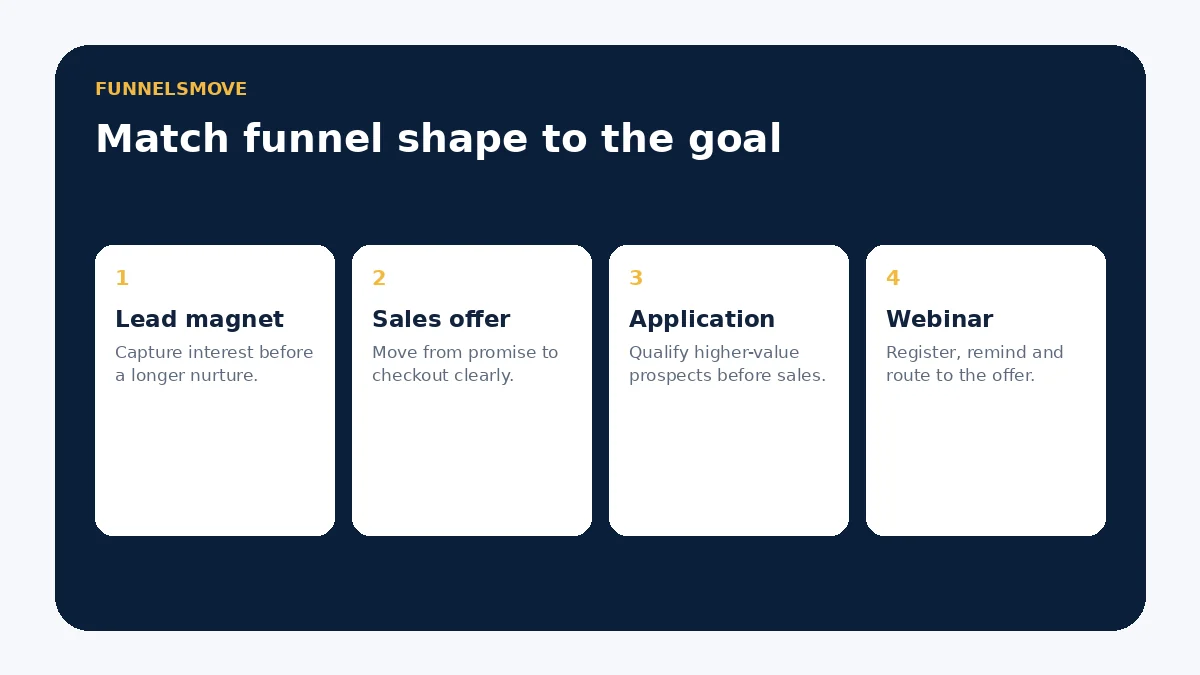
The four patterns below cover many small-business funnel needs. They are frameworks, not guaranteed conversion formulas. Traffic quality, offer strength, market fit, page clarity, trust and follow-up all affect results.
Example 1: lead-magnet funnel
Typical flow: traffic → opt-in page → thank-you page → nurture. The page offers a useful resource in exchange for contact information. The thank-you page delivers the promised next step and can introduce a related offer without making the original resource difficult to access.
Keep the form short unless qualification is essential. Explain what the subscriber will receive and how future marketing communication works. This pattern fits checklists, reports, templates, calculators and short training assets.
What to learn: one promise, one form and one obvious next step. Do not copy another company’s lead magnet simply because its funnel looks polished.
Example 2: direct sales funnel
Typical flow: sales page → checkout → optional upsell/down-sell → confirmation. This works when the visitor can understand and buy the offer without a salesperson.
The sales page should establish the problem, offer, evidence, terms and purchase decision clearly. Checkout should not introduce surprises about billing or delivery. Upsells should be genuinely complementary rather than obstacles between payment and confirmation.
What to learn: the sequence removes unnecessary navigation and keeps attention on the purchase path. The product still needs a supportable value proposition; funnel software cannot create demand by itself.
Example 3: application or consultation funnel
Typical flow: landing page → application/qualification → booking → confirmation and reminders. This pattern suits agencies, consultants, coaches and higher-value services where every visitor should not go straight to checkout.
Ask only questions that change routing or preparation. Explain who the service is for, what happens after applying and whether submission guarantees a call. If an appointment is the real conversion event, measure booked and attended calls separately from form submissions.
What to learn: qualification can improve operational fit, but a long form without a clear reason creates friction.
Example 4: webinar funnel
Typical flow: registration → confirmation → reminder sequence → webinar → offer/follow-up. Webinar funnels work when education or demonstration needs more time than a standard landing page provides.
Set expectations about live versus recorded delivery, schedule and replay access. Reminder messages should be useful and permission-aware. The transition from teaching to offer should make the commercial relationship clear.
What to learn: the funnel is not just the registration page. Attendance reminders, presentation, offer and post-event follow-up are all part of the journey. See our ClickFunnels webinar guide for implementation details.
Examples by business model
| Business | Useful funnel pattern | Primary action |
|---|---|---|
| Coach or consultant | Application / consultation | Qualified booking |
| Course creator | Lead magnet → nurture → course offer | Subscriber or purchase |
| Ecommerce / direct response | Sales → checkout → upsell | Purchase |
| Local service | Offer → lead form → appointment | Lead or booking |
| Real estate | Focused seller/buyer lead funnel | Qualified inquiry |
ClickFunnels examples vs templates
An example explains the strategy and flow. A template gives you reusable page or funnel structure. They overlap, but the search intent is different. If you need reusable layouts and how template systems work, use our ClickFunnels templates guide.
ClickFunnels Classic documentation says users can save pages as templates, and its Marketplace supports funnel-template distribution. It also warns that the original page used to create a template can act as the master template, so cloning before reuse can avoid unintended updates in Classic workflows.
What not to copy from another funnel
- Claims: another seller’s proof, statistics or testimonials do not become yours.
- Brand assets: logos, photography and proprietary creative may be protected.
- Pricing: match your actual offer and billing terms.
- Form fields: collect data because you need it, not because a template includes it.
- Page length: use the amount of explanation your buyer needs.
- Tracking: configure your own analytics and consent rather than copying scripts.
How to evaluate a ClickFunnels example
- Identify the audience and traffic source.
- State the page’s primary conversion action.
- Map every funnel step and ask why it exists.
- Check whether the offer is understandable without hidden context.
- Review friction in forms and checkout.
- Inspect mobile readability and page speed.
- Trace what happens after opt-in or purchase.
- Separate transferable structure from brand-specific creative.
Build your own example deliberately
ClickFunnels’ Classic Funnel Builder and Cookbook documentation describe choosing a goal, funnel type and template suggestion. Modern plan packaging has changed over time, so use the current interface available in your account rather than expecting an older tutorial to match every menu.
Start from the closest structural pattern, then remove anything that does not support the conversion goal. Test the funnel before sending paid traffic. Our funnel testing guide, landing-page guide and tracking guide cover the next steps.
Example 5: product-launch funnel
Typical flow: pre-launch content or waitlist → launch page → sales page → checkout → follow-up. This pattern is useful when the audience needs education or anticipation before an offer opens. The funnel should make dates, availability and terms clear rather than manufacturing false scarcity.
What to learn: launch sequencing coordinates attention over time. It does not require every business to use countdown timers or aggressive urgency. Use deadlines only when they are real.
Example 6: local-service funnel
Typical flow: local campaign → service-specific page → form or booking → confirmation → follow-up. The page should focus on one service and geographic area rather than reproducing the company’s entire website.
What to learn: a funnel can complement a broader site. The main site can handle navigation, trust and content while a campaign landing page handles one conversion action.
How examples connect to traffic sources
A funnel that works for branded email traffic may not be appropriate for cold paid traffic. Visitors arriving from a specific advertisement expect the page to continue the same promise. Search visitors may need more explanation and evidence. Existing subscribers may already understand the brand and need less introductory content.
When studying an example, ask where its visitor came from. Without that context, copying the page structure can produce the wrong amount of explanation, the wrong call to action or an offer that appears too early.
Examples for different price points
Lower-friction offers can often move directly from explanation to checkout. Higher-value services frequently need qualification, consultation or a longer education sequence. Price alone does not dictate funnel length, but the perceived risk and complexity of the decision matter.
Use funnel steps to answer real buyer questions. Do not add pages because a template contains them. Every additional step should perform a job such as qualification, payment, onboarding or presenting a genuinely relevant next offer.
Primary sources
- ClickFunnels Building Your First Funnel (opens in a new tab)
- ClickFunnels Funnel Cookbook (opens in a new tab)
- ClickFunnels page-template guide (opens in a new tab)
- ClickFunnels Marketplace seller profile (opens in a new tab)
Product details were checked on September 19, 2026. Treat examples as structural inspiration, not evidence that a funnel will produce the same result for another business.
Evaluate ClickFunnels for your workflow
Use the current plan details and test the complete journey that matters to your business before moving production traffic.
Explore ClickFunnels (opens in a new tab)