How to Drive Traffic to a ClickFunnels Funnel
A channel-neutral acquisition guide for sending the right prospects to the right funnel without assuming paid traffic is required.
See the parent guide for broader context around this topic.
How to market ClickFunnels: start with the offer, not the traffic source
Marketing a ClickFunnels funnel means attracting the right people to an offer and giving them a clear next step. The software can host landing pages, funnels, checkout, forms, tracking, and follow-up, but it does not create demand on its own. Start by defining who the offer is for, what problem it solves, what action you want the visitor to take, and why that action is worth taking now.
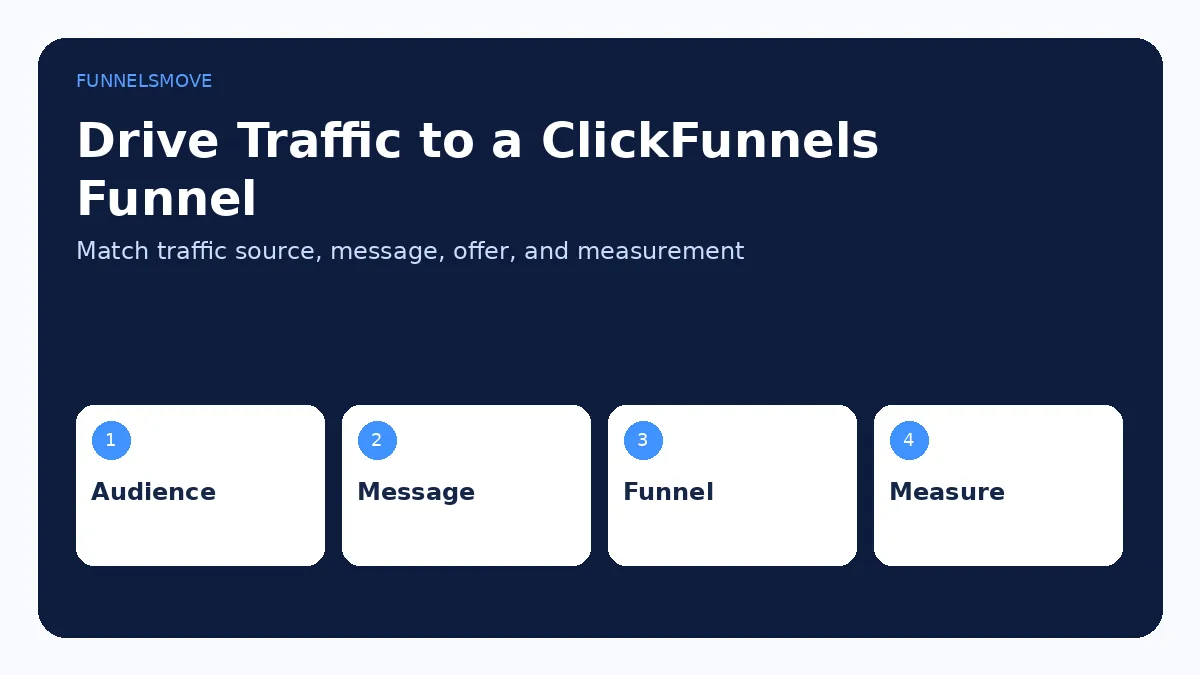
A useful acquisition plan connects four elements: audience, message, traffic source, and funnel experience. If the ad, social post, email, search result, or partner recommendation promises one thing while the landing page immediately talks about something else, more traffic usually magnifies the mismatch rather than fixing it.
Before buying traffic, make sure the funnel has a credible offer, a focused page, working forms or checkout, and measurement. The sales funnel for small business guide covers the broader funnel architecture.
Choose traffic sources based on intent and economics
There is no mandatory traffic source for ClickFunnels. Organic search, YouTube, social media, email, communities, partnerships, affiliates, referrals, webinars, podcast appearances, direct outreach, and paid advertising can all send visitors to a funnel. The useful question is which source gives you access to people with the right intent at a sustainable cost.
High-intent traffic may come from branded search, comparison searches, partner referrals, existing subscribers, or prospects already evaluating a solution. Lower-intent traffic may require more education before asking for a purchase. Match the funnel entry point to that awareness level: a cold audience may need a useful guide, lead magnet, webinar, or diagnostic before a sales offer, while a warm audience may be ready for a product page, booking page, or checkout.
Do not spread a small budget across every channel. Pick one or two sources you can operate consistently, define the conversion you expect, and learn from the resulting data before expanding.
How to use ClickFunnels with Facebook and Instagram ads
Meta ads can send traffic directly to a ClickFunnels landing page or funnel step. Build the landing page around the specific audience and promise in the ad rather than routing every campaign to a generic homepage. Keep the message, imagery, offer, and CTA consistent enough that the visitor immediately recognizes they reached the expected destination.
ClickFunnels’ current Site Settings documentation includes fields for Meta/Facebook Pixel, Conversions API access, and a Facebook Test Event Code. Those settings are measurement tools, not a substitute for campaign setup inside Meta Ads Manager. Configure tracking only after confirming your privacy, consent, and advertising obligations for the markets you serve.
Use a dedicated campaign URL when practical so you can distinguish paid social traffic from other sources. After launch, check both ad-platform reporting and the funnel’s downstream outcomes. A cheap click is not valuable if it produces no qualified leads, orders, or customer value.
Use search traffic when people actively want the answer
Search traffic is valuable when your audience already expresses a problem or buying intent through queries. The long-term approach is usually to create useful, indexable content that answers those queries and then route interested readers into a relevant funnel. This is different from expecting a short sales page to rank for every informational topic.
If organic search is central to acquisition, see the ClickFunnels SEO guide. It explains where ClickFunnels’ site and blog features can support search visibility and when a dedicated content-management system may be a better primary publishing environment.
Use email to bring warm prospects back to the funnel
An email list gives you a way to follow up after the first visit. Send useful, permission-based messages that move subscribers toward the next appropriate step rather than simply repeating the same sales link. A lead magnet funnel might be followed by onboarding, educational content, objection handling, and then an offer; a customer funnel might lead to activation, support, or a relevant next product.
Keep promotional consent and unsubscribe handling clear. The ClickFunnels email marketing guide covers broadcasts and workflows in more detail.
Partnerships, affiliates, and referral traffic
Partners can introduce a funnel to an audience that already trusts the source. Good partnership traffic comes from fit: the audience has a real reason to care about the offer, and the referring partner can explain that value honestly. Provide partners with approved positioning, destination URLs, and any disclosure requirements rather than encouraging exaggerated claims.
Track partner sources separately where possible. If one partner sends fewer visitors but a much higher proportion of qualified customers, raw traffic volume can be misleading. Protect the customer experience by making sure promotional promises match the actual offer.
Measure the whole acquisition path
At minimum, know the number of relevant visitors, leads or bookings, purchases where applicable, and revenue or customer value that can reasonably be attributed to the acquisition effort. ClickFunnels supports tracking integrations such as GA4 and Meta Pixel/CAPI, while ad platforms and payment tools provide additional views of performance.
Use the ClickFunnels tracking guide to set up measurement, then validate events with the funnel testing workflow. Avoid making decisions from one dashboard without checking whether events fire correctly and whether the business outcome actually occurred.
Set paid-traffic guardrails before spending
Paid traffic can accelerate learning, but it can also accelerate losses. Set a test budget you can afford, define the conversion event, and estimate the economics before launch. If the offer earns $100 per sale but fulfillment, refunds, processing, sales labor, and support consume most of that amount, the acceptable acquisition cost is much lower than the headline revenue suggests.
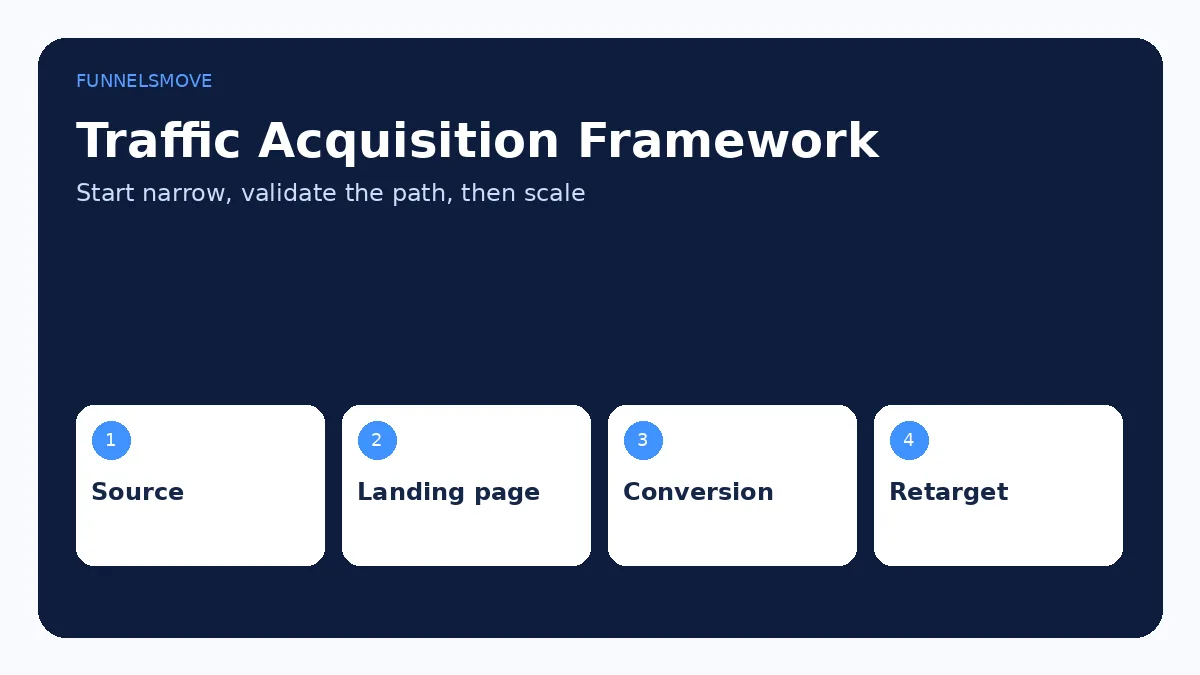
Start with a narrow audience and a small number of creatives or messages so you can understand what changed. Pause or revise campaigns when the data shows a structural mismatch. Increasing spend is not a fix for a weak offer or broken funnel.
Retarget thoughtfully rather than chasing every visitor
Retargeting can remind interested visitors about an offer, but it should respect privacy choices and advertising rules. Segment where possible: someone who read an article may need a different message from someone who began checkout. Exclude customers from acquisition campaigns when the offer is no longer relevant to them.
Use frequency and creative variety sensibly. Repeatedly showing the same ad to a small audience can create fatigue without improving conversion.
A practical traffic-to-funnel launch checklist
Confirm the audience, offer, landing-page message, CTA, mobile experience, forms or checkout, privacy links, analytics, ad pixels where applicable, thank-you experience, follow-up workflow, and attribution labels. Test the full path before promotion. Then launch one channel with a clear learning goal and review downstream outcomes—not just clicks.
The goal is not “more traffic” in isolation. It is a repeatable acquisition path that brings appropriate prospects into a funnel, measures what happens, and gives you enough evidence to decide what to improve next.
Match the landing page to traffic temperature
Cold traffic usually needs more context than an existing customer or subscriber. If a person has never heard of the business, the first page may need to establish the problem, audience, credibility, and value before asking for a high-commitment action. Warm traffic can often move faster because some of that trust and context already exists.
That does not mean cold traffic always needs a long page. It means the page must answer the questions required for the decision. A simple local-service booking funnel may only need a focused promise, proof, location information, and a clear appointment CTA. A complex B2B service may need a stronger explanation, qualification step, or case-study path before a sales call.
Test acquisition messages without changing everything at once
When a campaign underperforms, separate the traffic problem from the funnel problem. Test a small number of meaningful variables: audience, offer framing, creative hook, landing-page headline, lead magnet, or CTA. If you change the audience, ad, page, pricing, and follow-up simultaneously, you may improve the result but learn very little about why.
Keep notes on the hypothesis, date, traffic source, page version, and primary conversion event. That lightweight discipline matters when several campaigns point to similar funnels. It also helps prevent teams from re-running ideas that already failed for a clear reason.
Optimize for traffic quality, not just volume
Two sources can send the same number of visitors and produce very different business outcomes. One may generate cheap opt-ins that rarely open emails, book calls, or buy. Another may send fewer visitors but produce customers with stronger retention and lower support needs. Evaluate source quality at the deepest reliable point in your customer journey.
For lead-generation funnels, consider qualified lead rate and booked-call show rate. For commerce, consider contribution margin, refund rate, repeat purchase, and customer support burden. The best acquisition channel is the one that fits the economics and customer experience, not necessarily the one with the lowest cost per click.
Use a review cadence that matches the channel
Paid campaigns may need frequent checks for spend, broken links, disapproved ads, tracking failures, and sudden cost changes. Organic channels usually need a longer observation window because content discovery and search visibility develop more slowly. Set the review rhythm before launch so you do not overreact to normal short-term variation.
At each review, separate technical failures from market feedback. Fix broken tracking or checkout immediately; treat weak message-market fit as a hypothesis to test rather than a reason to randomly redesign the entire funnel.
Keep one source of truth for campaign URLs, tracking parameters, funnel versions, and conversion definitions. Consistent naming makes channel comparisons more reliable and reduces debugging when several people manage acquisition.
Evaluate ClickFunnels for your workflow
Check the current ClickFunnels offer, features, and limits against the funnel system you actually need.
Visit the ClickFunnels signup page (opens in a new tab)Primary product sources
ClickFunnels interface and capability details were checked against current first-party documentation on September 10, 2026. Commercial terms and interface labels can change, so verify critical settings in your own account.