ClickFunnels vs Shopify: Which Fits Better?
Choose ClickFunnels when campaign-led funnels and offer sequencing are central; choose Shopify when a durable ecommerce catalog, inventory and fulfillment operation is the core business.
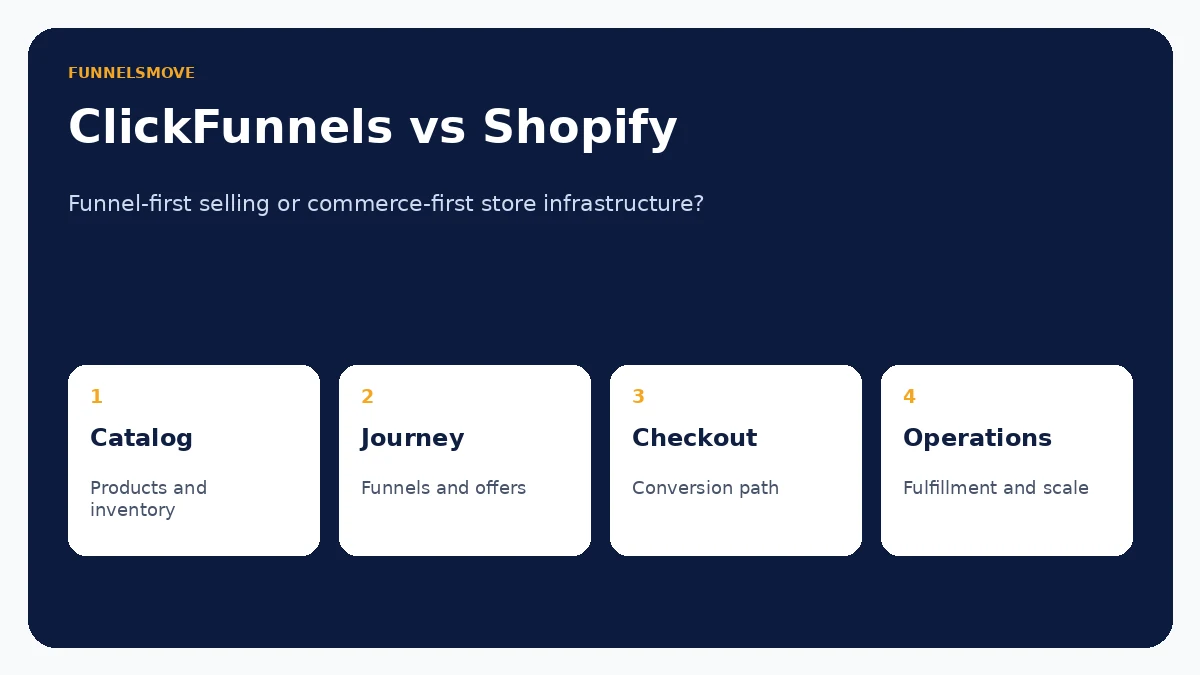
Start with our ClickFunnels platform guide, ClickFunnels review and ClickFunnels alternatives if you need broader context.
ClickFunnels vs Shopify: the short answer
ClickFunnels is usually the better fit for businesses organized around campaigns, offers and sequenced conversion funnels. Shopify is usually the better fit for businesses organized around a product catalog, inventory, shipping, merchandising and multichannel commerce. Both can sell online, but the operational center is different.
If you sell a small number of high-margin offers, courses, services or campaign-driven products, ClickFunnels can keep the journey from landing page through checkout and follow-up in one funnel-oriented system. If shoppers need to browse many SKUs, variants and collections—and your team must manage inventory, shipping, returns and storefront merchandising—Shopify is the more natural commerce foundation.
The core difference: funnel system vs commerce platform
ClickFunnels is built around directing a visitor through a deliberate sequence: opt-in, sales page, checkout, upsell, confirmation and follow-up. Shopify is built around a persistent online store where customers can discover products, browse collections, manage carts and complete commerce transactions across a larger catalog.
This difference matters more than individual feature overlap. A funnel business asks, “What is the next action for this visitor?” A store business asks, “How do customers discover, purchase and receive products across the catalog?” Start there before comparing page editors.
Products, inventory and fulfillment
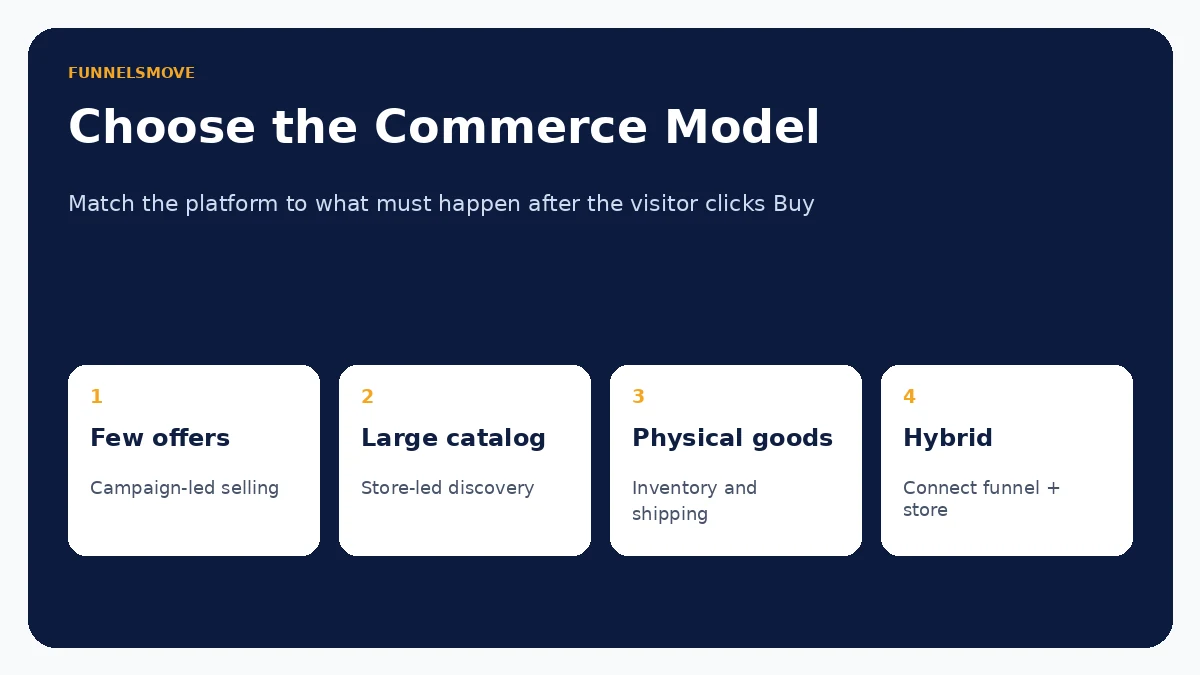
Shopify’s current Basic plan includes a full online store, unlimited products, inventory management, themes, SSL, reports and international commerce capabilities. Higher tiers add staff and more advanced commerce controls. For physical products, Shopify’s mature inventory and fulfillment ecosystem is a major advantage.
ClickFunnels supports products, stores and checkout flows, but its strongest use case remains selling through structured offers. FunnelsMove already has a separate ClickFunnels Shopify integration guide for businesses that want funnel-led acquisition while Shopify handles fulfillment. That hybrid model can be sensible when neither platform alone matches the entire operation.
Funnels, landing pages and conversion paths
ClickFunnels has the clearer advantage when the sales process needs multiple purpose-built steps, upsells and a controlled sequence. Its pricing currently includes unlimited landing pages and site pages, and the product is explicitly organized around funnels and workspaces.
Shopify can create campaign landing experiences through themes, apps and custom development, but its native mental model remains a store. If your team spends most of its time launching one-off offers rather than merchandising a catalog, funnel-native tooling can reduce the amount of assembly required.
Checkout, upsells and average order value
Both platforms care deeply about checkout. Shopify provides its commerce checkout across plans, with deeper customization on Plus. ClickFunnels places checkout inside the funnel sequence, making order bumps and post-purchase offer logic part of the campaign design.
Do not choose based on vendor conversion claims. Your conversion rate depends on traffic quality, offer, price, page speed, trust and checkout friction. Build the same representative offer and measure completion, average order value and support burden.
Email, follow-up and customer lifecycle
ClickFunnels bundles email capacity and funnel follow-up into its broader platform tiers. Shopify includes customer segmentation and email campaign capabilities and connects to a very large app ecosystem. The operational question is whether marketing automation should live beside the funnel or beside the store.
For a creator with a few core offers, ClickFunnels can reduce tool switching. For an ecommerce team with merchandising, retention, inventory and channel-specific apps, Shopify’s commerce ecosystem can be more valuable than having every marketing function under one vendor.
Pricing and total operating cost
ClickFunnels currently sells Launch at $97/month, Scale at $197/month and Optimize at $297/month, with annual billing discounts; Dominate is an annual-only $5,997 plan. The current pricing page lists unlimited funnels as a limited-time inclusion across the plans, while workspaces, team members, contacts, email volume, courses and domains scale by tier. Scale and above list the custom code editor plus webhooks/full API access.
Shopify’s U.S. pricing currently lists Basic at $39/month monthly or $29/month billed yearly, Grow at $105/$79, and Advanced at $399/$299; Shopify Plus starts at $2,300/month. Payment rates and third-party transaction fees vary by plan and payment setup.
The subscription comparison is therefore incomplete. Model payment processing, apps, email, fulfillment tools, funnel software, staff access and development. Shopify can start cheaper as a store, while a heavily extended app stack can add cost. ClickFunnels starts higher than Shopify Basic but bundles more funnel-oriented functionality.
What about dropshipping?
For classic dropshipping with a broad catalog, supplier apps, inventory synchronization and order fulfillment, Shopify is usually the more natural base. ClickFunnels can be useful for a focused “hero product” campaign where paid traffic goes to a controlled offer and upsell path.
If you combine them, define which system owns product data, orders, customer records and fulfillment. Duplicate sources of truth create more operational problems than they solve.
Who should choose each platform?
| Situation | Better starting point |
|---|---|
| Large or growing physical-product catalog | Shopify |
| Campaign-led sales funnels and offer sequencing | ClickFunnels |
| Inventory, shipping and multichannel retail | Shopify |
| Courses, services or a few high-value offers | ClickFunnels |
| Store operations plus funnel acquisition | Potentially both, with clear system ownership |
Neither platform is universally better. Choose the operating model you expect to maintain for years, not the page-builder demo that looks easiest on day one.
Migration and system-of-record questions
Migration is more than moving page copy. If you are moving from Shopify toward ClickFunnels, inventory, historical orders, customer accounts, fulfillment rules, discounts, tax settings and app-dependent processes need explicit destinations. A business with years of store history should be cautious about replacing the commerce system merely to gain a different page-building workflow.
Moving the other direction has a different challenge: funnel logic may be spread across pages, products, automations and follow-up. Document every entry point, upsell, conditional path and post-purchase action before rebuilding it as a store-led experience. Preserve URLs where search traffic matters and decide whether old funnel pages should redirect, remain live or become campaign-specific assets.
For a hybrid stack, assign one source of truth for products and orders. The existing ClickFunnels Shopify integration guide explains the setup intent separately from this buyer comparison. The important architectural rule is to avoid maintaining competing product or fulfillment records unless there is a deliberate synchronization process.
Operational workload after launch
Shopify’s advantage becomes clearer as commerce operations grow. Product variants, inventory locations, shipping, returns, staff access and international selling are recurring operational jobs, not one-time setup tasks. Shopify’s plan structure and ecosystem are designed around those jobs.
ClickFunnels reduces friction in a different area: repeatedly creating and optimizing campaign journeys. A business launching webinars, challenges, lead magnets and direct-response offers may spend more time changing funnels than managing inventory. In that environment, funnel reuse and connected follow-up can matter more than catalog depth.
Ask which team will live in the platform every day. If operations and merchandising own it, Shopify usually has the stronger center of gravity. If growth marketers and offer owners own it, ClickFunnels may better match the work.
How to compare conversion performance fairly
Do not compare vendor-reported conversion statistics as though they predict your result. Run a controlled evaluation with the same product, traffic source, price and core message. Track landing-page conversion, checkout completion, average order value, refund/support burden and the time required to maintain the flow.
For Shopify, include product discovery and repeat shopping if those are important to the business. For ClickFunnels, include upsell acceptance and follow-up performance. A single-page conversion rate can make one system look better while hiding a weaker total revenue journey.
Try ClickFunnels against your real workflow
Use a real offer, page flow and checkout during your evaluation. The right platform is the one that removes operational friction after the first conversion—not simply the one with the longest feature list.
Visit ClickFunnels (opens in a new tab)Buyer scenarios: where each platform makes sense
Creator with three digital offers: ClickFunnels is likely the simpler starting point if acquisition is driven by launches, webinars or paid funnels and there is little inventory complexity. Direct-to-consumer brand with 200 SKUs: Shopify is usually the stronger operational base because catalog, inventory, shipping and merchandising are daily work. Hero-product ecommerce brand: a hybrid can be rational—use a focused funnel for acquisition while the commerce system remains responsible for durable order and fulfillment operations.
Local service business adding a small product line: do not overbuild a store if products are secondary to appointments or lead generation. Retailer expanding internationally: Shopify’s commerce and market-management capabilities deserve priority. These scenarios are not rules; they show why “which converts better?” is too narrow. The platform must fit the business model after the conversion as well.
Before you decide: commerce architecture checklist
Write down the number of active SKUs, variants and inventory locations you expect in the next two years. Then document whether customers need collection browsing, search, accounts, returns, shipping choices, international pricing or in-person retail. Those requirements push the decision toward commerce infrastructure rather than campaign tooling.
Next, count how many sales motions are campaign-led. If most revenue comes from paid traffic into a handful of hero offers, webinars or launches, model the exact funnel steps and upsells. If most revenue comes from shoppers exploring a catalog, model discovery and repeat purchase instead.
Finally, list every system that must remain: accounting, fulfillment, email, support, analytics and warehouse tools. Estimate migration effort and recurring integration maintenance. A hybrid ClickFunnels-plus-Shopify architecture is justified only when each system has a clear responsibility and the extra integration produces more value than operational complexity.
Frequently asked questions
Can ClickFunnels replace Shopify?
For a small catalog sold mainly through campaign funnels, it may replace enough of the selling stack. For businesses dependent on deep inventory, merchandising, shipping, retail or multichannel commerce, Shopify remains the more purpose-built foundation. Map operational requirements before replacing a mature store.
Can Shopify replace ClickFunnels?
Shopify can build a full store and campaign pages, and apps can extend funnel behavior. The question is whether recreating ClickFunnels-style offer sequences, upsells and follow-up through Shopify plus apps is simpler than keeping a dedicated funnel system.
Should I use ClickFunnels and Shopify together?
A hybrid can make sense when ClickFunnels owns campaign acquisition and Shopify owns fulfillment or store operations. Define the source of truth for products, orders and customer data, and test the integration before sending production traffic.
Which is better for digital products?
Both can sell digital offers. ClickFunnels often fits businesses built around a few campaign-led offers; Shopify can fit a larger mixed catalog. Delivery, tax, customer access and post-purchase automation should be part of the decision.
Which is better for SEO?
Shopify has a mature store and blogging architecture for ecommerce discovery, while ClickFunnels can publish site and landing pages. For serious content SEO, compare editorial workflow, URL control, internal linking and long-term publishing needs rather than relying on a generic SEO label.
Sources checked
Time-sensitive product facts and pricing were reviewed on September 15, 2026.