ClickFunnels Ecommerce: Stores, Carts, Checkout and Funnel Fit
ClickFunnels can now support a conventional multi-product store as well as funnel-led ecommerce. The right fit depends on catalog complexity, fulfillment and how much of the buying journey you want to organize around funnels.
Can ClickFunnels run an ecommerce store?
Yes. Current ClickFunnels includes a Store app and Store Funnels for physical-product selling, with product pages, collections, variants, carts, checkout and upsell paths. This is broader than the older ClickFunnels model that many merchants associate mainly with one-product order-form funnels.
That does not make it the best store platform for every merchant. Large catalogs, complex inventory, marketplace selling, international tax requirements, specialized fulfillment or a mature ecommerce ecosystem may justify a dedicated commerce platform.
Storefront versus funnel-led ecommerce
A storefront helps shoppers browse multiple products and collections. A funnel is more controlled: traffic arrives for a specific product or offer and moves through a deliberate sales path. ClickFunnels can now support both patterns and connect store purchases to funnel-style upsells.
Choose the pattern based on buyer behavior. A fashion catalog with many sizes and categories benefits from browsing. A campaign for one flagship product may benefit from a focused product page, checkout and post-purchase offer.
A practical ClickFunnels ecommerce model
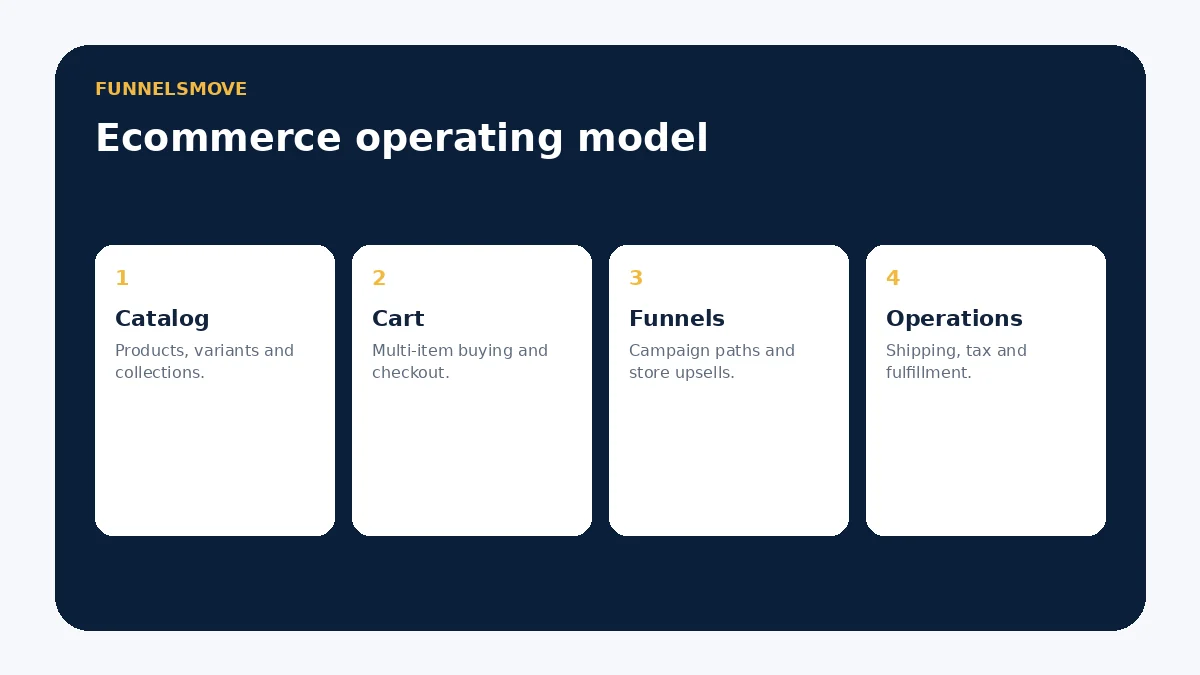
A workable model has four layers: product/catalog setup, cart and checkout, campaign funnels, and operations. ClickFunnels’ current Store app supports products and collections; Add to Cart lets shoppers put multiple items into one cart; Store Upsells can route buyers into additional offers based on purchases.
Operations still matter. Shipping, tax, payment processing, returns, customer support and inventory ownership must be configured and tested. Do not judge ecommerce software only by the product-page editor.
Products, variants and collections
Current Store Funnels documentation describes grouping products into collections and supporting variants such as sizes, colors and styles. ClickFunnels also promotes Global Products, which lets a product be created once and sold across funnels.
Before migrating a catalog, inventory SKUs, variants, images, prices, subscription rules, tax status and fulfillment mappings. A small catalog can be rebuilt manually; a large or highly structured catalog needs a migration plan and careful validation.
Cart and checkout
ClickFunnels’ Add to Cart feature lets shoppers add multiple products and check out together. The cart can be placed across store pages, while Smart Checkout is designed to reduce repeat data entry for recognized returning customers.
Test guest and returning-customer paths, mobile checkout, failed payments, coupons, taxes, shipping and confirmation. A smoother checkout does not remove the need for accurate product, payment and fulfillment configuration.
Upsells and funnel paths
Funnel-led selling is where ClickFunnels remains distinctive. A merchant can build campaign pages around a product and use upsells or related offers after the initial decision. Current Store Upsells can connect cart behavior to funnel-based offers.
Use upsells because they are relevant, not because the software supports them. Keep billing terms clear and ensure buyers can reach confirmation without confusing loops. Measure revenue and refund behavior as well as immediate order value.
Physical products and fulfillment
Current ClickFunnels Store Funnels marketing describes shipping rates, tax calculation and shipping-label capabilities. Older Classic workflows can also connect Shopify so order data is sent to Shopify for fulfillment after a ClickFunnels sale.
If fulfillment already works reliably in Shopify or another system, replacing it may add risk without enough benefit. A hybrid model can keep the established inventory/fulfillment platform while ClickFunnels handles campaign-specific funnels. See our ClickFunnels and Shopify guide.
Digital products and subscriptions
ClickFunnels can also sell digital products, courses and recurring offers. The implementation questions differ from physical commerce: what grants access, what happens after failed renewal, how refunds affect entitlement, and which system owns the customer record.
For checkout-specific setup, see ClickFunnels products and checkout. Test the actual payment provider and billing model you plan to use.
SEO and content considerations
A store is not automatically a content strategy. Merchants that depend on large editorial catalogs, sophisticated faceted navigation or extensive organic-search publishing should evaluate whether ClickFunnels’ site/store architecture matches those requirements.
A hybrid architecture can keep an established content site while using ClickFunnels for campaign landing pages and offer funnels. Preserve canonical URLs and redirects deliberately if any indexed product or category URLs move.
When ClickFunnels ecommerce fits
| Situation | Fit | Reason |
|---|---|---|
| Small catalog + direct-response campaigns | Strong | Store and funnel paths can live together |
| Single flagship product | Strong | Focused funnel and upsell journey |
| Large complex catalog | Evaluate carefully | Dedicated commerce ecosystems may offer deeper operations |
| Existing Shopify fulfillment | Hybrid may fit | Keep mature operations and add funnels selectively |
| Content-heavy SEO publisher + store | Hybrid may fit | Separate publishing and conversion jobs |
Ecommerce implementation checklist
- Inventory products, SKUs, variants and collections.
- Confirm payment processors, currencies and billing models.
- Configure shipping, tax and fulfillment.
- Build cart, checkout and confirmation.
- Add only relevant upsell paths.
- Test successful, failed, refunded and recurring transactions.
- Verify analytics and traffic-source attribution.
- Test mobile browsing and checkout.
- Preserve existing indexed URLs if migrating.
Related: ClickFunnels vs Shopify, Shopify integration and ThriveCart vs ClickFunnels.
ClickFunnels ecommerce versus a dedicated store platform
A dedicated commerce platform can be preferable when the catalog and operations are the business: thousands of SKUs, advanced inventory, point-of-sale, marketplace feeds, international localization or a large app ecosystem. ClickFunnels can be preferable when the merchant’s advantage is campaign-led selling and tightly controlled offer journeys.
This distinction is why the existing ClickFunnels vs Shopify comparison serves a different intent from this guide. That comparison helps choose between two platforms; this page explains how to operate ecommerce inside ClickFunnels and where its boundaries matter.
Tracking ecommerce performance
Measure more than checkout conversion. Useful metrics can include product-page views, add-to-cart rate, checkout starts, completed purchases, average order value, refund rate and repeat purchase behavior. Funnel campaigns should also preserve source and campaign data so product performance is not confused with traffic quality.
Define events before launch and test them with real browser flows. If analytics, ad platforms and the payment system report different totals, document which system owns each metric rather than silently mixing them.
Returns, support and customer experience
The buying journey continues after payment. Publish clear shipping, return and support expectations appropriate to the product. Make order confirmation useful, keep customer contact data accurate and define who handles delivery problems.
For physical goods, test the path from checkout to fulfillment and tracking. For digital goods, test access and revocation. Ecommerce software can automate parts of this process, but operational ownership remains with the merchant.
Primary sources
- ClickFunnels Store Funnels (opens in a new tab)
- ClickFunnels Add to Cart (opens in a new tab)
- ClickFunnels Global Products (opens in a new tab)
- ClickFunnels Shopify integration (opens in a new tab)
Product details were checked September 19, 2026. Ecommerce tax, shipping and payment requirements vary by business and jurisdiction.
Evaluate ClickFunnels for your workflow
Test the actual workflow, plan limits and integrations your business needs before moving production traffic.
Explore ClickFunnels (opens in a new tab)