What to Sell With ClickFunnels to Make Money
A practical offer-selection guide focused on customer value, workable economics, and sustainable acquisition—not income promises.
See the parent guide for broader context around this topic.
Can you really make money with ClickFunnels?
ClickFunnels can be used to sell products and services, but the software itself does not generate income. Revenue comes from having something people value, reaching the right audience, converting enough prospects, and delivering the offer at a cost that leaves acceptable margin. There is no responsible way to promise that using ClickFunnels will make a particular business profitable.
The platform can support the sales infrastructure: landing pages, checkout, products, subscriptions, courses, email workflows, and related funnel steps. Whether that produces profit depends on the offer, pricing, traffic cost, fulfillment, refunds, support, taxes, processing fees, and customer retention.
Use this guide to choose a viable offer category and think through funnel economics before you build.
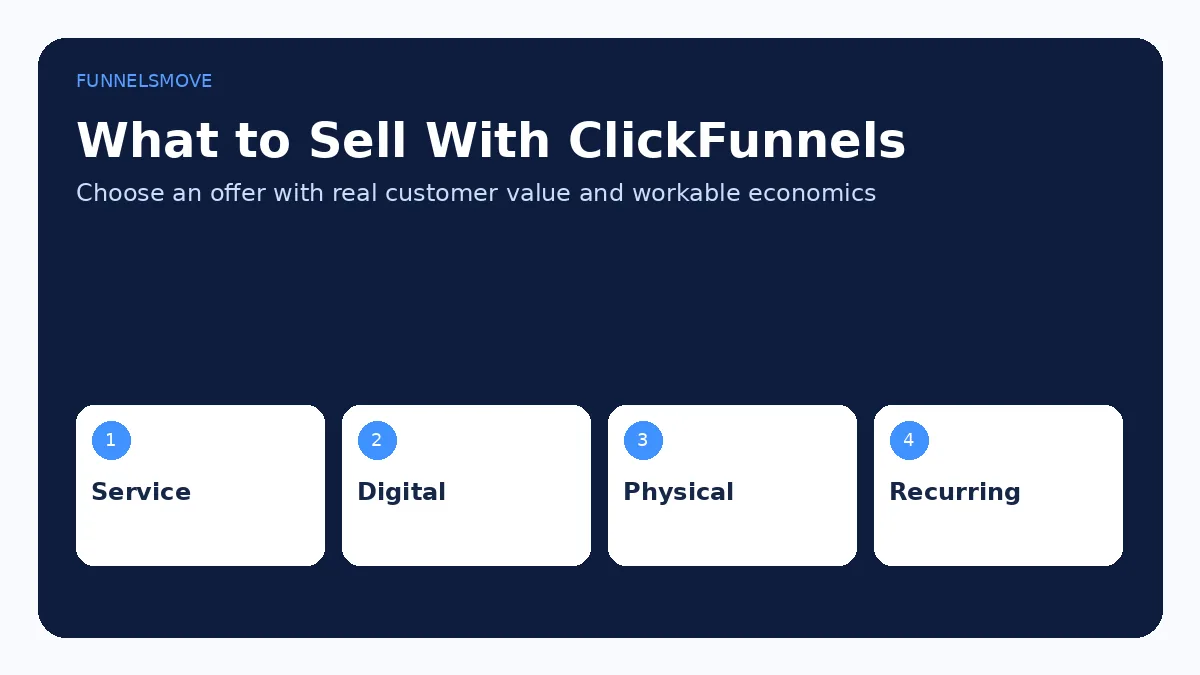
Sell services, consulting, coaching, or appointments
Services are often a practical starting point because you can validate demand before building a large product catalog. Consultants, coaches, agencies, freelancers, and specialists can use funnels to explain a problem, qualify prospects, collect applications, book calls, sell a fixed-scope service, or take payment for a workshop or session.
The funnel should reduce uncertainty: who the service is for, what is included, what outcome is being pursued, what it costs, and what happens after the prospect submits or pays. Avoid vague transformation promises. Specific scope and credible proof are usually more useful than hype.
For small businesses, connect the offer to the broader process in the sales funnel for small business guide.
Sell digital products and education
Digital products can include templates, guides, resource packs, paid newsletters, workshops, memberships, and courses. ClickFunnels’ current product system supports digital products and can connect purchases to delivery flows. Courses can also be created inside the platform when structured learning is part of the offer.
A digital product still needs meaningful value. “Easy to make” is not the same as “worth buying.” Start with a concrete customer problem, decide what format solves it efficiently, and validate willingness to pay before investing heavily in production.
If the core offer is a course, see how to create a course in ClickFunnels and the broader course-creator fit guide.
Sell physical products through funnels
ClickFunnels supports physical products as well as digital ones. A funnel can highlight a hero product, bundle, limited collection, or promotional offer and then move the buyer through checkout, order bumps, upsells, confirmation, and follow-up. Physical commerce adds operational costs that digital sellers do not have: inventory, shipping, returns, damaged goods, customer service, and potentially fulfillment software.
Model those costs before setting the price. A funnel that generates strong gross sales can still lose money if discounts, shipping subsidies, advertising, refunds, and fulfillment consume the margin.
Subscriptions, memberships, and recurring offers
Recurring revenue can improve predictability, but only when customers keep receiving enough value to remain subscribed. ClickFunnels’ product pricing supports one-time, subscription, and payment-plan structures. A recurring offer might be software access, membership content, coaching, a community, recurring services, or replenishable products.
Think beyond the first payment. Track activation, engagement, support load, churn, refunds, failed payments, and the cost of continually delivering value. A subscription with poor retention can be less attractive than a one-time offer with strong margins.
Affiliate marketing as a different business model
You can also use funnels to promote third-party products as an affiliate, provided the merchant permits your promotional method and you follow disclosure, advertising, email, and platform rules. In that model, you do not control the product, price, checkout, or customer experience to the same degree, so choose partners carefully.
For implementation considerations, see ClickFunnels for affiliate marketing. Do not build an income forecast around commission screenshots or exceptional anecdotes; use the actual program terms and your own validated traffic economics.
How to find products to sell on ClickFunnels
Start with the customer, not the funnel template. Look for problems you understand, audiences you can reach, and offers you can deliver reliably. Useful validation signals include repeated customer questions, existing spending in the category, preorders, paid pilots, discovery calls, waitlists, or small tests where real people exchange money for the proposed value.
For physical products, confirm supply, quality, shipping, returns, and unit economics. For digital products, validate the outcome and delivery format. For services, confirm that the scope can be fulfilled profitably at the promised quality. Avoid sourcing products solely because they appear easy to advertise.
Calculate funnel economics before chasing revenue
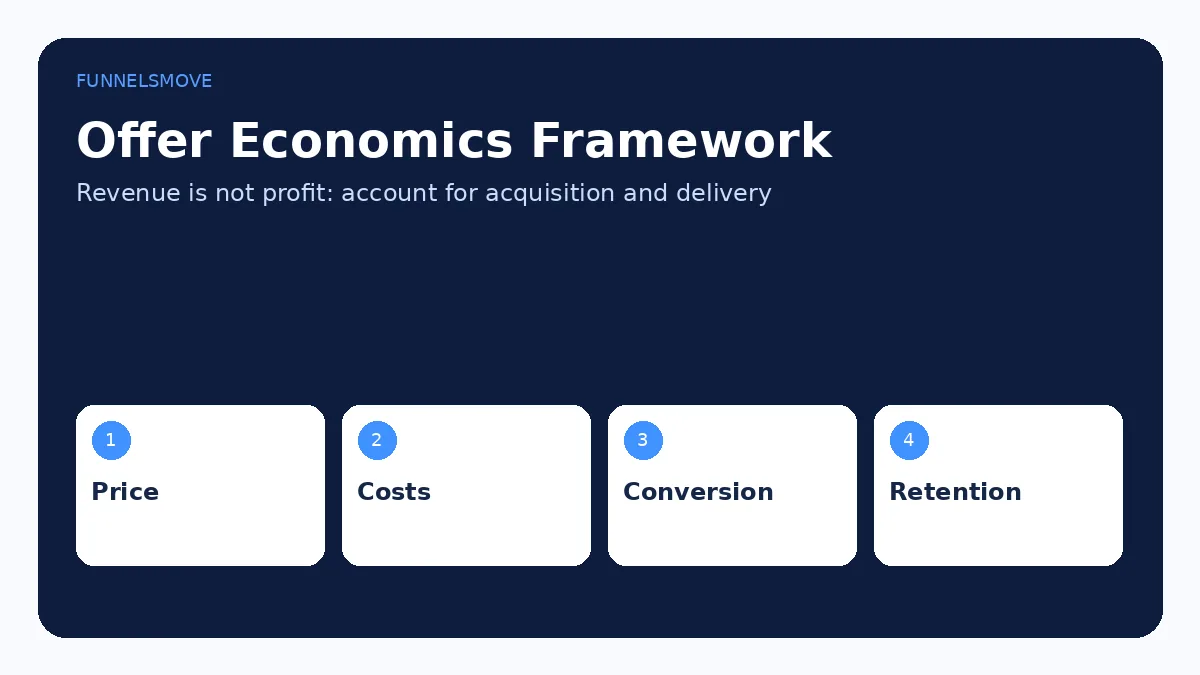
A basic model starts with selling price minus product or fulfillment cost, processing fees, refunds, variable support, and other per-customer expenses. That gives you contribution margin before acquisition. Your sustainable customer acquisition cost must fit inside the remaining economics while leaving room for overhead and profit.
Then consider conversion rate and average order value. ClickFunnels supports order bumps, multiple products, subscriptions, and other checkout structures, but adding more offers is not automatically better. Each extra step should make sense for the buyer and be tested for its effect on the complete customer journey.
The ClickFunnels products and checkout guide covers the implementation layer.
Build one clear offer before adding complexity
A focused offer is easier to explain, test, and improve. Define the target customer, primary problem, promised deliverable, price, guarantee or refund terms if applicable, fulfillment method, and next step. Then build the simplest funnel that can sell or validate it.
Do not add an order bump, upsell, webinar, survey, quiz, subscription, and long automation sequence simply because the platform supports them. Complexity is useful only when it solves a customer or operational problem.
Revenue needs a customer-acquisition plan
An offer with no distribution is not a business model. Decide how qualified prospects will reach the funnel: existing audience, referrals, partnerships, content, search, email, social media, direct outreach, affiliates, or paid traffic. Estimate what each source costs in money and time.
See how to drive traffic to a ClickFunnels funnel for channel selection, paid-social handoff, tracking, and testing.
Match funnel type to the offer
A consultant may use content or outreach → application → booking. A course creator may use educational content → opt-in or webinar → sales page → checkout → enrollment. A physical-product seller may use ad or creator traffic → product page → checkout → post-purchase offer. A membership may use lead generation → nurture → recurring offer → onboarding.
These are frameworks, not guaranteed formulas. Choose the shortest path that gives the customer enough information and confidence to make the next decision.
Avoid common 'make money with ClickFunnels' traps
Be skeptical of income promises, copied offers, fake urgency, misleading testimonials, and economics that ignore refunds or ad costs. Do not present someone else’s exceptional result as a normal outcome. Do not buy traffic until the funnel works technically and the offer has at least some evidence of demand.
Also separate revenue from profit. A funnel can show strong sales while the underlying business loses money. Keep accounting, fulfillment, tax, legal, and customer-support obligations outside the dashboard in your decision-making.
A practical offer-selection checklist
Choose a customer you can identify, a problem worth solving, an offer you can deliver, a price with workable margin, a reliable acquisition path, and a funnel that matches the buying decision. Test with real prospects, measure the full economics, and improve based on evidence.
If ClickFunnels is only one possible tool in the stack, review the ClickFunnels review before committing. The best offer is not the one that uses the most funnel features; it is the one that creates legitimate customer value and can be delivered sustainably.
Validate demand before building the full funnel
Before spending weeks on pages and automation, run the smallest credible demand test. For a service, that may be direct conversations or a paid pilot. For a course, it may be a live workshop or presale to a clearly defined audience. For a digital product, it may be a prototype, sample, or limited first version. For a physical product, it may be a small inventory run or preorder only when you can responsibly fulfill it.
Validation should test whether the proposed customer will exchange something meaningful—money, time, a booked conversation, or a strong commitment—for the promised value. Likes and compliments can be useful signals, but they are weaker evidence than behavior tied to the actual buying decision.
Set pricing around value, cost, and positioning
Pricing has to support the customer promise and the delivery model. A low price can make paid acquisition impossible when transaction fees, support, and fulfillment consume the margin. A high price can require more trust, proof, qualification, or sales interaction. There is no universal “best ClickFunnels price point.”
For services, estimate the real delivery hours and capacity. For physical products, include landed cost, packaging, shipping, returns, and damage. For digital products, include creator time, software, support, updates, and payment costs. For subscriptions, model churn and ongoing delivery rather than assuming every customer stays indefinitely.
Increase customer value ethically
Order bumps, upsells, bundles, subscriptions, and follow-on services can increase average customer value when they solve an adjacent need. They become counterproductive when they create confusion, pressure buyers into irrelevant additions, or make the original offer feel incomplete.
A useful upsell should answer a natural next question: faster implementation, additional support, more capacity, a complementary product, or a deeper level of training. Measure not only take rate but also refunds, support load, satisfaction, and retention. Short-term revenue is not automatically a better business outcome.
Choose an offer that fits your actual capabilities
A profitable idea can still be a poor choice if you cannot deliver it consistently. Consider expertise, available time, supplier reliability, support capacity, cash flow, refund exposure, and legal or compliance requirements. A simpler offer you can fulfill well is often a stronger starting point than a complex offer that depends on systems you do not yet have.
Use ClickFunnels to support the business model you can operate—not to disguise an untested one.
Evaluate ClickFunnels for your workflow
Check the current ClickFunnels offer, features, and limits against the funnel system you actually need.
Visit the ClickFunnels signup page (opens in a new tab)Primary product sources
- How to Create and Manage Products (opens in a new tab)
- Adding a Checkout Page in a Funnel (opens in a new tab)
- Setting Up Payments in ClickFunnels (opens in a new tab)
ClickFunnels interface and capability details were checked against current first-party documentation on September 10, 2026. Commercial terms and interface labels can change, so verify critical settings in your own account.