Kajabi vs ClickFunnels: Which Fits Better?
A decision-focused comparison for creators and online businesses choosing between a product-delivery-first platform and a funnel-first platform.
See the parent guide for broader context around this topic.
Kajabi vs ClickFunnels: the short answer
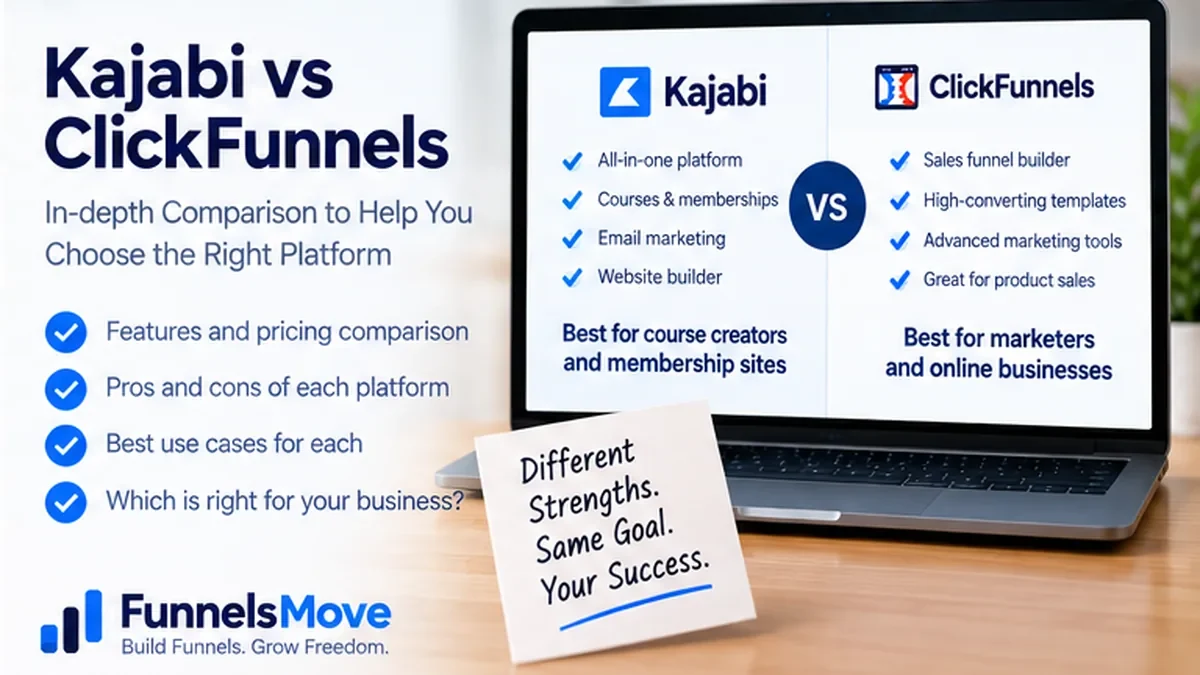
Kajabi is usually the more natural fit when the core business revolves around creating and delivering courses, memberships, communities or other knowledge products in one creator-focused system. ClickFunnels is usually the more natural fit when the priority is flexible funnel architecture, conversion campaigns, offer flows and multi-step sales journeys.
There is significant overlap. Both platforms now support landing pages, funnels, email/automation, products and online business infrastructure. That means this comparison is less about whether a feature exists and more about which product model feels native to the business you are building.
A course creator who spends most of the week inside curriculum, member experience and community may value Kajabi’s integrated delivery model. A marketer running many funnels, launches, tests and varied conversion paths may prefer ClickFunnels’ funnel-first workflow. Neither choice guarantees better revenue or conversion.
Kajabi vs ClickFunnels at a glance
| Decision area | Kajabi | ClickFunnels |
|---|---|---|
| Primary orientation | Knowledge products, courses, memberships, community and expert businesses | Funnels, conversion flows, landing pages, checkout and campaign systems |
| Courses | Core product experience with structured learning and member delivery | Built-in courses and communities, with limits varying by plan |
| Funnels | Built-in funnels connected to Kajabi products, email and checkout | Core workflow with flexible multi-step funnel building |
| Built-in broadcasts, sequences and automations | Built-in email contacts, sending and workflows | |
| Website | Integrated website and landing-page builder | Site pages, blog, landing pages, funnels and theme pages |
| Best fit | Creators prioritizing product delivery and member experience | Businesses prioritizing funnel experimentation and conversion architecture |
The table describes current positioning and capabilities, not a permanent feature boundary. Both companies continue to expand their products, so verify the specific feature and plan limit you need before migrating.
Courses, memberships and communities
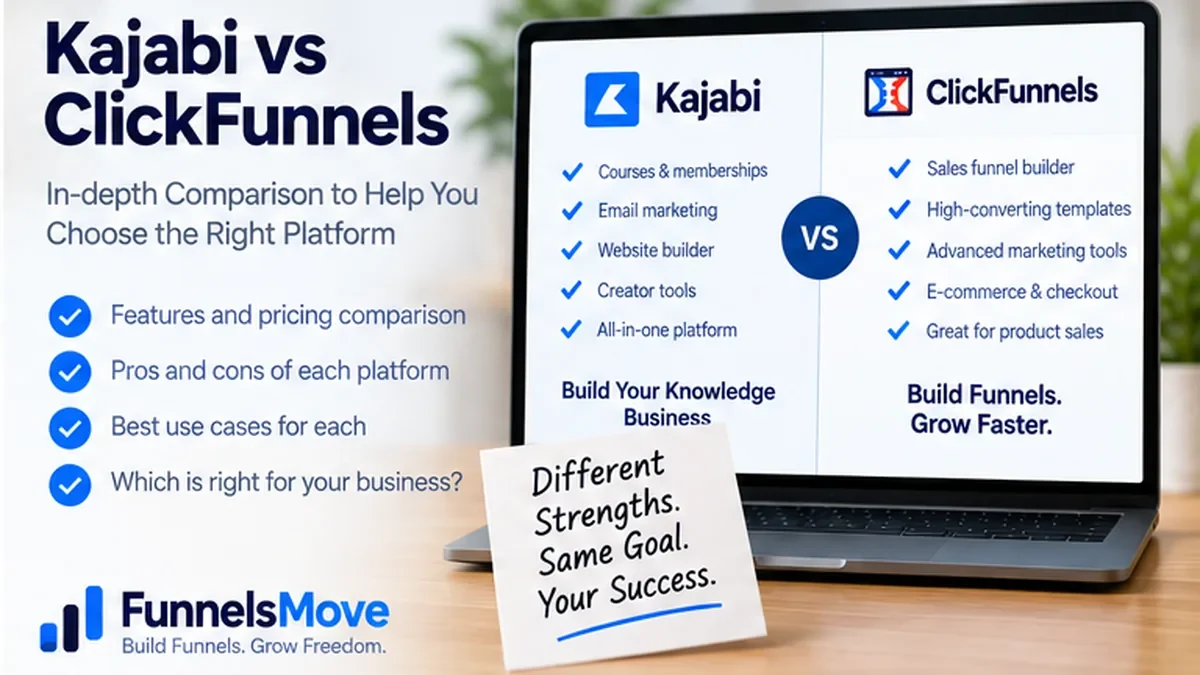
Kajabi’s product is strongly organized around knowledge businesses. Its current first-party pages position courses, coaching programs, digital products, memberships and communities as central use cases. Course delivery connects to email, automations, checkout and community so the creator can manage the customer lifecycle in one system.
ClickFunnels also offers courses and communities. Current ClickFunnels pricing lists course and community allowances by plan, and FunnelsMove’s ClickFunnels for course creators guide covers how that experience fits into a funnel-first stack.
If course delivery and ongoing member engagement are the center of the business, compare the actual learner experience in both products. If courses are one offer among many funnel-driven products, ClickFunnels may fit more naturally with the surrounding acquisition system.
Sales funnels and conversion flexibility
ClickFunnels is explicitly built around funnels. Users can create funnel steps, attach products, connect workflows, run split tests and design conversion paths around launches, lead generation, webinars, applications or checkout. That makes the funnel object itself a central organizing concept.
Kajabi also has funnels—historically often called Pipelines—and its current product pages promote integrated funnels that connect landing pages, opt-ins, checkout, email and follow-up. For a creator business, that level of integration may be exactly what is needed.
The practical test is complexity. If your funnels are mostly lead magnet → nurture → course or membership offer, Kajabi may keep the whole journey closer to the product experience. If you routinely build different funnel types, share funnel structures, experiment with detailed step sequences or manage campaign-specific conversion architecture, ClickFunnels deserves the closer look.
Email marketing and automation
Both platforms include first-party email marketing and automation. Kajabi currently promotes marketing emails, automated sequences and behavior-based triggers tied to course or member activity. ClickFunnels includes email contacts, sending allowances and workflow automation that can connect funnel actions to follow-up.
Do not choose on “has email” alone. Compare contact limits, sending limits, automation logic, segmentation, deliverability controls, templates, reporting and the events your business actually needs. If a separate email service is already deeply embedded in your operation, also compare how each platform integrates with that service.
For ClickFunnels-specific implementation, see ClickFunnels email marketing.
Website, landing pages and blogging
Kajabi’s website builder is designed to keep the public site, landing pages and knowledge-product business connected. Its current marketing emphasizes templates, branded pages, forms and landing pages without code. For creators who want one coherent front-end around courses and memberships, that can simplify operations.
ClickFunnels has Site & Blog, standalone landing pages, funnel pages and theme pages. That can support a full site, although businesses with large SEO-led publishing programs may still prefer a dedicated CMS. See the ClickFunnels SEO guide for that architecture decision.
Checkout, offers and monetization
Both systems support selling. Kajabi connects offers, checkout and product access closely to courses, memberships and other creator products. Its current product pages highlight upsells, order bumps, affiliates and flexible pricing as part of the monetization stack.
ClickFunnels centers checkout inside funnel workflows and supports products, order forms, bumps, subscriptions and post-purchase paths. That is useful when monetization logic changes between campaigns or when several offers use different funnel sequences.
Compare your real checkout needs: taxes, payment providers, currencies, subscriptions, payment plans, refunds, affiliates, order bumps and post-purchase delivery. Do not migrate based on one screenshot of a checkout editor.
Kajabi vs ClickFunnels pricing approach
Pricing changes frequently enough that a durable comparison should focus on structure rather than one promotional number. As of September 12, 2026, Kajabi’s public pricing page shows Basic, Growth and Pro plans with differences in products, contacts, admin users, websites and related limits. ClickFunnels’ public pricing shows Launch, Scale, Optimize and Dominate plans with differences in workspaces, contacts, email volume, courses, custom domains, API/custom-code access and support.
Kajabi currently lists the Basic plan at $179/month when billed monthly and $143/month when billed annually. ClickFunnels currently lists Launch at $97/month or an annual-billing equivalent of $81/month on its pricing page. These figures can change and do not capture payment processing, add-ons or the value of tools you might replace.
Instead of comparing subscription price alone, calculate the stack cost. If one platform replaces a course host, community tool, email service and landing-page builder, its higher sticker price may still reduce total cost. Conversely, if you already use specialized tools you intend to keep, paying for overlapping features may not help.
Which is better for course creators?
For a business whose main product is education or membership, Kajabi deserves strong consideration because product delivery, community, email and website are designed around that operating model. It can reduce the number of separate systems a creator manages.
ClickFunnels can still be a strong fit for course creators who place greater weight on acquisition funnels, launches, complex offer paths or funnel experimentation. A creator may also prefer ClickFunnels if courses are only one part of a broader portfolio.
Use the course setup guide to understand the ClickFunnels implementation before deciding.
Which is better for coaches and consultants?
Either can work. Kajabi fits coaches who package expertise into programs, memberships, communities and structured client experiences. ClickFunnels fits coaches who rely heavily on lead generation, applications, webinars, appointment funnels and differentiated campaigns.
Map the workflow from first visit to delivered service. If the hardest part is nurturing, converting and routing prospects through different campaign paths, ClickFunnels may solve more of the problem. If the hardest part is delivering ongoing content, member access and community after purchase, Kajabi may solve more of it.
What about ecommerce and physical products?
Neither comparison should be reduced to traditional ecommerce alone. ClickFunnels can sell physical and digital products through funnel and store experiences, while Kajabi’s center of gravity remains knowledge products and expert businesses. A merchant managing a broad physical catalog, inventory and complex store operations may also need to compare dedicated ecommerce platforms such as Shopify.
For ClickFunnels and Shopify specifically, use the existing ClickFunnels + Shopify integration guide. A future buyer-comparison page should remain separate because integration intent and platform-selection intent are different.
Migration and switching costs
Switching platforms is more than rebuilding pages. You may need to migrate contacts, products, courses, community access, automations, domains, analytics, payment settings and email authentication. URLs can change, which creates SEO and attribution risk. Existing subscribers or students may also need a carefully managed access transition.
Before migrating, inventory every system connection and define what must remain live during the move. Rebuild the smallest representative workflow first and test it end to end before moving the rest of the business.
Choose Kajabi if...
Choose Kajabi when your business is fundamentally an expert or creator business and you want course or membership delivery, community, email, website, checkout and funnels in one product. It is especially compelling when the post-purchase learning/member experience matters as much as acquisition.
Do not choose it solely because it is “all in one.” An all-in-one platform is valuable only when its implementation of the features you need is good enough to replace the tools you would otherwise keep.
Choose ClickFunnels if...
Choose ClickFunnels when funnel design, campaign flexibility, landing pages, sales-flow experimentation and conversion infrastructure are central to the operation. It is also worth considering when you want built-in products, courses, email and sites but still want the funnel workflow to be the primary organizing layer.
Read the ClickFunnels review, pricing guide and alternatives overview before committing.
Kajabi vs ClickFunnels: decision checklist
List your primary product type, acquisition model, course/community needs, funnel complexity, email requirements, website and SEO needs, checkout model, integrations, team size and total software budget. Then build or trial one real customer journey in each shortlisted platform rather than comparing feature tables forever.
If most of your complexity happens after purchase in learning, membership and community, Kajabi may have the more natural operating model. If most of your complexity happens before and around purchase in funnels, campaign paths and conversion workflows, ClickFunnels may fit better. The right answer is the platform that reduces operational friction for your actual business, not the one with the longest feature list.
Automation depth and day-to-day operations
Automation is where similar feature lists can feel very different in practice. Kajabi emphasizes behavior connected to its products: someone purchases, completes learning activity, joins a community or becomes inactive, and that behavior can feed communication and customer management. That can be intuitive for an education-led business because the post-purchase product experience and marketing system share the same context.
ClickFunnels workflows are naturally close to funnel activity, contacts, purchases and campaign steps. For teams that think in terms of acquisition journeys, lead routing and sales sequences, that model can be easier to reason about. The better choice depends on which events your team uses every day, not on the raw number of automation actions listed in a feature table.
During a trial, build one real automation: registration or opt-in, segmentation, email follow-up, purchase, customer onboarding and a post-purchase action. That reveals more than watching a feature demonstration.
Team, workspace and multi-brand considerations
ClickFunnels organizes businesses around workspaces, with workspace and team-member allowances varying by plan. That can matter to agencies, operators with several brands, or businesses that want clearer separation between projects. Kajabi plan limits instead emphasize products, contacts, admin users, websites and communities, which may map more naturally to a creator business centered on one or a few brands.
Count the actual operating units you need. A founder with one course brand and a small team may not benefit from many workspaces. An agency or portfolio operator may care about workspace separation far more than advanced course delivery. Compare permission needs as well as headline limits.
Analytics and decision-making
Both products provide reporting, but the useful question is whether the reports answer the decisions you make. Course businesses may care about product sales, member engagement, email performance and retention. Funnel teams may care about step conversion, traffic source, checkout performance and experiment results.
For serious measurement, many businesses will still connect analytics, ad platforms or financial reporting outside the core platform. Before choosing, identify the events and dimensions your team needs and confirm how each platform exposes them.
Support, documentation and ecosystem
Platform fit also includes the help ecosystem. Compare the quality of current documentation, onboarding, support channels, partner ecosystem and availability of specialists who understand your use case. Both platforms have large user communities, but third-party tutorials may describe older interfaces or legacy plans.
When evaluating advice, prefer current first-party documentation for product behavior and plan limits, then use community material for workflow ideas rather than as the sole source of truth.
How to test both platforms before deciding
Create one representative journey in each product using your own offer. Build a landing page, collect a lead, send follow-up, sell or simulate the core product, and walk through the customer experience after purchase. Record what required workarounds, what felt native, and which external tools were still necessary.
Then estimate migration and operating cost, not just subscription cost. The platform that is slightly cheaper can become more expensive if it requires extra software, manual administration or a rebuild of workflows your team already depends on.
Compare current ClickFunnels plans
Compare the current ClickFunnels features and limits with the workflow you actually need before choosing a plan.
Visit the ClickFunnels signup page (opens in a new tab)Primary product sources
- Kajabi Pricing (opens in a new tab)
- Kajabi Online Courses (opens in a new tab)
- Kajabi Email Marketing (opens in a new tab)
- ClickFunnels Pricing (opens in a new tab)
Product capabilities and plan details were checked against current first-party sources on September 12, 2026. Interfaces, pricing and limits can change, so verify critical details before purchasing or publishing a live funnel.