Kartra vs Systeme.io: Tools, Pricing and Fit
When comparing Kartra vs Systeme.io, the first question is how much marketing infrastructure your business actually needs. A new creator validating a course or lead magnet faces a different decision from a team coordinating sales, memberships and customer support. This guide examines the funnel-to-purchase journey, email follow-up, delivery, ongoing costs and the trade-offs of managing everything in one platform.

Quick comparison and decision
Choose Systeme.io if you are launching a straightforward funnel, mailing list or course and want to validate demand before committing to a larger software budget. Its free entry tier is especially relevant when contact and feature allowances meet your immediate needs.
Choose Kartra if you already sell multiple offers and want to assess a connected setup for pages, checkout, email, membership access and support workflows. That integration is only valuable if you will use it and the applicable plan limits fit your operation.
Deciding factor: map your first twelve months of contacts, campaigns and products, then compare the actual plan allowances and the work needed to complete one purchase-and-follow-up journey. A lower subscription is not automatically cheaper if it requires extra services; a broader suite is not automatically better if most features go unused.
Core product focus
Systeme.io emphasizes accessible funnel, email, course and affiliate workflows with a free entry tier. Kartra positions itself as a broader connected sales and marketing suite with plan-based limits. Consider Systeme.io when starting small and controlling subscription costs. Evaluate Kartra if its workflow depth, membership features or integrated support justify the cost.
Test a complete customer journey
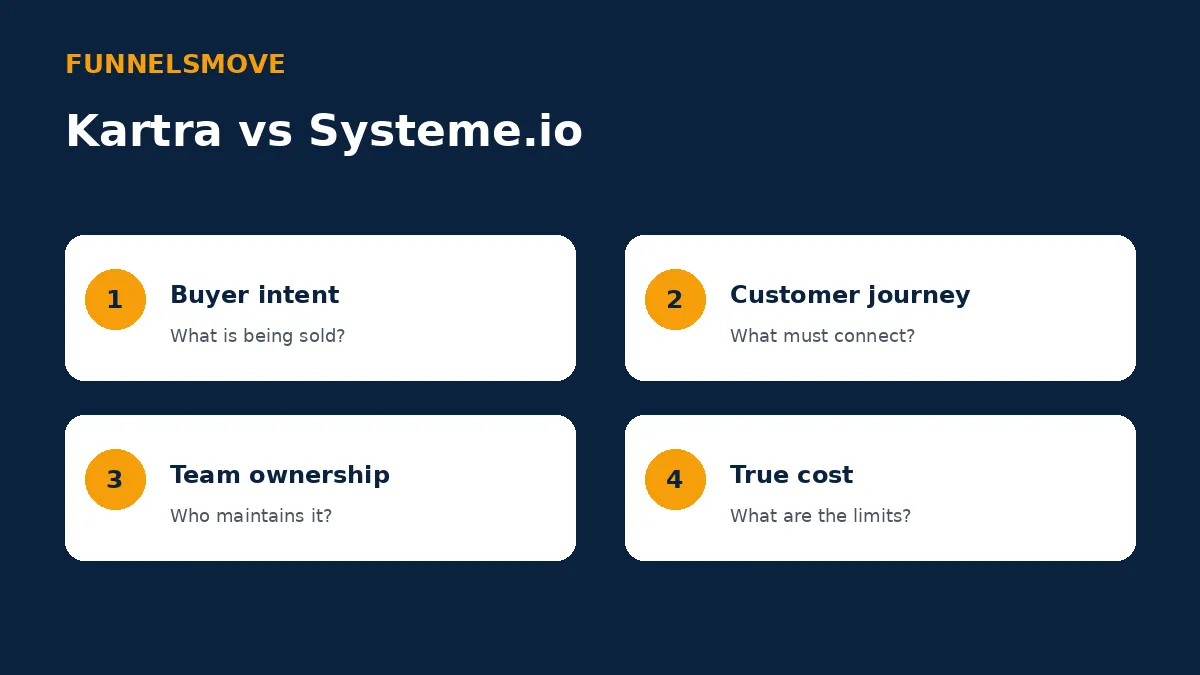
Build the same offer in Kartra and Systeme.io. Start with a mobile landing page, collect a consenting lead, send a follow-up and complete a test purchase. Confirm that access and contact status change correctly. Note the setup steps and external tools required.
Systeme.io entry-level economics
Systeme.io advertises a free entry plan and paid tiers with higher resource allowances. That can reduce the cost of validating a first funnel or course. Confirm the actual limits on funnels, contacts, email, automation rules, custom domains and memberships rather than assuming the free tier is unrestricted.
Kartra suite depth
Kartra combines sales pages, email, checkout, contact records, membership delivery and support-oriented tools. The appeal is workflow consolidation for a business with established sales activity. Whether that depth is worth paying for depends on which capabilities you will actively use, not on the longest feature list.
How the comparison is framed
A useful platform decision begins with a representative customer journey, not a feature count. Write down the traffic source, landing page, opt-in, checkout, confirmation, delivery, follow-up and reporting requirements. Evaluate whether the platform handles those steps directly or needs integrations. Neither a feature list nor a promotional demo establishes that a workflow will operate correctly for your business.
Landing pages and funnels
Both platforms should be evaluated with the same campaign brief: one offer, one landing page, one lead capture, one checkout or booking action and one confirmation step. Compare editing effort, mobile presentation, reusable blocks, URL control and the ability to test alternative paths. Funnel templates save time only when they can be adapted without breaking accessibility or brand consistency.
Email marketing and automation
Build a small but realistic follow-up sequence: welcome message, engagement branch, purchase exclusion and unsubscribe handling. Check whether events and contact fields can trigger the right sequence. Evaluate deliverability setup, sending allowances, list segmentation and the ability to export contacts. Email capability is not equivalent to a mature automation program until the operational details are verified.
Contact management and CRM
Define the minimum customer record your team needs. For example, record lead source, purchase status, subscription preference and next follow-up. Test whether forms and checkouts update the same record and whether staff can view a clear activity history. Businesses with complex sales pipelines should examine reporting, permissions and integrations rather than assuming any built-in contact database is a complete CRM.
Checkout and payments
Create a test product with the correct currency, tax and delivery rules. Review order forms, payment providers, recurring payments, confirmation messages and refund workflows. The checkout design matters, but so do failed payments, customer support and reconciliation. Confirm transaction fees and processor availability in the relevant country, as these may differ by plan or integration.
Courses, memberships and gated content
If you sell education or subscriptions, test the actual learner or member journey: enrollment, welcome email, content access, lesson navigation, cancellation and support. Compare content organization, video delivery, progress tracking and community needs where applicable. A basic gated portal may be enough for a small library but insufficient for a sophisticated learning program.
Scaling constraints
As a business grows, evaluate the cost of additional contacts, products, domains, email sending and team members. Also consider support load and the effort to rebuild automations. A low-cost start is useful, but it should not obscure the operational work required to migrate once customer journeys become complex.
Decision after a hands-on trial
Use the same real offer in both trials and record the contact limits, automation steps, payment and delivery outcomes. If the simpler setup completes your essential workflow without costly workarounds, there is little reason to upgrade merely for more features. If support handoffs and multi-offer follow-up are consuming time, calculate whether Kartra's connected tools reduce that burden.
Websites, SEO and content publishing
Create an example service page and editorial article, then inspect title tags, meta descriptions, heading structure, canonical URLs, redirects and mobile rendering. Businesses dependent on organic search should evaluate publishing efficiency and migration complexity. A strong funnel editor does not automatically replace a full editorial CMS, and a feature-rich website builder does not guarantee strong rankings.
Analytics, attribution and privacy
Use a controlled test lead and test purchase to check whether the platform records the expected events. Where external analytics or advertising pixels are used, verify consent behavior, duplicate event prevention and conversion reporting. Do not assume that dashboards from two products count conversions in exactly the same way. Agree on the metric definitions before interpreting differences.
Integrations and portability
List essential external tools for accounting, payments, calendars, messaging, data warehousing and analytics. Verify each integration at the plan level, including authentication and failure handling. Ask which data can be exported, what automation logic must be rebuilt and how customer access is preserved during migration. A low subscription price can be offset by significant integration maintenance.
Pricing and ownership cost
Compare the complete configuration needed for the next twelve months, not just the entry-plan headline. Include contacts, domains, funnels, products, sending capacity, seats, video storage, agency accounts and support. Add processing fees and third-party services, and compare monthly versus annual commitments. Prices and entitlements change; check the current official pricing pages immediately before purchase.
Operational learning curve
Invite the person who will maintain the system to edit a page, update an email and troubleshoot a test purchase. Count the steps and note unclear interfaces or permissions. An all-in-one suite may reduce vendor handoffs but increase the learning curve for a small team. A simpler product can be preferable when the business has limited operational capacity.
Who should consider neither
A business primarily publishing a large content library may prefer a specialist CMS. A retailer with complex inventory, shipping and tax rules may need a dedicated commerce platform. An enterprise with advanced data governance or custom CRM requirements may be better served by specialized systems. The correct choice may be a smaller stack of well-integrated tools rather than either compared suite.
Migration and implementation plan
Pilot one offer before moving a live business. Inventory existing URLs, contacts, automations, products, payment subscriptions and customer access. Document redirect requirements and create backups where possible. Define acceptance tests for signup, purchase, confirmation, access and analytics. Keep a rollback plan for critical journeys, and avoid switching systems in the middle of a major campaign.
Decision checklist
Score each product against your own weighted requirements: essential workflow completion, team effort, marketing automation, customer data, content delivery, support, integrations and total cost. Mark unknown features for trial verification rather than assigning an optimistic score. A decision record helps prevent feature marketing from overshadowing the practical work your team needs to do.
Official sources and plan verification
Check the Kartra website (opens in a new tab) and the Systeme.io website (opens in a new tab) for current features, billing terms, regional availability and restrictions. These are vendor sources; compare their claims with your own trial requirements.
Related reading
Start with our Kartra overview, Kartra review, Kartra pricing guide and Kartra alternatives. Also see our Systeme.io coverage for additional context.
Evaluate Kartra for your business
Review current plans and test the workflow that matters most to your customers.
Test Drive Kartra (opens in a new tab)