HighLevel AI Employee: Pricing, Features and Fit
HighLevel AI Employee bundles AI-assisted capabilities around conversations, voice and other workflows, but the real cost depends on the plan, channels and usage model.
For broader context, see the HighLevel platform hub. Related reading: HighLevel platform guide HighLevel pricing guide HighLevel CRM guide.
What does HighLevel AI Employee cost?
HighLevel’s AI pricing is more layered than a single flat subscription. The company’s current AI pricing documentation distinguishes pay-per-use access, AI Employee Growth and AI Employee Unlimited, while individual AI products can have their own usage rules. That means the useful buying question is not simply “what is the monthly price?” but which AI capabilities you will use, at what volume, and whether predictable subscription access or usage billing fits better. HighLevel explicitly warns that pricing and model availability can change, so verify the in-app Billing area before committing client pricing. For budgeting, treat AI as a separate operating-cost layer on top of the core HighLevel subscription.
What AI Employee is designed to do
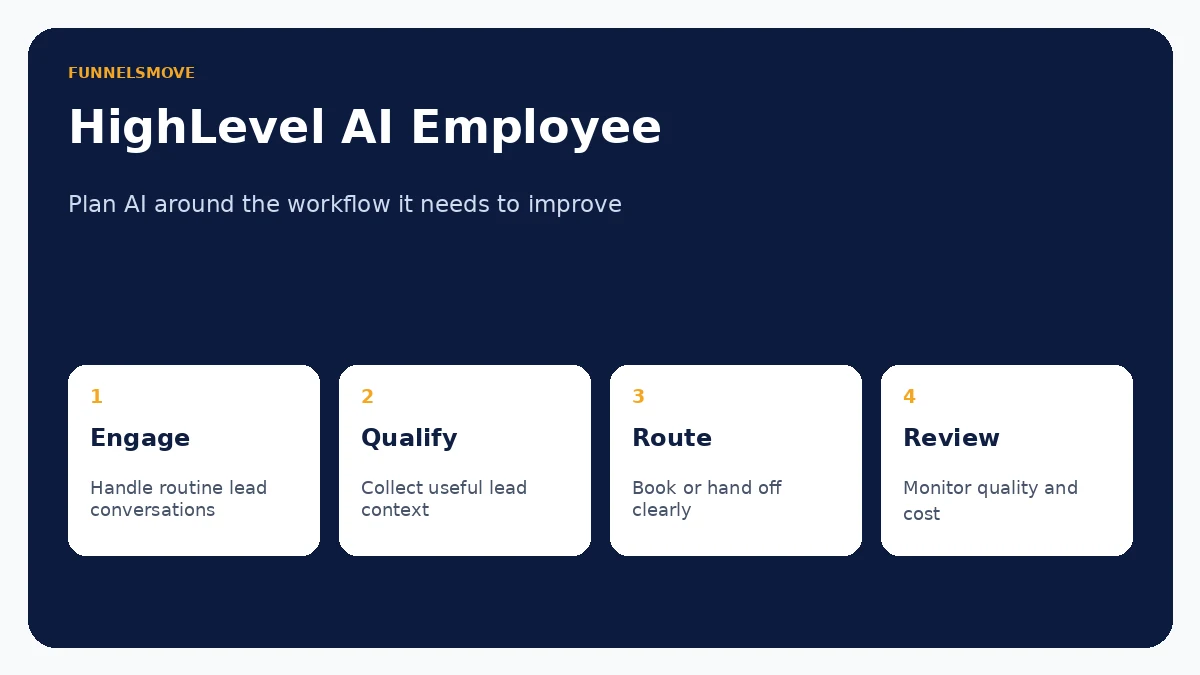
AI Employee is intended to reduce repetitive work around lead conversations and operational tasks. Depending on the enabled product, HighLevel documents AI capabilities for conversations, voice, content and other assisted workflows. The practical value is strongest when AI is connected to a defined lead process: answer a common question, collect information, qualify intent, book an appointment or route the conversation to a person. It is less useful when a business has no clear escalation rules, weak source data or a sales process that changes from one employee to another. AI can execute a workflow faster; it cannot make an undefined workflow coherent.
How the AI cost model works
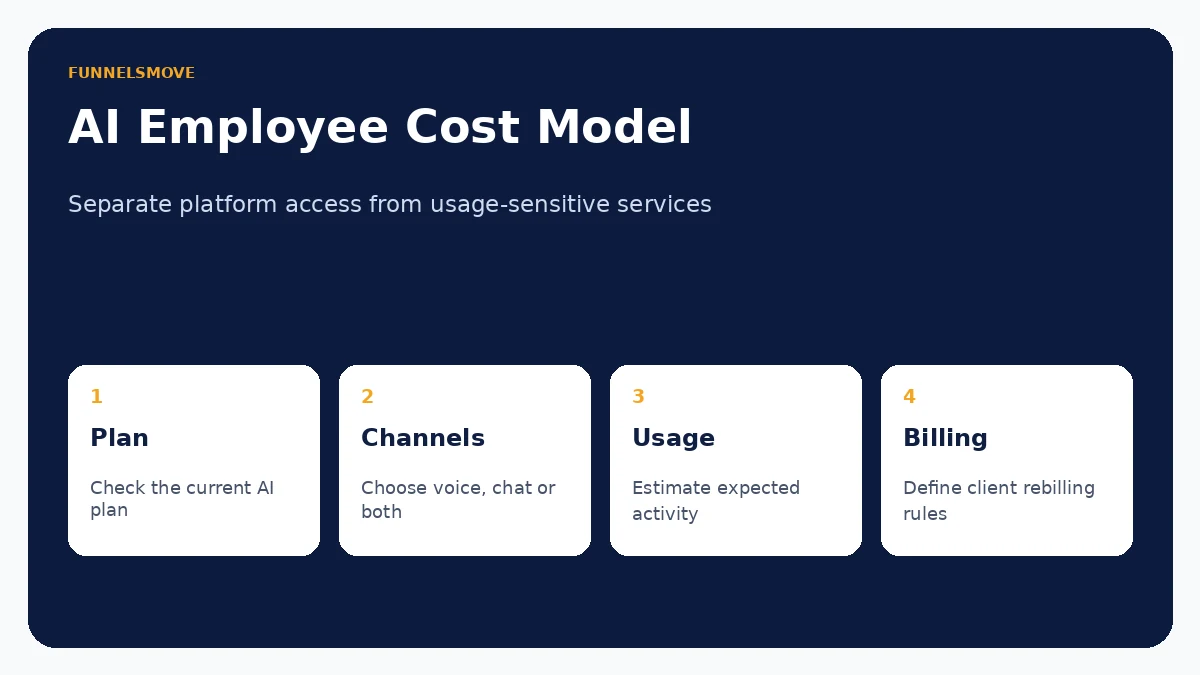
Separate four cost questions: the core HighLevel plan, the AI Employee plan, pay-per-use products, and any rebilling policy for client sub-accounts. HighLevel’s September 2026 AI pricing guide says some features are included with AI Employee, some have fair-usage protections, and others are billed by usage. Voice is particularly important to model because call duration and telephony-related activity can make its economics different from text-based assistance. Agencies should review the current Wallet Pricing page and AI billing settings rather than copying an old rate from a tutorial.
Voice AI versus Conversation AI
Conversation AI is best evaluated as a messaging and qualification layer: what questions can it answer, what information should it collect, and when should it stop and hand off? Voice AI adds the complexity of live calls, caller expectations, phone costs and consent. A business that mainly receives web leads may get more value from conversational automation than from voice. A call-heavy local business may reach the opposite conclusion. Start with the channel where response delay or repetitive work is measurably creating friction.
A practical rollout sequence
Start with one narrow use case rather than automating every conversation. Document the trigger, approved information sources, desired outcome and escalation rule. Test common questions, edge cases and failure paths. Then monitor conversations before increasing scope. If the AI books appointments, verify calendar rules and confirmation messages. If it qualifies leads, define which answers should create an opportunity or alert a salesperson. Keep a human review path for unusual, sensitive or high-value conversations.
Limitations and risks to plan for
AI output can be wrong, incomplete or inappropriate for a specific situation. Businesses should avoid letting an AI agent make unsupported guarantees, give regulated professional advice or improvise policies. Voice and messaging also introduce consent, recording, carrier and privacy considerations. HighLevel’s feature set can change quickly, which is another reason not to hard-code client promises around a particular model or rate. The operational discipline around prompts, knowledge sources, permissions and monitoring matters as much as the feature list.
Who AI Employee is a good fit for
It is most compelling for agencies and service businesses already using HighLevel for contacts, calendars, conversations and workflows, because the AI can operate closer to the same lead data and automation. It may be excessive for a low-volume business that can answer every inquiry manually, or for a team whose required AI stack is already standardized elsewhere. Compare the incremental cost with the actual hours or response gaps you expect it to address—not with a generic promise of “automation.”
Common questions about HighLevel AI Employee
Is AI Employee included in the normal HighLevel subscription?
Do not assume every AI capability is included in the base subscription. HighLevel maintains separate AI pricing and wallet-billing documentation, and availability can vary by product and plan.
Can agencies rebill AI usage?
HighLevel documents rebilling controls for AI products, including fixed-rate rebilling for Conversation and Voice AI. Agencies should define the client-facing price and disclosure before enabling it.
Should I choose unlimited or pay per use?
Low or uncertain usage can favor usage-based billing; steady high usage can make a subscription easier to forecast. Use your own expected activity and current in-app rates.
Evaluate HighLevel for your workflow
Check the current plan, feature and usage details against the workflow you actually need before committing.
Visit HighLevel (opens in a new tab)Sources checked
Product facts and time-sensitive pricing were reviewed on September 13, 2026.