HighLevel AI Employee
Understand AI Employee pricing, channels, usage costs and rollout decisions.
HighLevel is a CRM, marketing automation and lead-generation platform built around agencies, marketers and service businesses.
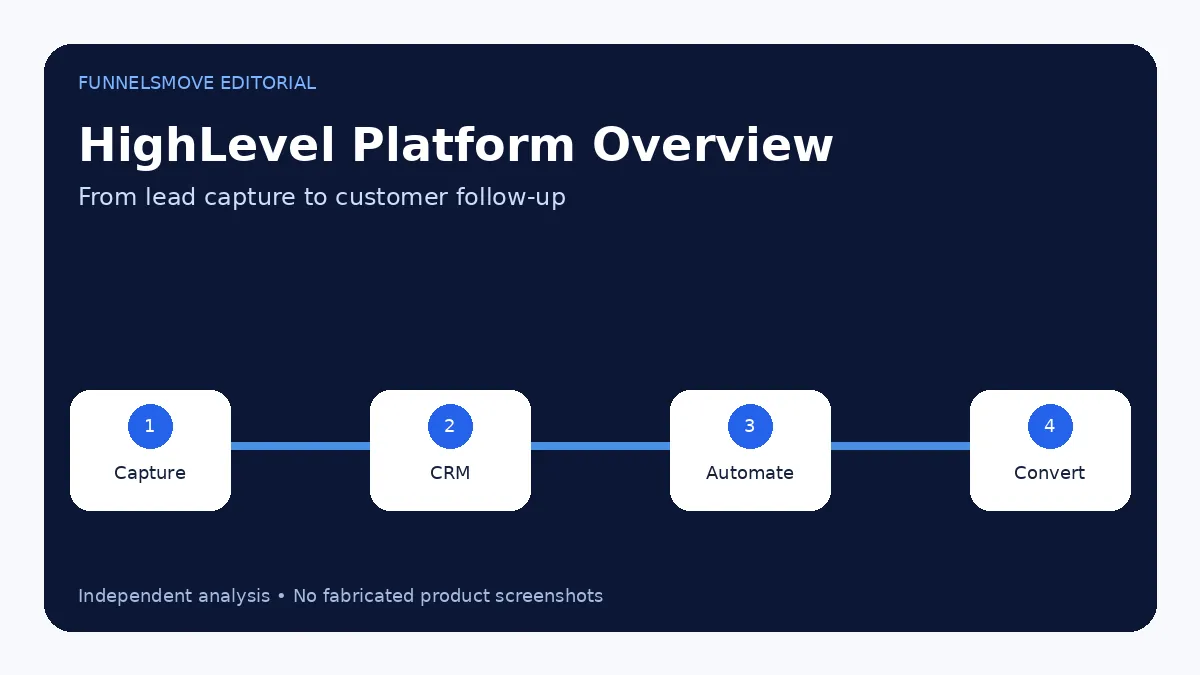
See the platforms for broader context.
HighLevel is an all-in-one CRM, marketing automation and lead-generation platform built especially around agencies, marketers and service businesses. It combines contact management, sales pipelines, conversations, email and SMS, workflows, calendars, forms, funnels, websites, reputation tools, payments and other client-facing features in one system. The product is formally branded HighLevel, although many people still search for and refer to it as GoHighLevel.
The value proposition is consolidation: instead of stitching together a CRM, page builder, calendar, messaging tools and automation platform, a business or agency can manage much of the lead-to-customer journey from one account. That breadth is also the main trade-off. HighLevel can be more system than a solo operator needs if the requirement is only a simple landing page or email sequence.
HighLevel’s current pricing and product pages explicitly position Starter for smaller businesses, freelancers and solo marketers, while Unlimited and Agency Pro are aimed at growing agencies and SaaS-oriented operators. The platform is especially relevant when you manage many leads, need repeatable follow-up, book appointments, track opportunities, or operate multiple client sub-accounts.
Common fits include marketing agencies, local-service businesses, consultants, appointment-driven companies, lead-generation businesses and teams that want CRM data connected directly to campaigns and automation. Agencies get additional leverage from sub-accounts, snapshots, white-label options and the ability to rebill selected services on higher plans.
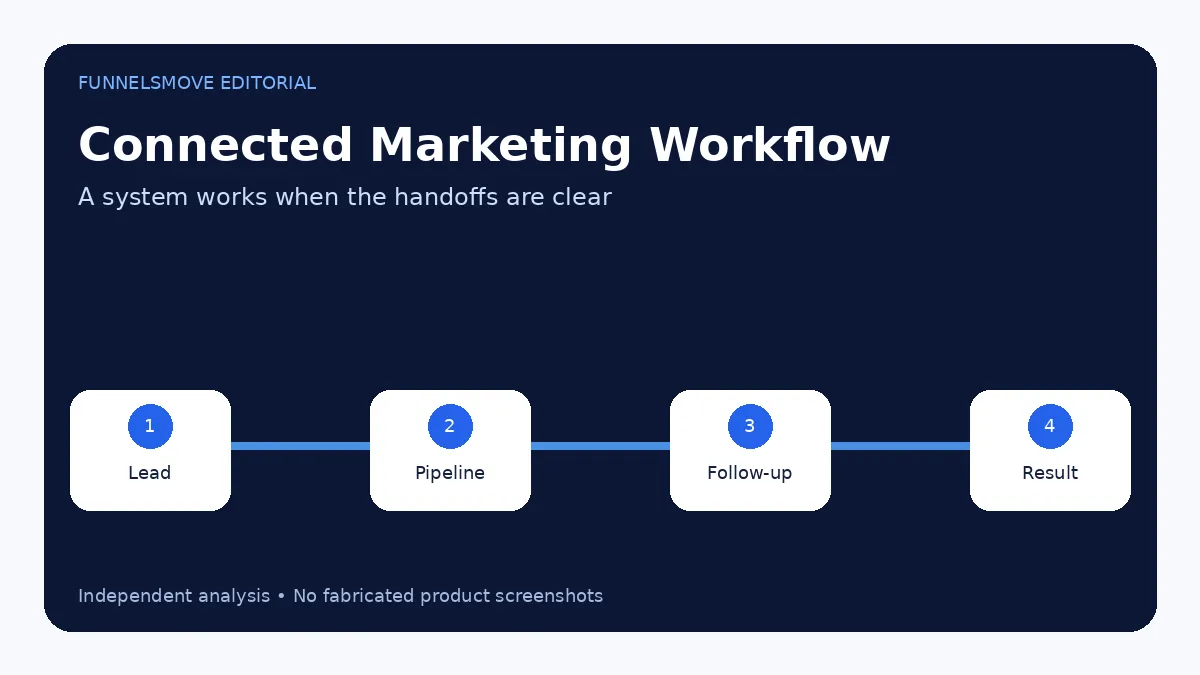
HighLevel is best understood as a connected operating layer rather than a single-purpose funnel builder. CRM contacts feed opportunities and pipelines. Forms, calendars, chat and ads can create or update leads. Workflows can respond to triggers, send messages, create tasks and update records. Websites and funnels handle front-end conversion pages, while payments, reviews, courses and other modules extend the stack.
That integration can reduce data handoffs between tools. It can also create implementation work: naming fields, defining pipelines, configuring messaging, deciding which automations own a task and controlling permissions across accounts. The platform becomes more valuable as those systems are designed deliberately.
As of September 13, 2026, HighLevel lists three main self-serve plans: Starter at $97/month, Unlimited at $297/month, and Agency Pro at $497/month. Annual pricing is listed at $970, $2,970 and $4,970 respectively. HighLevel advertises a 14-day free trial on these plans.
Starter includes up to three sub-accounts. Unlimited moves to unlimited sub-accounts and adds basic API access plus phone/email rebilling without markup. Agency Pro adds SaaS Mode, automated sub-account creation, markup on phone/email rebilling, user/agent reporting and advanced API access. Usage-based communication costs and optional products can sit on top of the subscription, so the headline plan price is not the whole operating cost.
For a deeper breakdown, see GoHighLevel pricing and plan costs.
The platform is strongest when several steps in the customer journey need to work together. A local service business can capture a lead, create an opportunity, send an automated response, offer a calendar, route missed calls to follow-up and track the deal through a pipeline. An agency can standardize that setup across clients using snapshots and sub-accounts.
HighLevel also supports websites, funnels, forms, surveys, courses and payments, so some businesses can replace multiple tools. Replacement should be evaluated module by module rather than assumed. A team with a mature specialist CRM, advanced ecommerce stack or sophisticated publishing workflow may prefer to integrate HighLevel with existing systems instead of migrating everything.
The most important trade-off is breadth versus simplicity. Because HighLevel spans CRM, automation, messaging, sites, ads, payments and agency operations, setup can require more planning than a focused tool. A small creator who mainly needs a sales page and checkout may find a funnel-first product simpler. A large company with deep enterprise CRM governance may need capabilities or controls outside HighLevel’s sweet spot.
Costs can also extend beyond the base subscription. HighLevel’s pricing page lists optional products and usage-based services including AI plans, dedicated email IPs, WhatsApp, WordPress hosting and other add-ons. Phone and email usage are not simply “unlimited” because the plan includes the surrounding software.
Finally, features change quickly. The platform’s documentation is updated frequently, so implementation guides written even a year earlier can be outdated.
HighLevel may be excessive if you only need a basic website, a single email newsletter, a lightweight contact list, or one simple funnel with little ongoing automation. It may also be a poor migration target when a business already has tightly integrated best-of-breed systems and no operational reason to consolidate.
Choose based on workflow, not the number of features. If the business problem is primarily funnel creation, compare the existing ClickFunnels hub. If the problem is broader CRM, automation and multi-client operations, HighLevel deserves a closer look.
Start with the HighLevel review for a balanced fit assessment, then use the pricing guide to estimate realistic cost. If you are implementing the platform, move to how to use HighLevel, the CRM guide, integrations and snapshots.
HighLevel’s official materials now use HighLevel as the product and company-facing brand, while “GoHighLevel” remains deeply established in search behavior, tutorials and older documentation. For readers, the useful distinction is simple: these names refer to the same platform ecosystem rather than competing products.
The company describes its original problem as fragmentation across marketing and sales tools: agencies and operators were managing lead capture, communication and customer relationships across too many disconnected systems. That history helps explain why the product keeps expanding beyond classic CRM into sites, payments, AI, reputation, courses and client operations.
For SEO and usability, FunnelsMove uses “HighLevel” as the formal name and “GoHighLevel” when it matches how people actually search.
HighLevel separates the agency layer from sub-accounts. The agency layer handles subscription, client/account administration and higher-level controls. A sub-account is the operating workspace for a business or client: contacts, opportunities, conversations, workflows, calendars, websites, funnels and other assets generally live there.
This structure is one reason HighLevel fits agencies particularly well. A single agency can standardize process while isolating client data. The same architecture can also work for a business with multiple brands or locations, although the correct setup depends on reporting and permission needs.
Starter currently limits the account to three sub-accounts. Unlimited and Agency Pro are designed for operators who need many more locations.
HighLevel deserves serious consideration when three conditions are true: your business has recurring lead flow, follow-up and sales stages matter, and several of those activities currently live in separate tools. In that situation, consolidation can improve both visibility and automation.
It is less compelling when there is no real CRM process to manage. A creator selling one digital product through a simple page and checkout may not gain much from pipelines, sub-accounts and white-label capabilities. Likewise, an enterprise team may prefer to keep a mature CRM and connect specialist tools around it.
The question is not whether HighLevel has enough features. It is whether its operating model matches the way your business captures, follows up with and converts leads.
| Area | What it does | When it matters |
|---|---|---|
| CRM & opportunities | Stores contacts and tracks potential deals through pipelines | Teams need visibility from lead to closed business |
| Conversations | Centralizes communication context across supported channels | Follow-up is shared across sales or service staff |
| Workflows | Runs trigger-and-action automation | Repetitive follow-up, routing and administration need to scale |
| Calendars | Handles appointment availability and booking flows | Calls, consultations or services depend on scheduled time |
| Sites & funnels | Builds websites, landing pages and funnel journeys | The business wants acquisition pages inside the same platform |
| Forms & surveys | Captures lead and qualification data | Marketing data needs to feed CRM and automation directly |
| Payments | Connects supported payment providers and payment experiences | The customer journey includes checkout, invoices or paid bookings |
| Snapshots | Packages reusable sub-account configuration | Agencies repeat similar setups across clients |
| SaaS/white-label tools | Supports a resold software model on higher plans | An agency wants client subscriptions and branded delivery |
No single business needs every module. This table is useful because it separates “the platform has this feature” from “this feature solves a problem we actually have.”
An agency can use HighLevel as a multi-client operating system. Sub-accounts isolate client data, snapshots accelerate deployment, and Agency Pro adds SaaS-oriented capabilities. The account model makes it possible to standardize a service offering while still customizing each client workspace.
A single business can ignore much of that agency layer. It may use one sub-account for CRM, forms, calendars, workflows, pages and messaging. Starter’s three-sub-account limit can therefore be more than enough for a small company with one primary brand.
This difference matters when reading third-party reviews. Advice written for agencies may overemphasize white labeling and SaaS Mode for a local business; advice written for one location may understate the operational value of snapshots and multi-account administration.
HighLevel is not configured simply by choosing a plan. A useful implementation typically requires decisions about contact fields, pipeline stages, lead sources, user permissions, calendars, sending infrastructure, consent, automation ownership and reporting. If sites or funnels are moving too, domains and tracking also become part of the project.
The safest sequence is progressive: configure one sub-account, import a small contact sample, build one pipeline, connect one lead source, create one workflow and test the journey. Once that works, duplicate the pattern or add complexity.
This is also where HighLevel’s agency tooling becomes valuable. A well-tested configuration can become a snapshot for future deployments rather than being rebuilt manually each time.
Automation can magnify mistakes as easily as it magnifies good process. Duplicate triggers can send repeated messages, poorly defined pipeline logic can move opportunities incorrectly, and broad permissions can expose more data than a user needs. Agencies also need controls around who owns integration credentials and who can modify global templates.
Build change management into the account. Use clear names, document critical workflows, test before publishing and keep a fallback process for revenue-critical automations. For regulated or consent-sensitive communication, confirm the legal and carrier requirements that apply to your business rather than assuming the software configuration itself creates compliance.
Use the 14-day trial as a workflow test, not a tour. Choose one representative lead source and reproduce the actual path from first contact through follow-up and conversion. For an appointment business, that might mean form → contact → opportunity → SMS/email confirmation → calendar booking → reminder → pipeline update.
Measure setup friction as well as the final result. Ask how many steps required documentation, which integrations were needed, what the team found confusing and which existing subscriptions could realistically be removed. A platform can work technically while still being the wrong operational choice.
At the end of the trial, decide based on the live workflow, not the promise that additional modules might be useful later.
HighLevel and ClickFunnels overlap in pages, funnels, email and online selling, but the center of gravity differs. HighLevel starts from CRM, lead management, automation and agency operations. ClickFunnels starts from funnel journeys, offers and conversion pages. A business can build funnels in either product, but the surrounding operating system feels different.
If the hardest problem is routing leads, booking appointments, managing opportunities and automating multi-channel follow-up, HighLevel is usually the more natural architecture to investigate. If the hardest problem is creating and optimizing sales journeys around offers, ClickFunnels may feel more direct.
That difference is why FunnelsMove is maintaining separate platform clusters rather than merging both products into one generic “funnel software” category.
HighLevel can potentially replace a lightweight CRM, landing-page builder, appointment scheduler, form tool, basic reputation workflow, some email/SMS automation and parts of a funnel stack. Whether it should replace them depends on feature depth and migration cost. A team with advanced ecommerce, complex content publishing, specialized sales forecasting or deeply customized enterprise CRM requirements may still keep dedicated systems.
Make replacement decisions one module at a time. Consolidation is valuable when it removes handoffs and duplicated data; it is not valuable when it forces the team into weaker tools for critical work.
Use the current trial and plan details to check whether the platform fits your real lead-generation, CRM and automation workflow.
Visit HighLevel (opens in a new tab)Yes. HighLevel is the current formal product name; “GoHighLevel” remains a common search term and informal name.
Yes. Contacts, opportunities, pipelines and related sales-management tools are core parts of the platform.
It is particularly well aligned with agencies, marketers and service businesses that need CRM, follow-up, appointment and automation workflows in one system.
Research checked on September 13, 2026. HighLevel changes features, limits and pricing regularly; verify time-sensitive details before purchase or implementation.
FunnelsMove Editorial Team researches official product documentation, current pricing and independent user feedback. We do not claim hands-on testing unless explicitly stated.
Understand AI Employee pricing, channels, usage costs and rollout decisions.
Compare branding, SaaS Mode, plan requirements and agency economics.
Configure automatic missed-call replies and safer workflow controls.
Choose between a CRM-and-agency operating model and a funnel-led selling platform.