HighLevel Email Marketing: Features, Costs & Deliverability
HighLevel can run one-time campaigns, bulk email and automated workflow email from the same CRM. Its strongest fit is businesses that want email tied closely to contacts, funnels and automation; dedicated email platforms may still suit advanced newsletter or enterprise needs.
For broader context, see our HighLevel platform guide, HighLevel review and HighLevel setup guide.
What email marketing features does HighLevel include?
HighLevel supports regular email campaigns, bulk sends, reusable templates, automated workflow emails, dynamic recipient segments and unified email reporting. Regular campaigns are one-time broadcasts that can be sent immediately or scheduled. Bulk email is available from Contacts, while workflows handle lifecycle messages triggered by CRM events.
That makes HighLevel practical when email is one part of a broader lead-management process. A form submission can create a contact, segmentation can determine who receives a campaign, and a HighLevel workflow can handle automated follow-up without exporting the audience to another system.
Campaigns, bulk email, templates and personalisation
HighLevel's Email Marketing area separates reusable templates from campaigns. Templates provide a repeatable layout; campaigns apply content, recipients and delivery settings. Current documentation also supports batch scheduling for larger sends. The Contacts bulk-email builder can use quick compose, the smart builder or saved templates and automatically filters contacts that are invalid, unsubscribed or marked DND.
Personalisation should use CRM data that is complete and trustworthy. A merge field does not improve a message when the underlying contact value is missing or stale. Preview and test messages before scheduling, particularly when templates contain dynamic values, links or mobile-sensitive layouts.
Contact segmentation and automated email workflows
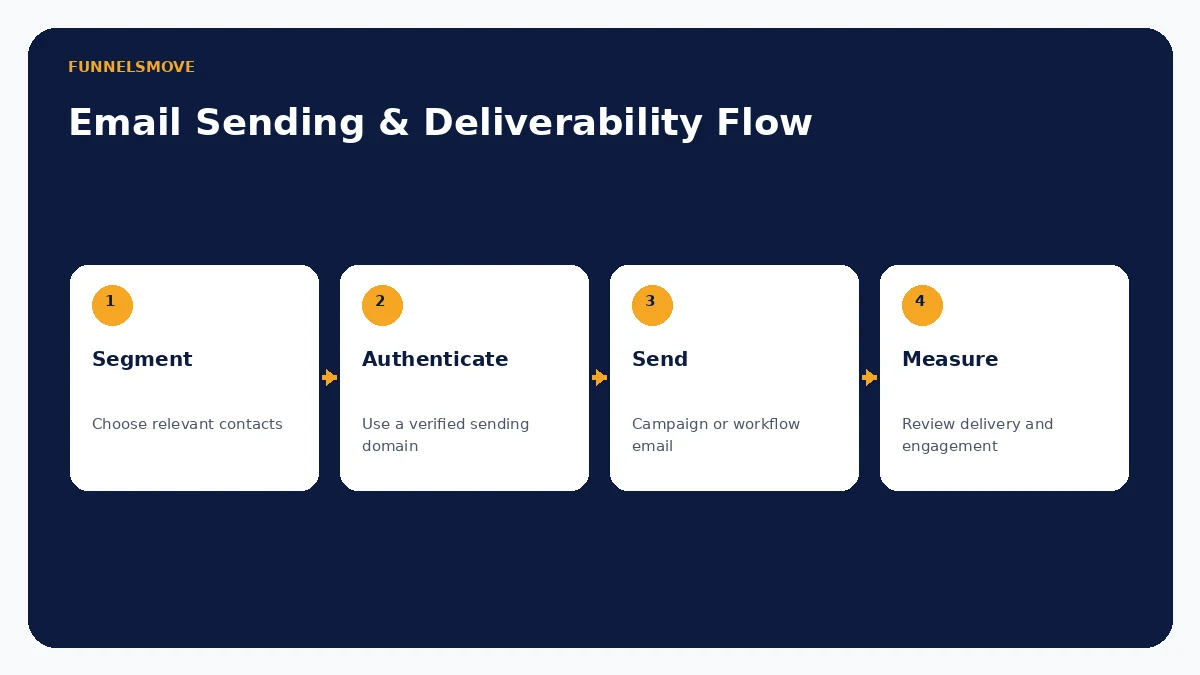
HighLevel's campaign Segments are dynamic groups built from conditions such as tags, contact fields, activity or engagement. They update as contacts enter or leave the qualifying conditions. This is different from assuming a scheduled bulk selection will always remain dynamic: HighLevel notes that contacts for some bulk scheduled sends are captured at scheduling time.
For event-driven messaging, workflows are the more natural tool. They can send email after a lead-capture, appointment or other supported trigger. Keep promotional broadcasts and lifecycle automation conceptually separate so recipients do not receive conflicting messages.
Sending domains, authentication and LC Email
For LC Email, HighLevel supports dedicated sending domains configured under Email Services. HighLevel generates DNS records that must be verified; documentation recommends using a subdomain when the root domain already serves another email provider. Dedicated domains can be assigned to campaign, workflow, bulk-action and one-to-one email types.
Current campaign documentation requires an appropriate verified sender/domain configuration. Authentication improves trust and alignment, but it does not guarantee inbox placement. Reputation, complaint rate, list quality, message content, recipient engagement and mailbox-provider decisions still matter.
Deliverability: what HighLevel can and cannot control
HighLevel documents ramp-up and sending-limit behavior for LC Email and recommends warming a new sending domain rather than immediately sending a large list. Email verification can also screen addresses before sending. These controls can reduce avoidable problems, but no platform can promise that every message reaches the inbox.
Use permission-based lists, suppress unsubscribed contacts, remove persistent hard bounces and monitor complaint signals. Avoid purchased lists. If deliverability deteriorates, investigate the audience source, authentication, sending pattern and content before simply increasing volume.
LC Email pricing and other sending configurations
As of September 16, 2026, HighLevel's pricing documentation lists LC Email usage at $0.675 per 1,000 emails across plans. HighLevel also supports external SMTP configurations such as Mailgun or other supported providers; those providers have their own pricing and reporting characteristics. LC Email is designed to work without a separate Mailgun account.
Email cost is separate from the base HighLevel subscription. Agencies should also check current rebilling rules if they plan to pass usage charges to sub-accounts. Do not treat a per-thousand sending rate as the total cost of an email program: domain management, list acquisition, creative work and compliance processes still require resources.
Reporting, tracking and interpretation
HighLevel's current Email Statistics experience consolidates supported Campaign, Workflow and Bulk Action email reporting. Available metrics include delivery states and engagement signals such as opens, clicks, bounces and unsubscribes. Dashboard widgets can further break reporting down by source, status, sender or domain.
Open tracking is an imperfect signal because mailbox privacy features can affect it. Use clicks, replies, conversions and downstream CRM outcomes alongside delivery metrics. Reporting should help diagnose audience and message quality, not become a reason to chase a single vanity metric.
When HighLevel email is a good fit—and when it is not
HighLevel email is a strong fit for agencies, coaches and service businesses that want campaigns and lifecycle automation close to CRM, forms, calendars and pipelines. It can reduce integration work when the same contact data drives marketing and sales follow-up.
A dedicated email-marketing platform may be better for publishers with complex newsletter operations, teams needing specialized editorial workflows, organizations with advanced enterprise deliverability requirements, or businesses whose email stack is intentionally independent from their CRM. Compare the full workflow rather than feature counts alone.
Evaluate HighLevel with your real workflow
Use a representative setup, confirm account-specific limits and costs, and test normal and failure paths before putting the process in front of customers.
Visit HighLevel (opens in a new tab)Sources checked
Product and integration documentation was reviewed on September 16, 2026. Pricing, permissions and feature availability can change; verify account-specific settings before deployment.