HighLevel vs ActiveCampaign: CRM and Automation Compared
HighLevel is built around service-business and agency operations; ActiveCampaign is built around marketing automation with an increasingly capable CRM. The better fit depends on your operating model.
HighLevel vs ActiveCampaign: the short answer
HighLevel is usually the closer fit when a service business or agency wants CRM, pipelines, calendars, funnels, phone/SMS, reputation tools and automation in one operational platform, especially across multiple client sub-accounts. ActiveCampaign is usually the closer fit when sophisticated marketing automation, email-led lifecycle orchestration and a large integration ecosystem are central, with CRM capabilities added around that marketing engine.
Neither platform is universally stronger. ActiveCampaign’s current product has expanded beyond email into CRM, SMS and WhatsApp, while HighLevel has expanded well beyond agency CRM. Compare the workflows your team actually owns rather than relying on older “email tool vs all-in-one CRM” descriptions.
Audience and operating model
HighLevel explicitly packages agency operations around sub-accounts. Its current Unlimited and Agency Pro plans are designed for agencies managing multiple accounts, with Agency Pro adding SaaS-oriented capabilities. A single service business can also use HighLevel, but the architecture remains closely tied to lead response and client/account operations.
ActiveCampaign positions its platform around autonomous marketing, marketing automation and CRM. Its current plan structure separates base email plans from optional capabilities such as enhanced CRM, SMS and other add-ons. That can be attractive when a business wants to deepen marketing automation without replacing every surrounding system.
CRM and sales pipelines
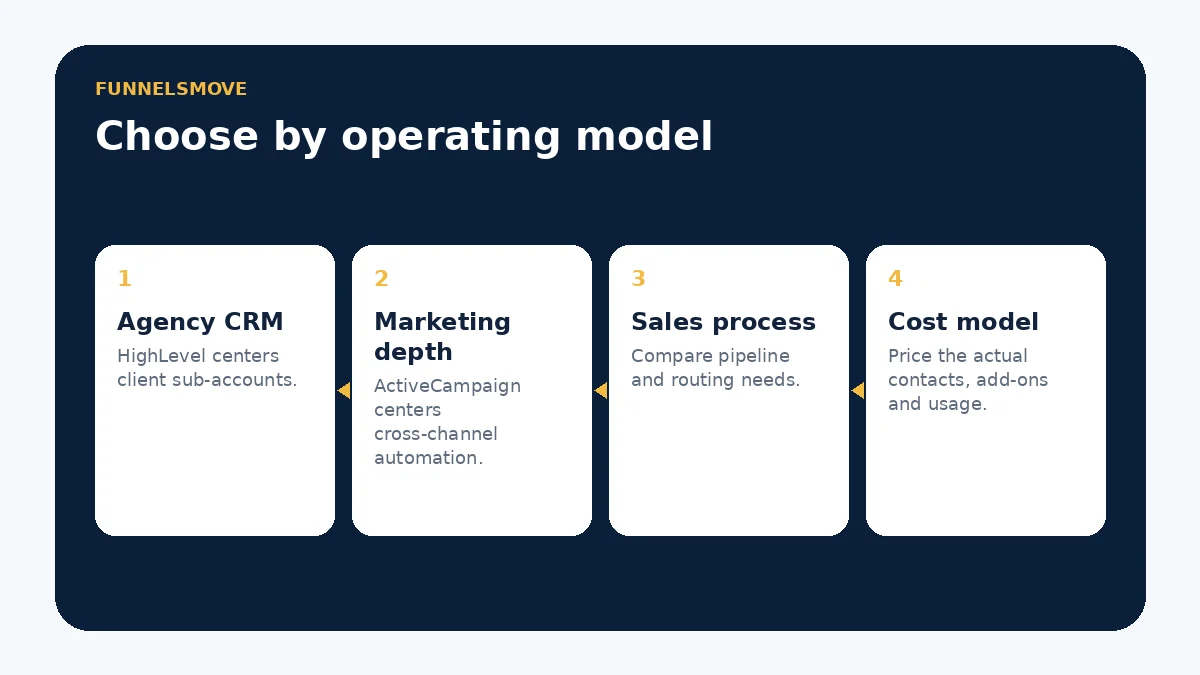
Both platforms can manage contacts and sales pipelines. HighLevel opportunities are closely connected to conversations, calendars, workflows and lead-response operations. ActiveCampaign’s CRM supports pipelines, stages, deals, tasks, routing and automation; current pricing documentation shows enhanced CRM functionality as an add-on area rather than something to assume is identical across every base email plan.
For a sales team, test ownership rules, task management, pipeline permissions, reporting and handoffs. For an agency, test whether the account structure itself matches how clients must be separated.
Marketing automation
ActiveCampaign’s core identity remains marketing automation. Its current platform supports branching customer journeys, segmentation, site and event tracking, cross-channel orchestration and campaign reporting. HighLevel workflows can respond to CRM events, appointments, forms, messages, opportunities and other triggers, making them particularly useful for operational lead follow-up.
The difference is less “can it automate?” and more “what is the automation centered on?” ActiveCampaign often starts with lifecycle marketing across channels and connected apps. HighLevel often starts with a lead/contact moving through a service-business process.
Email, SMS and WhatsApp
Both platforms now span multiple communication channels. ActiveCampaign supports email, SMS and WhatsApp offerings, but current documentation notes that SMS requires an add-on and WhatsApp packaging has its own plan/add-on rules. HighLevel also separates subscription pricing from usage-based communications and channel-specific compliance requirements.
Do not compare only the monthly software fee. Estimate email volume, SMS destinations and segments, WhatsApp requirements, phone usage, contact counts and any add-ons needed for the actual campaign mix.
Funnels, websites and appointment workflows
HighLevel has native funnels, websites, forms, surveys and calendars, so it can cover more of the lead-capture and booking stack without another page builder. ActiveCampaign integrates with a broad ecosystem and can capture/automate around external forms, ecommerce and website activity, but it is not primarily positioned as an all-in-one funnel-and-appointment platform.
If replacing several SMB tools is the objective, HighLevel’s breadth may matter more. If the website, ecommerce and scheduling stack is already established, ActiveCampaign’s integration-first model may be less disruptive.
Pricing model and total operating cost
HighLevel currently lists Starter at $97/month, Unlimited at $297/month and Agency Pro at $497/month, with separate usage charges and optional services. ActiveCampaign’s current pricing varies by email plan, contact/usage configuration and add-ons; enhanced CRM, SMS, WhatsApp and custom reporting can affect the configured cost.
Because the models are different, a single headline-price table can mislead. Price the configuration needed for one year, including communications, CRM add-ons, migration work and any tools each platform does not replace.
Decision table
| Priority | HighLevel | ActiveCampaign |
|---|---|---|
| Multi-client agency structure | Purpose-built sub-account model | Not the core packaging model |
| Marketing automation depth | Strong operational workflows | Core platform strength |
| Funnels + calendars + CRM | Native integrated stack | Often uses connected tools |
| Email-centric lifecycle marketing | Capable | Core product focus |
| Sales CRM | Native opportunities/pipelines | CRM and enhanced CRM capabilities; check plan/add-ons |
Choose HighLevel if…
- You operate an agency or repeatable service-business lead system.
- Calendars, conversations, funnels and CRM need to work together closely.
- Client sub-accounts and agency rebilling/SaaS options matter.
- You are prepared to manage communications setup and usage costs.
Choose ActiveCampaign if…
- Marketing automation and email lifecycle orchestration are the center of the stack.
- You already have website, ecommerce or scheduling systems you want to keep.
- You value a broad integration ecosystem and behavior-driven marketing.
- You are comfortable configuring CRM and channel add-ons around the required plan.
Migration and implementation trade-offs
Switching either direction means more than importing contacts. Preserve consent and suppression data, map custom fields, rebuild automations, verify domains and sending identities, recreate pipeline logic and test integrations. Run one revenue-critical journey in staging before redirecting production forms or campaigns.
If you are already using HighLevel, review our workflow guide and email marketing guide. For alternatives around the CRM stack, see HighLevel vs HubSpot.
Contact data, segmentation and lifecycle design
Both platforms can segment contacts, but the surrounding data model affects how teams work. In HighLevel, contact activity often sits beside opportunities, conversations, appointments and workflow history. In ActiveCampaign, segmentation and automation are deeply tied to marketing behavior, lists, tags, custom fields, site/event tracking and campaign engagement.
Before migrating, list the fields and events that actually drive decisions. A platform with more available fields is not automatically better if staff cannot keep them clean. Define which system owns contact identity, lifecycle stage, consent, revenue status and lead source, then test how those values synchronize with the rest of the stack.
Reporting and attribution
ActiveCampaign’s current plan matrix includes campaign, automation, contact/subscriber, site/link and other reporting capabilities, with some reporting varying by plan or add-on. HighLevel provides reporting around CRM, conversations, attribution and agency operations, but the exact dashboards available can depend on features and account configuration.
For a marketing team, test whether reports answer campaign and lifecycle questions without spreadsheet reconstruction. For an agency, test whether reporting can be separated and presented at the client-account level. Neither vendor’s marketing page can tell you whether your specific attribution model will survive a migration.
Integrations and stack strategy
ActiveCampaign emphasizes a large integration ecosystem and is often deployed as the automation layer between an existing website, ecommerce platform and other business tools. HighLevel also supports integrations, APIs and webhooks, but its all-in-one proposition encourages businesses to replace more of the surrounding SMB stack.
That creates a strategic trade-off. Consolidation can reduce handoffs and vendor sprawl, but it increases dependence on one platform. An integration-first stack can preserve best-of-breed tools, but every connection becomes another failure point to monitor. Map the systems you cannot replace before comparing feature lists.
Deliverability and messaging governance
Email deliverability is not guaranteed by either platform. Sender authentication, list quality, consent, complaint rates, content and sending behavior all matter. HighLevel’s email setup can involve its supported sending services and usage charges; ActiveCampaign packages email sending within its marketing plans but still expects responsible list and authentication practices.
SMS and WhatsApp introduce additional registration, consent and template requirements depending on country and channel. Do not treat “supports SMS” as permission to message every contact. Review the channel rules, opt-out handling and cost model before automating outreach.
Scenario comparison
Marketing agency with 30 local-business clients: HighLevel’s sub-account architecture is likely the more relevant starting point because separation, repeatable workflows and agency operations are first-class concerns. ActiveCampaign can serve sophisticated marketing programs, but the agency would need to evaluate how it wants to structure and bill many client environments.
Established ecommerce brand with a mature store and analytics stack: ActiveCampaign may be the more natural evaluation when the business wants marketing automation around systems it intends to keep. HighLevel deserves consideration if the company also wants to consolidate CRM, messaging, landing pages and appointment/service workflows.
Appointment-led service business: HighLevel’s native calendars, conversations and pipeline automation can reduce integration work. ActiveCampaign may still fit when lifecycle email sophistication and integration with an existing booking/CRM stack matter more than consolidation.
How to run a fair trial
- Import a small, permissioned test segment rather than the production database.
- Recreate one real lead or customer journey in both platforms.
- Test segmentation, email, sales handoff and reporting.
- Include one failure case, such as a reply, opt-out or duplicate submission.
- Record setup time and ongoing maintenance steps.
- Calculate first-year software, add-on, communications and migration cost.
Sales-team workflow and ownership
Sales automation should be evaluated separately from marketing automation. In ActiveCampaign, current CRM documentation supports pipelines, stages, deals, tasks, routing and 1:1 email capabilities, with enhanced CRM packaging affecting what is included. HighLevel opportunities and pipelines are integrated with its broader conversation and appointment environment.
Ask how a new lead is assigned, how a rep knows the next action, what happens when the lead replies, and how management sees stalled opportunities. Then test those steps. A visually attractive pipeline is not enough if ownership rules or activity history do not match the team’s process.
Agency use versus an internal marketing team
HighLevel’s sub-account model gives agencies a structural reason to choose it even when another tool has stronger individual marketing features. Client separation, reusable setups and agency billing controls can be more important than optimizing one campaign builder.
An internal marketing team has a different problem. It may prefer ActiveCampaign’s marketing-centered environment when there is one company database and the surrounding ecommerce, CMS, analytics and support stack is already established. In that case, replacing those systems may create more work than value.
Important limitations on both sides
HighLevel’s breadth creates a large configuration surface. Communications compliance, domains, workflows, calendars, permissions and usage billing all require ownership. ActiveCampaign’s modular plans and add-ons mean buyers need to verify which CRM, SMS, WhatsApp and reporting capabilities are included in the exact configuration.
Neither platform eliminates data governance. Duplicate contacts, stale tags, inconsistent lifecycle stages and poorly designed automations can undermine either system. Budget for cleanup and operating discipline, not only migration.
Questions to answer before choosing
- Do you need separate client environments or one internal customer database?
- Which channels must be native, and which can remain integrated?
- How sophisticated are segmentation, scoring and lifecycle campaigns?
- Do sales reps need tasks, routing and pipeline controls beyond basic opportunities?
- Which website, ecommerce, booking and analytics tools will remain?
- What are the expected email, SMS, WhatsApp and phone volumes?
- Who will maintain automations after launch?
Primary sources
- HighLevel pricing (opens in a new tab)
- ActiveCampaign pricing (opens in a new tab)
- ActiveCampaign Sales CRM (opens in a new tab)
- ActiveCampaign marketing automation (opens in a new tab)
- ActiveCampaign plan overview (opens in a new tab)
Time-sensitive product and pricing context was checked on September 19, 2026. Verify a configured quote before purchase.
Evaluate HighLevel for your workflow
Use the current plan and product details to test the workflows that matter before committing production data.
Explore HighLevel (opens in a new tab)