Best GoHighLevel Alternatives: 5 Options Compared
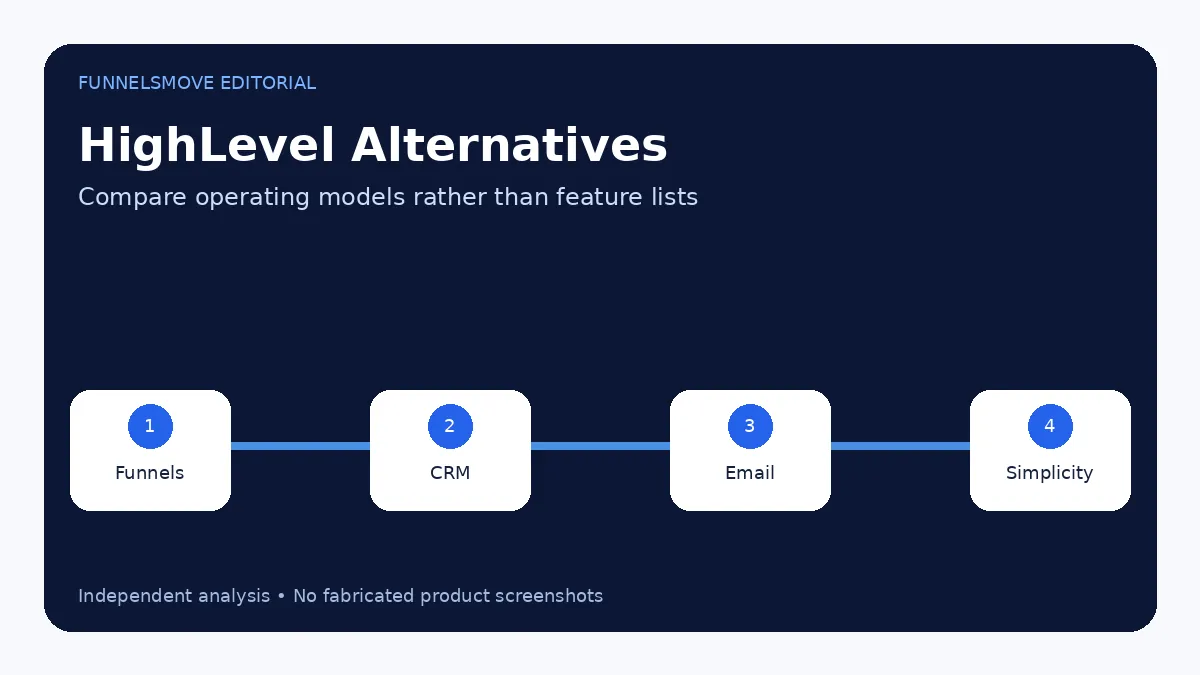
HighLevel has a broad agency-focused stack; the best alternative depends on whether you care most about funnels, CRM, email automation or simplicity.
See the reviews for broader context.
The strongest GoHighLevel alternatives by use case
The best alternative depends on what you are replacing. HighLevel combines CRM, automation, messaging, pages, calendars and agency account management, so no competitor is automatically “the same thing.” A better comparison starts with the job that matters most.
| Platform | Best reason to consider it instead | Main trade-off versus HighLevel |
|---|---|---|
| ClickFunnels | Funnel-first selling and campaign flows | Less agency/CRM breadth |
| HubSpot | Deep CRM and broader enterprise marketing/sales ecosystem | Can become more complex and expensive as hubs/features expand |
| ActiveCampaign | Email marketing and automation focus | Not an all-in-one agency operating system |
| Keap | Small-business CRM and automation | Different page/funnel and agency model |
| systeme.io | Simple creator funnel/email stack at a lower complexity level | Less CRM and multi-client depth |
ClickFunnels: better when funnels are the center of the job
ClickFunnels is the most relevant alternative on FunnelsMove because it organizes the product around funnels, landing pages, checkout, offers and campaign flows. It also includes sites, courses and email, but its operating model is more funnel-first than agency-CRM-first.
Choose ClickFunnels over HighLevel when the main problem is building and optimizing sales journeys and you do not need HighLevel’s broader CRM, multi-client sub-account and agency-SaaS structure. See the ClickFunnels hub and ClickFunnels review.
HubSpot: better when CRM depth and organizational adoption dominate
HubSpot is a major alternative for companies that prioritize CRM, sales and marketing alignment, reporting and a broad ecosystem. It is especially relevant to larger teams with formal sales processes and existing HubSpot skills.
The trade-off is that HubSpot’s packaging and total cost can become more complex as the organization needs additional hubs, seats and advanced functionality. Agencies wanting white-label client sub-accounts and SaaS-style resale should compare that operating model carefully.
ActiveCampaign: better for email-led automation
ActiveCampaign is a strong comparison when sophisticated email marketing and lifecycle automation matter more than replacing the whole agency stack. A business that already likes its website, CRM or scheduling tools may prefer a focused automation layer rather than consolidating into HighLevel.
HighLevel is more compelling when messaging, CRM, pipeline, forms, calendars and client accounts need to live together.
Keap: another small-business CRM path
Keap focuses on CRM, sales and marketing automation for small businesses. It can be a better conceptual fit for teams that want SMB CRM and follow-up without adopting an agency-oriented multi-client model.
Compare the actual workflow: lead capture, opportunity management, appointment flow, invoicing, email/SMS and team ownership. Similar feature names can hide different day-to-day experiences.
systeme.io: simpler creator-oriented consolidation
systeme.io targets entrepreneurs and creators with funnels, email, courses and related selling tools. It is worth considering when simplicity and creator workflows matter more than advanced CRM, agency account management or white-label SaaS operations.
It is not a direct replacement for every HighLevel use case, but that is precisely why it can be the better alternative for a smaller operation.
How to choose an alternative without feature-list bias
Write down the five workflows that generate or protect revenue. Then compare each platform against those workflows, integration requirements, migration cost and team skills. Do not award points merely because a product has a feature somewhere in its menu.
If you are primarily evaluating HighLevel itself, start with the HighLevel platform hub and review. If you are starting from ClickFunnels, the existing ClickFunnels alternatives guide provides the opposite perspective.
Comparison criteria that actually change the decision
Compare CRM depth, funnel flexibility, email automation, appointment scheduling, multi-client account structure, white labeling, payments, reporting, API/integration options and total operating cost. Give each criterion a weight based on your business rather than treating every feature equally.
An agency managing 30 local-service clients should heavily weight sub-accounts, automation, snapshots and client operations. A course creator may weight page building, checkout, course delivery and email much more heavily. A B2B sales team may care about CRM governance and reporting above everything else.
Do not ignore migration cost
An alternative is not better merely because the monthly subscription is lower. Rebuilding automations, re-authenticating sending domains, moving phone numbers, retraining a team and reconnecting payments can dwarf several months of software fees.
Before switching, inventory the current stack and mark each workflow as keep, replace, integrate or retire. That prevents a migration from turning into uncontrolled duplication.
HighLevel versus ClickFunnels: the architectural difference
FunnelsMove already covers ClickFunnels extensively because it represents a different center of gravity. ClickFunnels is organized around funnel journeys and offer conversion. HighLevel is organized around CRM, lead follow-up, agency operations and automation, while also including funnels and sites.
Neither framing is universally better. The right choice depends on whether your hardest problem is the conversion experience itself or the broader system for capturing, routing, nurturing and managing leads.
Best HighLevel alternative by scenario
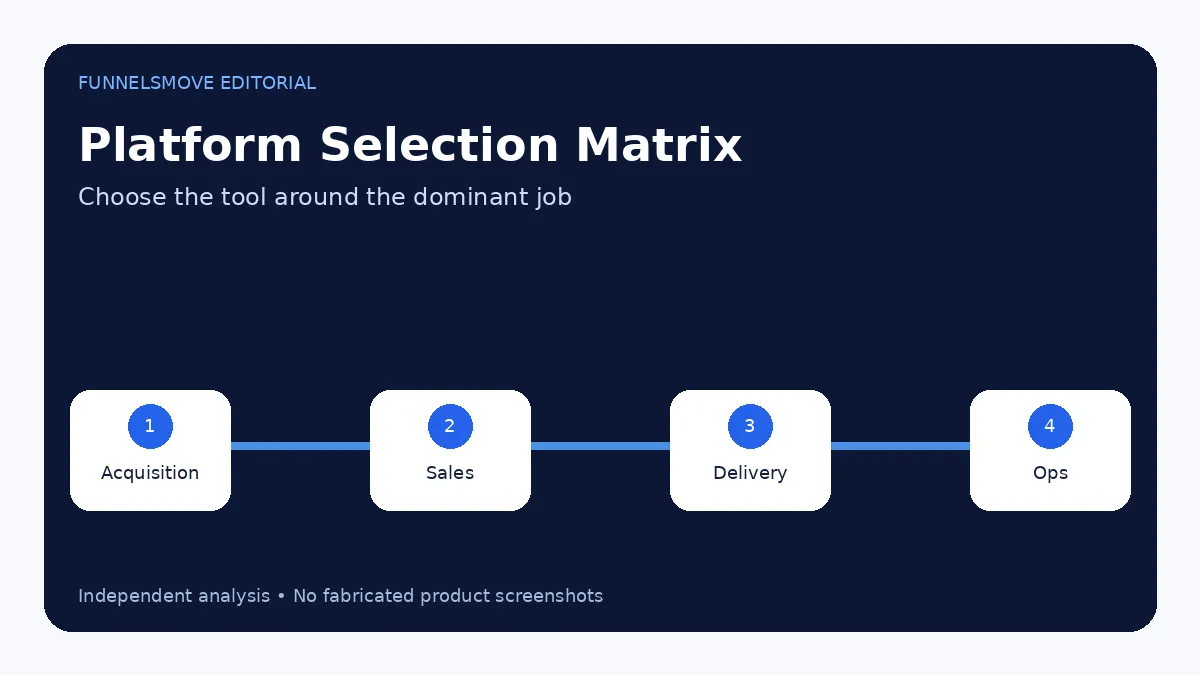
| If your main priority is... | Start by comparing... | Why |
|---|---|---|
| Sales funnels and offer flows | ClickFunnels | Its product model is centered on funnel steps, conversion pages and selling journeys |
| Enterprise-style CRM and cross-team customer operations | HubSpot | Its customer platform spans CRM, marketing, sales, service, content and data |
| Email-led marketing automation | ActiveCampaign | Automation and email lifecycle work remain central to the product |
| Small-business CRM plus follow-up | Keap | It is positioned directly around small-business CRM and sales/marketing automation |
| Lower-complexity creator funnels | systeme.io | Funnels, email and courses are packaged around a simpler online-business workflow |
This is not a ranking. Each recommendation starts from a different dominant job.
HighLevel vs HubSpot: different scale assumptions
HubSpot’s current product architecture is a broad customer platform with Smart CRM plus separate marketing, sales, service, content, data and revenue products. That can be attractive to organizations that want deep cross-team adoption, formal reporting and a large ecosystem.
HighLevel is more agency-oriented in its account structure and packaging. Sub-accounts, snapshots, rebilling and SaaS Mode are designed around operators managing or reselling systems to many client businesses. A company deciding between the two should therefore compare organizational model as much as features.
HubSpot may be the better direction when multiple internal departments need a shared enterprise customer platform. HighLevel may be the better direction when an agency or service operator needs repeatable client workspaces and marketing automation close to lead operations.
HighLevel vs ActiveCampaign: platform breadth versus automation focus
ActiveCampaign’s current documentation continues to position automation as a core capability, with email plans and optional features around SMS, reporting, transactional email and CRM. It is a natural comparison for businesses that already have a website, CRM or ecommerce system and primarily want sophisticated lifecycle messaging.
HighLevel becomes more attractive when the business wants the CRM, lead capture, appointment flow, pages and agency operations in the same environment. That broader scope can replace more tools but also creates more setup responsibility.
If email deliverability, segmentation and marketing automation are the dominant requirements, evaluate ActiveCampaign seriously before choosing an all-in-one platform simply for consolidation.
HighLevel vs Keap: two small-business automation approaches
Keap explicitly markets CRM, lead capture, sales pipeline, payments, appointments and automation to small businesses. That makes it conceptually closer to HighLevel than a pure email tool. The key distinction is operating model: Keap is a small-business CRM and automation platform, while HighLevel adds a strong agency/multi-client layer.
A single service business may find Keap’s framing more direct. An agency managing many client accounts may value HighLevel’s sub-accounts, snapshots and white-label capabilities more heavily.
HighLevel vs systeme.io: complexity versus simplicity
systeme.io’s current product education centers on sales funnels, email, courses, automation and online-business workflows. It can be appealing to a creator or solo operator who wants a smaller surface area and does not need deep agency CRM operations.
HighLevel offers substantially more CRM and client-management structure. That extra capability is useful only when the business will use it. A simple operation should not pay an implementation-complexity tax for features that remain untouched.
Questions to answer before switching away from HighLevel
- Where will contacts and opportunity history move?
- Which workflows must be rebuilt?
- What happens to phone numbers and messaging registrations?
- Which domains, funnels or forms currently depend on HighLevel?
- How will calendars and appointments migrate?
- Can the replacement platform reproduce required integrations?
- Which team members need retraining?
- What will run in parallel during the cutover?
The better alternative is the one that reduces total operational friction after migration—not simply the one with a cheaper headline subscription.
How FunnelsMove selected these alternatives
We selected platforms that represent meaningfully different answers to the same broader problem: managing leads and converting customers. ClickFunnels represents funnel-first selling, HubSpot represents a broad CRM/customer-platform model, ActiveCampaign represents automation-led marketing, Keap represents small-business CRM automation, and systeme.io represents a simpler creator-oriented all-in-one stack.
We intentionally did not include dozens of tools merely to lengthen the list. A useful alternatives page should help narrow a decision, not create another directory.
Other platforms worth considering in narrower cases
Some businesses should look beyond the five primary alternatives above. A commerce-led company may compare Shopify and a specialist CRM rather than forcing an agency platform into the store stack. A business deeply invested in WordPress may prefer to keep its website and connect forms, scheduling and automation separately. A sales-led B2B team may compare dedicated CRMs before evaluating funnel builders at all.
The right competitor set changes with the operating model. “Platforms like GoHighLevel” is therefore not one fixed list: it depends on whether you mean CRM, funnels, automation, appointments, agency management or all of them together.
Use a side-by-side trial plan
Pick one real lead journey and reproduce it in HighLevel and the strongest alternative. Use the same source data, form fields, pipeline stages, follow-up steps and success criteria. Record setup time, manual workarounds, integrations required and the clarity of the final workflow.
Then price the full stack required by each option. A specialist tool may look cheaper until you add the missing CRM or page builder; an all-in-one may look cheaper until you discover that you still need several external systems. Side-by-side implementation is more informative than comparing marketing pages.
Compare cost models, not just monthly prices
HighLevel uses a base subscription plus potential usage and add-on costs. Other platforms may price by contacts, email volume, seats, feature tiers or separate product hubs. That means a direct monthly-price comparison can be misleading.
Build a twelve-month estimate using your actual contact count, team size, client accounts, message volume and required modules. Include the cost of tools that remain outside each platform. For agencies, include the operational effect of client provisioning and rebilling, not just software expense.
When staying with HighLevel may be better than switching
If the platform already runs core CRM, phone, messaging, domains, funnels and client accounts reliably, switching can introduce more risk than benefit. A missing specialist feature may be solved through an integration instead of a full migration.
Switch when the alternative resolves a material constraint—poor fit, excessive complexity, missing governance, unacceptable economics or a fundamentally different operating model. Do not migrate because another platform has a longer feature list.
Evaluate HighLevel for your workflow
Use the current trial and plan details to check whether the platform fits your real lead-generation, CRM and automation workflow.
Visit HighLevel (opens in a new tab)Sources checked
- HighLevel pricing (opens in a new tab)
- HubSpot (opens in a new tab)
- ActiveCampaign (opens in a new tab)
- Keap (opens in a new tab)
- systeme.io (opens in a new tab)
Research checked on September 13, 2026. HighLevel changes features, limits and pricing regularly; verify time-sensitive details before purchase or implementation.
FunnelsMove Editorial Team researches official product documentation, current pricing and independent user feedback. We do not claim hands-on testing unless explicitly stated.
If ClickFunnels is on your shortlist, use the dedicated HighLevel vs ClickFunnels comparison for the CRM, funnel, agency and pricing differences.