HighLevel vs systeme.io: Which Fits Better?
HighLevel and systeme.io both combine marketing tools, but they emphasize different operating models. HighLevel is built around CRM, pipelines, client sub-accounts and agency operations; systeme.io emphasizes a lower-cost creator stack for funnels, email, courses and digital selling.
For broader context, see our HighLevel platform guide and HighLevel review.
HighLevel vs systeme.io at a glance
HighLevel is the more CRM- and agency-oriented platform, while systeme.io is positioned as a lower-cost all-in-one toolkit for entrepreneurs and creators. Both cover funnels, email and automation, but their pricing, client-account model and operational depth differ substantially.
| Area | HighLevel | systeme.io |
|---|---|---|
| Entry price | $97/month Starter | Free plan available |
| CRM/pipelines | Core emphasis | Included, simpler creator orientation |
| Funnels | Yes | Yes |
| Campaigns + workflows; usage charges can apply | Unlimited sends advertised on all plans | |
| Courses | Supported | Core creator feature |
| Agency model | Sub-accounts, rebilling, SaaS options by plan | Sub-accounts available; different agency model |
Pricing comparison as of September 2026
HighLevel currently lists Starter at $97/month, Unlimited at $297/month and Agency Pro at $497/month, plus annual options. Starter includes three sub-accounts; Unlimited adds unlimited sub-accounts and phone/email rebilling without markup; Agency Pro adds SaaS Mode and markup capability. Usage-based services such as phone, email and AI can add separate costs.
systeme.io's current official pricing shows a permanent Free tier, Startup at $17/month, Webinar at $47/month and Unlimited at $97/month. The Free tier includes 2,000 contacts, while paid tiers raise limits and Unlimited removes many caps. systeme.io advertises unlimited email sending and 0% platform transaction fees across plans; payment processors can still charge their own fees.
The decision framework: CRM operation or creator stack?
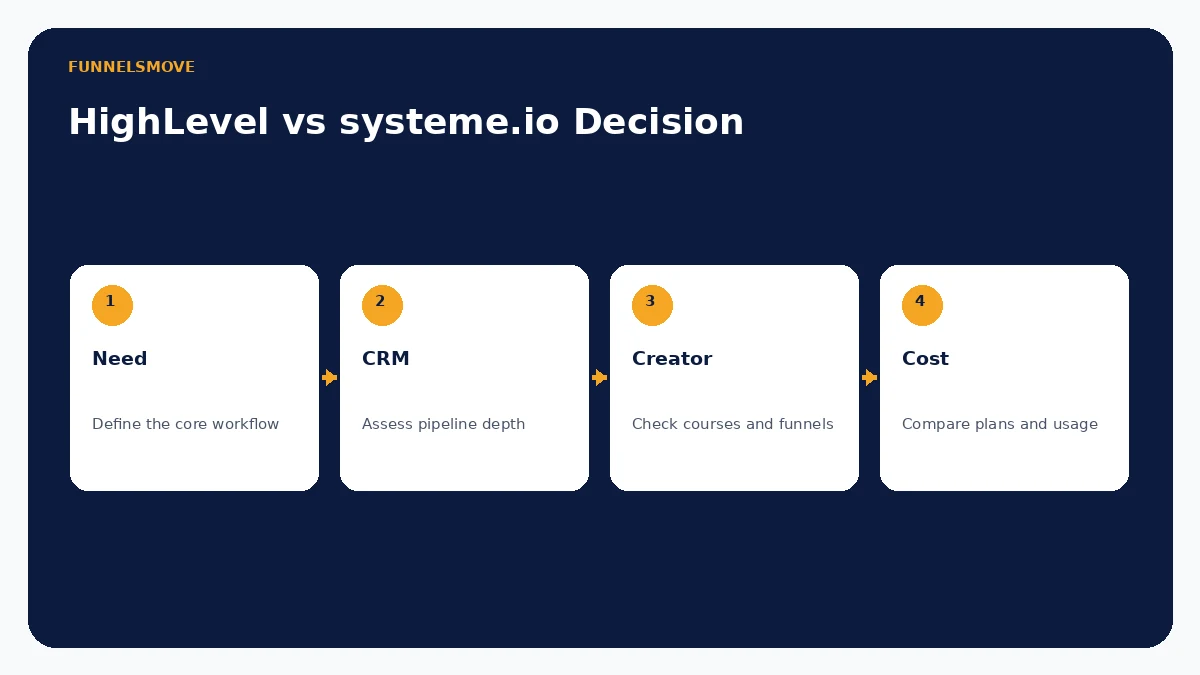
If the business is primarily an agency or service operation that needs lead pipelines, multiple client locations, conversations, calendars and sophisticated workflow automation, HighLevel's architecture is closer to that problem. If the business is primarily selling courses, digital products or funnels and wants to minimize software cost, systeme.io's bundled creator tools and free entry tier can be attractive.
Neither conclusion should be based on a single feature checkbox. List the systems that must be authoritative, the number of contacts/client accounts, the communication channels used and the expected automation complexity.
CRM, pipelines and client operations
HighLevel's CRM is deeply connected to contacts, opportunities, conversations, calendars and workflows. Agencies can separate clients into sub-accounts and, on higher plans, rebill supported services. That structure is one reason HighLevel is commonly evaluated by agencies and multi-client operators.
systeme.io includes CRM pipeline functionality and automation, but its public positioning centers more heavily on funnels, email, courses, affiliate management and creator commerce. A creator who only needs a straightforward sales pipeline may not benefit from paying for HighLevel's broader agency model.
Funnels, websites and conversion pages
Both platforms provide funnel/page building. systeme.io advertises sales funnels with upsells, order bumps, A/B tests and templates, with plan-based limits on funnels and steps. HighLevel combines websites/funnels with CRM, forms, calendars and workflow automation; see our HighLevel website builder guide.
For a mature WordPress site, neither platform necessarily needs to replace the CMS. HighLevel can also integrate CRM assets with WordPress through LeadConnector, as covered in our WordPress guide.
Email marketing and automation
systeme.io advertises unlimited email sends on every plan, with campaigns, tagging, segmentation and automated sequences. Plan limits apply to items such as contacts, campaigns, automation rules and workflows depending on tier.
HighLevel supports campaigns, segments and workflow email, with LC Email usage currently documented separately from the base subscription. HighLevel is compelling when email behavior needs to interact with pipelines, appointments and conversations. Our email marketing guide covers sending domains and deliverability considerations.
Courses, communities and creator tools
systeme.io treats online courses, communities, affiliate management and digital selling as central parts of its creator proposition. Its current pricing page includes courses and students across plans, with limits increasing by tier and Unlimited removing many caps.
HighLevel also supports courses and memberships, but buyers should compare the learner experience, content workflow and commerce requirements rather than assuming two “course builder” labels mean identical functionality. A creator-first business may value systeme.io's simpler packaging; an agency managing lead generation around courses may value HighLevel's CRM architecture.
Calendars, communications and local-service workflows
HighLevel has extensive calendar types and CRM-connected phone/SMS/WhatsApp capabilities. Those features suit appointment-led businesses but can create separate usage and compliance considerations. systeme.io now advertises booking-calendar and SMS capabilities too, so older comparisons that omit them are incomplete.
For a service business, compare the exact booking model, reminder channels, number provisioning and compliance requirements. HighLevel's calendar guide and messaging guide explain its side of that decision.
Agency and white-label considerations
HighLevel's Unlimited and Agency Pro tiers are explicitly structured around agencies, sub-accounts and rebilling; Agency Pro adds SaaS Mode. systeme.io's current pricing table also advertises sub-accounts, but it is not the same agency SaaS model. Agencies should compare client isolation, billing control, branding, permissions and support processes rather than simply count sub-accounts.
If white-label SaaS resale is central, see our HighLevel white-label SaaS guide.
Who should choose each platform?
HighLevel is likely the better architectural fit when CRM pipelines, client sub-accounts, appointment operations, multichannel conversations and complex workflows are central. systeme.io is likely the simpler fit when the priority is inexpensive funnels, email, courses and digital-product operations with fewer agency-specific requirements.
Those are use-case distinctions, not universal rankings. A small service business may prefer systeme.io's cost structure; a creator with a sales team may prefer HighLevel's CRM. Trial the workflow that matters most and calculate total cost, including usage-based communication and payment-processing fees.
Switching considerations
Migration is more than moving contacts. Inventory domains, funnels, forms, email automations, tags, course access, payment links, calendar links and integrations. Export what each platform allows, preserve consent and suppression status, and avoid turning on duplicate automations during cutover.
Run both systems in a controlled overlap only when necessary. Decide which platform owns each data type before launch, then test forms, purchases, email, booking and CRM updates end to end.
Plan limits matter more than headline price
systeme.io's pricing model is strongly limit-driven. Its current official comparison table shows the Free plan with 2,000 contacts, three sales funnels, one workflow and one email campaign; paid tiers increase those limits, while Unlimited removes many of them. This means a business can start inexpensively, but should model how contact count, funnels, workflows, domains and campaigns grow together.
HighLevel's public pricing emphasizes account structure instead. Starter lists three sub-accounts and unlimited contacts/users, while Unlimited lists unlimited sub-accounts and Agency Pro adds SaaS-oriented controls. Usage services sit outside that simple subscription comparison. A business sending significant SMS, email or AI traffic should estimate those costs separately rather than comparing only $97 to $97.
Payments and transaction economics
systeme.io advertises 0% platform transaction fees across its plans and supports payment integrations such as Stripe and PayPal; the payment processor can still charge its own processing fees. HighLevel supports Stripe and other payment-provider options across eligible invoices, payment links, funnels, forms, calendars and commerce surfaces, with product-specific availability.
For a simple digital-product funnel, systeme.io's packaging can be easy to understand. For a service business where a payment should update a contact, opportunity, appointment or workflow, HighLevel's CRM-connected payment events may be more important. Compare refunds, subscriptions, taxes and reporting requirements before migrating commerce.
Setup complexity and operational ownership
systeme.io markets itself toward entrepreneurs who want an integrated toolkit without stitching together many services. Its feature set can therefore be attractive when one owner manages funnels, email and courses. HighLevel exposes more operational layers—sub-accounts, phone systems, workflows, pipelines, calendars, permissions and agency rebilling—which can support more complex organizations but also require stronger administration.
That difference affects implementation cost. A lower subscription can still be expensive if the team spends time working around missing process controls; a more capable CRM can be wasteful if the business uses only a landing page and email sequence. Assign an owner for automations, data hygiene and billing in either platform.
Data, integrations and extensibility
HighLevel provides API and webhook capabilities and has a growing integration ecosystem, which matters when the CRM must exchange data with other operational systems. systeme.io also publishes API/integration capabilities, but the required endpoints, rate limits and objects should be checked against the exact integration rather than assumed from a generic “API available” label.
Before choosing either platform, list the systems that cannot be replaced: accounting, analytics, ecommerce, webinar, support, data warehouse or specialized industry software. Then test the data handoff. Native all-in-one convenience is valuable only when the platform can reliably exchange the information that must leave it.
How to run a fair trial comparison
- Build one real lead-capture funnel in each platform.
- Connect the same domain and sender identity where practical.
- Create the same segmentation and follow-up logic.
- Test a purchase or booking if that is central to the business.
- Measure setup effort, ongoing maintenance and failure recovery—not just page-building speed.
- Calculate 12-month subscription plus expected communication, payment and integration costs.
Do not migrate production data solely because one editor feels easier during a short demo. The more durable question is which system your team can operate correctly every week.
Three practical buying scenarios
Solo creator selling courses and digital products
A solo creator who mainly needs opt-in pages, sales funnels, email sequences, courses and affiliate management may find systeme.io's packaging easier to justify. The free tier provides a way to validate the operating model before paying, and the paid tiers scale contacts and asset limits. The key checks are whether the course experience, automation limits and reporting are sufficient.
Local service business with appointments and a sales pipeline
A service business that depends on calls, SMS, appointment distribution, pipeline stages, review requests and staff ownership is closer to HighLevel's center of gravity. Its calendar types, conversations and workflow engine can keep those activities around one contact record. The trade-off is a higher base subscription and usage-based communication costs that should be forecast.
Agency managing multiple client accounts
An agency should examine account isolation, permissions, rebilling, reusable configuration and white-label requirements. HighLevel's higher tiers explicitly target multi-client and SaaS-style operations. systeme.io now offers sub-accounts, but agencies should verify whether its client-management model covers their billing, branding and operational controls rather than assuming “sub-account” means the same thing on both platforms.
Support, learning curve and maintenance
Feature breadth affects training. HighLevel teams may need documented conventions for pipelines, workflows, phone configuration, calendars and sub-account administration. systeme.io's narrower creator orientation can reduce setup decisions, although sophisticated funnels and automations still require governance.
During a trial, ask the person who will maintain the system to reproduce a real failure: a bounced email, an opted-out contact, a failed payment or a changed booking. A platform is easier to operate when the team can diagnose exceptions without rebuilding the process.
Evaluate HighLevel with your real workflow
Use your actual lead sources, communication channels and operational requirements, then confirm current plan and usage charges before rollout.
Visit HighLevel (opens in a new tab)Sources checked
Product documentation and pricing were reviewed on September 17, 2026. Messaging rates, plan features and integration requirements can change, so verify account-specific settings before implementation.