HighLevel Website and Landing Page Builder Guide
HighLevel can build multi-page websites, focused landing pages and sequenced funnels, with forms, calendars, CRM and automation connected inside the same platform.
For broader context, see the HighLevel platform hub. Related reading: HighLevel platform guide · How to use HighLevel · HighLevel CRM · HighLevel integrations.
What can the HighLevel website builder do?
HighLevel can create client-facing websites, landing pages and funnels inside its Sites area. The core website builder supports multi-page sites, reusable elements, custom domains, page-level SEO settings and desktop/mobile editing. Its funnel builder uses a similar editing experience but organizes pages as a conversion sequence and supports split testing.
The strongest reason to use HighLevel for pages is not that it has a page editor; many platforms do. The advantage is that forms, calendars, contacts, opportunities and workflows can sit close to the same lead journey. A visitor can submit a form or book a call and enter the CRM without a separate page-builder integration.
Website vs landing page vs funnel
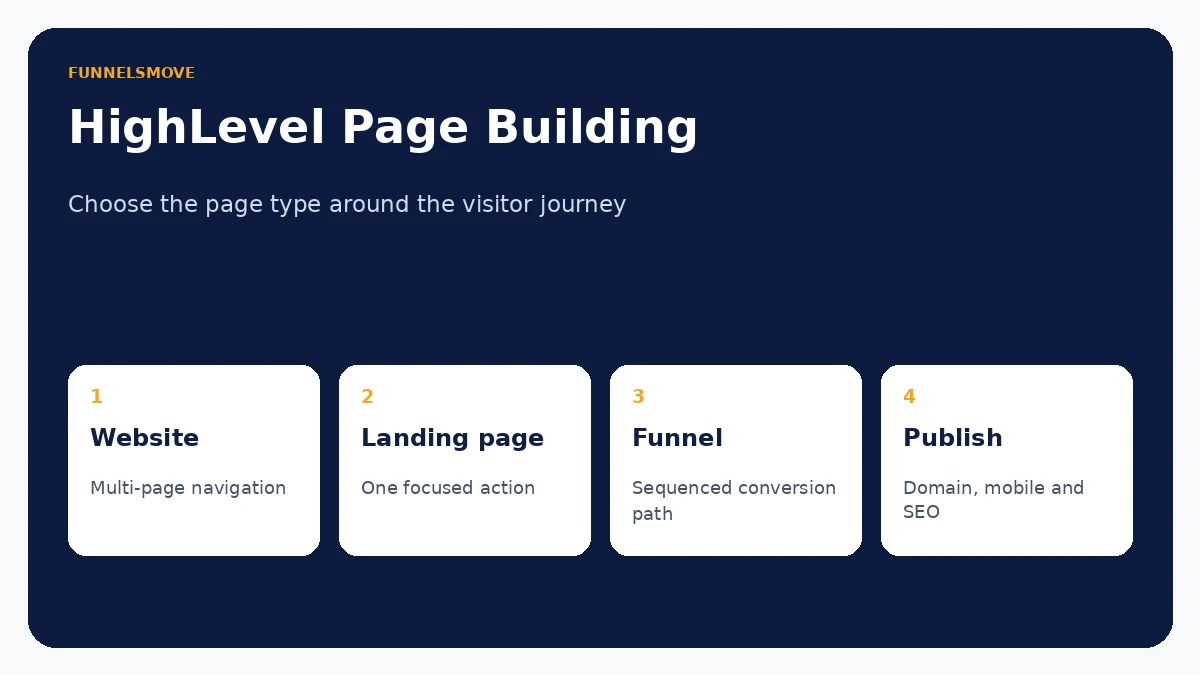
A website is usually a navigable set of pages for a business, such as Home, Services, About and Contact. A landing page is a single page built around one primary action, such as booking a call or downloading a resource. A funnel is a sequence of pages designed to move a visitor through a defined conversion path.
HighLevel’s official Websites Overview makes the same architectural distinction: websites serve broader page collections, while funnels are direct page sequences for goals such as lead capture or appointments. HighLevel currently limits native split testing to funnels, which is a meaningful reason to use a funnel when systematic conversion experiments matter.
Templates and starting options
HighLevel lets users start websites and funnels from blank layouts or templates. Its template library supports browsing and previewing designs, and the builder also supports reusable saved assets such as element templates. For a conversion page, templates are useful for structure and speed; they are not evidence that a page will convert for your offer.
Choose a template based on the information architecture you need, then replace generic copy, images, calls to action and proof. Avoid keeping decorative sections that add scrolling without helping the visitor decide. HighLevel also has AI-assisted funnel and website creation in Labs as of September 2026, but Labs features can change and should be reviewed before they become part of a production dependency.
Editing, reusable elements and layout control
The page builder provides sections, rows, elements and styling controls in a live editing canvas. Current HighLevel documentation describes desktop/mobile device switching, page metadata controls, preview, save and publish actions, plus right-side styling controls for selected elements. Newer page-builder updates also let users create and organize pages without leaving the editor.
Reusable element templates are useful for approved buttons, forms, images or branded components that should stay consistent across a location. Global sections can reduce repeated editing across larger sites. The trade-off is governance: once several team members create reusable blocks and copies, naming and ownership matter.
Forms, calendars, CRM and automation connections
HighLevel can create forms and surveys directly within the website and funnel builder, or reuse existing form assets. Form submissions can create or update CRM records and trigger follow-up. Calendar elements can be placed directly into HighLevel pages, and custom forms can collect additional information before an appointment is booked.
This is the builder’s most important strategic advantage for many service businesses: a landing page is not an isolated front end. It can connect directly to contact records, calendars, opportunities and workflows. Test the complete journey—submission, CRM record, confirmation, owner assignment and follow-up—rather than judging the page only by its visual design.
Mobile responsiveness and responsive editing
HighLevel’s builder includes mobile views and device-specific controls. The company’s website-launch documentation recommends reviewing desktop and mobile layouts before publishing, and its responsive-design guidance describes changing settings independently for mobile where needed.
Responsive capability does not remove QA. Test headline wrapping, buttons, forms, calendars, navigation, image dimensions and spacing on real screen widths. HighLevel allows desktop-only and mobile-only visibility in some cases, but duplicating large sections just to repair responsive design can create maintenance problems.
SEO controls and organic-search considerations
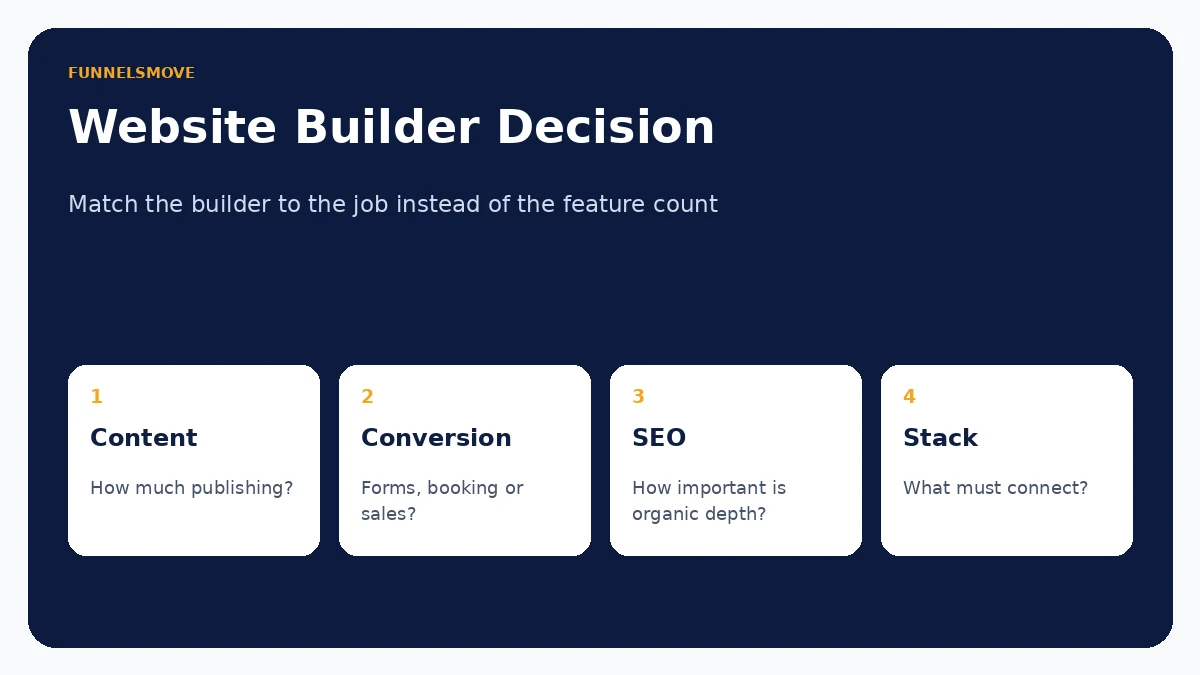
Page-level SEO settings include titles and meta descriptions, and HighLevel supports heading tags, URL paths, custom domains and other basic controls required for indexable pages. That is enough for many local-business and campaign sites. HighLevel also supports blogs, although content-heavy SEO teams should evaluate publishing workflow, taxonomy, technical flexibility and editorial tooling—not merely whether a blog module exists.
If organic publishing is the primary growth engine and the team expects hundreds or thousands of editorial pages, a dedicated content-management system may provide a better long-term authoring ecosystem. HighLevel can still handle landing pages and lead capture while an external CMS owns the content site.
Domains, publishing and launch checks
HighLevel supports root domains and subdomains for websites and funnels. Its current documentation covers both automated Domain Connect and manual DNS configuration. Before launch, verify the intended homepage, page paths, SSL issuance, navigation links, forms, calendar booking, tracking and mobile layout.
Keep website, funnel, email-sending, API/white-label and other domain purposes distinct. HighLevel’s September 2026 domain guide explicitly documents multiple domain types, and mixing them without a plan can create DNS conflicts.
Who should use HighLevel for websites and landing pages?
HighLevel is a strong fit for agencies and service businesses that want lead-generation pages tightly connected to CRM, scheduling and automation. It is also attractive when an agency wants to standardize pages across client sub-accounts.
A dedicated website platform may be preferable when the project requires advanced content management, complex ecommerce catalogs, highly specialized design systems, large-scale editorial workflows or developer-controlled application behavior. The correct question is not whether HighLevel “can build a website,” but whether its builder and operational model fit the website you intend to maintain.
If a page needs custom server-side data exchange beyond native forms and integrations, see the HighLevel API and webhooks guide before designing a custom connection.
Test the builder with a real lead journey
Use a real form, booking flow or funnel during the trial so you can judge the page editor and the CRM/automation handoff together—not as separate feature checklists.
Visit HighLevel (opens in a new tab)Frequently asked questions
Does HighLevel have landing-page templates?
Yes. HighLevel provides template-based starting points for sites and funnels, along with reusable page-builder assets. Templates should still be customized for the offer and audience.
Can HighLevel build a full website?
Yes. HighLevel’s Websites builder supports multi-page sites, navigation, custom domains, SEO metadata and responsive editing.
Does HighLevel support A/B testing?
HighLevel currently documents split testing for funnels. Its support documentation notes that split testing is available across plans and requires a connected domain.
Is HighLevel good for SEO websites?
It provides core SEO controls such as titles, meta descriptions, headings, URL paths and custom domains. Content-heavy publishers should also evaluate CMS depth and editorial workflow before choosing it as their primary publishing system.
Sources checked
Research and time-sensitive product facts were reviewed on September 14, 2026.
- HighLevel Websites Overview (opens in a new tab)
- Launch a website from template (opens in a new tab)
- HighLevel Template Library (opens in a new tab)
- HighLevel forms and surveys in the builder (opens in a new tab)
- HighLevel domain setup (opens in a new tab)
- HighLevel split testing (opens in a new tab)
- HighLevel SEO metadata (opens in a new tab)