HighLevel vs HubSpot: CRM, Automation and Agency Fit
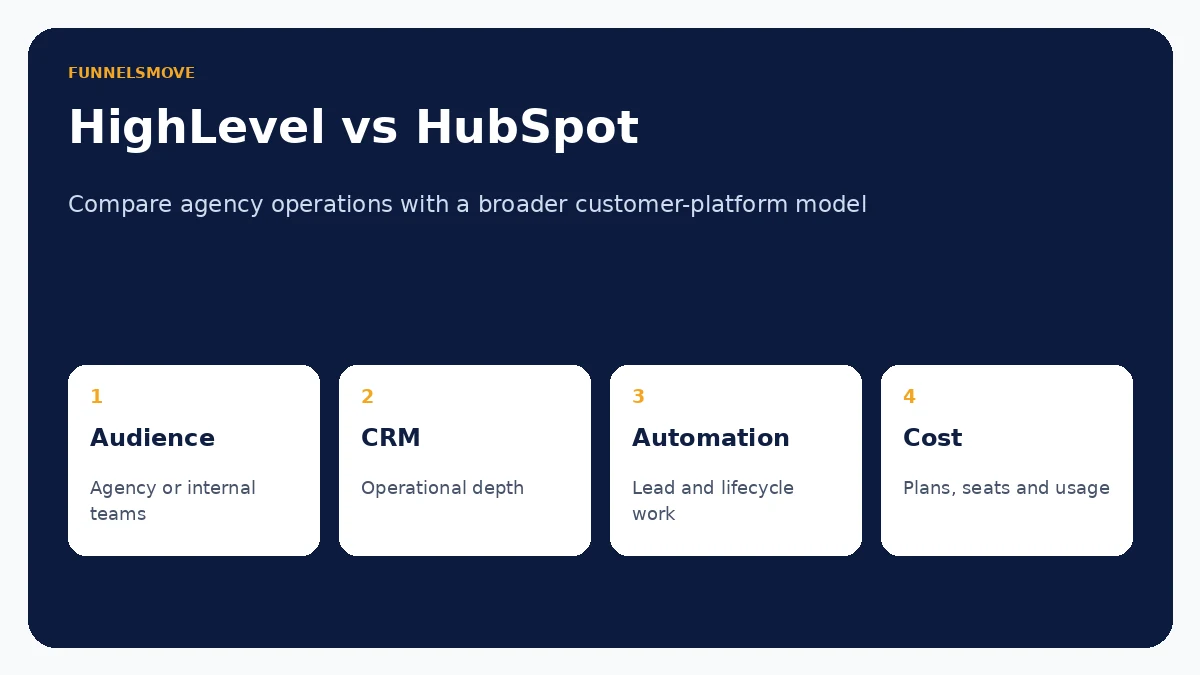
HighLevel is built around agency and service-business lead operations; HubSpot is a broader customer platform designed to unify CRM, marketing, sales, service and data across internal teams.
For broader context, see the HighLevel platform hub. Related reading: HighLevel platform guide · HighLevel review · HighLevel alternatives · HighLevel vs ClickFunnels.
HighLevel vs HubSpot: the short answer
HighLevel is generally the more natural fit for marketing agencies and service businesses that want CRM, conversations, appointments, funnels and automation organized around multiple client sub-accounts. HubSpot is generally the stronger fit for organizations that want a mature cross-functional CRM platform spanning marketing, sales, service, content, data and reporting.
Neither is a universal winner. HighLevel concentrates more agency-specific operating features in one subscription model. HubSpot offers a broader customer-platform ecosystem with modular products, seat-based access and more formal data/governance options as organizations scale. The right choice depends on who will operate the system and what process it must standardize.
Who each platform is designed for
HighLevel’s public pricing and product pages explicitly target smaller businesses, marketers and agencies, with Unlimited and Agency Pro built around unlimited sub-accounts, rebilling and SaaS-style agency operations. That account structure is a major differentiator for agencies managing many clients.
HubSpot positions Smart CRM as the shared data foundation for Marketing Hub, Sales Hub, Service Hub, Content Hub, Data Hub and Revenue Hub. Its model suits internal teams that want customer data, permissions, reporting and workflows to span departments. HubSpot also has an agency partner ecosystem, but the core product model is not centered on one agency account spinning up unlimited client sub-accounts in the HighLevel sense.
CRM and data model
Both products manage contacts and sales pipelines, but HubSpot offers the deeper enterprise-oriented CRM architecture. Its current Smart CRM product supports contacts, companies, deals, configurable CRM layouts and, at higher tiers, features such as custom objects and single sign-on. HubSpot also documents object pipelines, associations, enrichment and broader data-management products.
HighLevel’s CRM is more directly tied to lead capture, conversations, appointments and workflow automation for service businesses. Contacts and opportunities move through pipelines and can trigger follow-up without assembling separate Hubs. For a local-service operator or agency, that can be simpler. For a larger organization with complex account hierarchies, custom data models and governance, HubSpot usually deserves the deeper evaluation.
Email, SMS and customer communication
HighLevel combines email, SMS, phone and conversation history around the contact record and workflow engine. That is particularly useful for appointment-driven businesses where a missed call, form submission or pipeline change should trigger a coordinated response. Messaging usage can create additional costs, so an agency should model message volume and any rebilling policy rather than treating communication as unlimited simply because the software subscription is active.
HubSpot also supports marketing email and sales communication, but its model is more modular. Marketing Hub handles lifecycle marketing and contact-based campaigns, while Sales Hub supports seller outreach and sequences at eligible tiers. HubSpot's approach can be preferable when separate marketing and sales teams need governed tools around the same CRM record; HighLevel can be preferable when a smaller team wants calls, texts, appointments and automation concentrated in one operational workspace.
Migration, administration and switching cost
A comparison should account for the system you already have. Moving into HighLevel can mean rebuilding pipelines, workflows, calendars, phone and email configuration, forms, websites or funnels. Moving into HubSpot can involve data-model design, property mapping, lifecycle stages, permissions, marketing-contact rules, sales processes and reporting. Either migration can become expensive when historical data or integrations are messy.
Run a small representative migration before making a platform-wide decision. Import a controlled data set, reproduce one lead-to-sale journey, verify ownership and consent fields, connect critical integrations and confirm reporting. Then estimate the operational burden of ongoing administration. HubSpot may justify more formal CRM administration in a larger company; HighLevel may reduce overhead for an agency that can standardize the same configuration across clients.
Funnels, landing pages and lead capture
HighLevel has native website and funnel builders, forms, surveys and calendars inside the same platform. Funnels support sequenced conversion steps and split testing, making HighLevel well suited to lead-generation campaigns that need to flow directly into CRM automation.
HubSpot also provides landing pages, forms and content tools, with form submissions creating or updating CRM records and supporting follow-up automation. The difference is strategic emphasis: HighLevel puts funnel and appointment experiences close to agency operations, while HubSpot’s landing pages sit within a wider marketing and content platform. Businesses with extensive content operations may prefer HubSpot’s broader content ecosystem; agencies producing repeatable lead funnels may prefer HighLevel’s packaging.
Marketing automation and email
HighLevel workflows can react to forms, appointments, messages, opportunity changes and other events, combining email, SMS, internal actions and CRM updates. Its strength is operational automation around lead response and service-business workflows.
HubSpot Marketing Hub and its workflow ecosystem are built for lifecycle marketing, segmentation, campaigns and cross-object automation. HubSpot also distinguishes sales sequences from workflows: sequences are targeted sales-outreach cadences, while workflows automate broader record-based processes. Larger marketing teams may value that specialization and governance; smaller teams may prefer HighLevel’s consolidated model.
Sales pipelines and sales-team workflow
HighLevel provides opportunities and pipelines as part of the core lead-management experience. This works well where sales stages are closely connected to calls, texts, calendars and appointment follow-up.
HubSpot Sales Hub goes further for dedicated sales organizations with features such as sequences, forecasting, team structures and more specialized sales tooling depending on tier. HubSpot’s current documentation requires Professional or Enterprise for several advanced sales capabilities. A small sales team may not need that depth; a larger sales organization often will.
Agency and multi-client management
This is HighLevel’s clearest structural advantage. Its Unlimited plan currently includes unlimited sub-accounts, while Agency Pro adds SaaS Mode, automated sub-account creation and other agency-oriented capabilities. Agencies can standardize deployments with snapshots and operate many client workspaces under one agency layer.
HubSpot accounts are better thought of as customer platforms for the organization using them. Agencies can manage HubSpot client relationships through partner processes, but client portals remain individual HubSpot environments with their own subscriptions and governance. An agency selling a standardized CRM/automation environment to many local businesses will usually find HighLevel’s model more purpose-built.
Reporting, governance and scalability
Both platforms provide reporting, but HubSpot’s architecture is better suited to organizations that need formal cross-team governance, custom reporting and increasingly sophisticated data models. Its Professional and Enterprise tiers add capabilities around teams, custom CRM configuration, data products and other controls.
HighLevel reporting is oriented more toward agency, marketing, pipeline and operational use cases. It can scale to high-volume organizations, and HighLevel also offers a custom Enterprise plan, but companies with complex BI, governance and CRM-administration requirements should validate reporting depth and data architecture carefully before replacing a mature enterprise CRM.
Integrations and APIs
HighLevel supports native integrations, Marketplace apps, OAuth/private integrations, webhooks and public APIs. Unlimited currently lists Basic API Access; Agency Pro lists Advanced API Access. This is useful for agencies building repeatable client systems or SaaS extensions.
HubSpot has a large app ecosystem and developer platform spanning CRM, marketing, sales, service and data use cases. The more important comparison is not marketplace size in isolation: list the systems that cannot move—finance, product, data warehouse, support, ecommerce—and verify the exact integration depth, ownership and failure handling required.
For the HighLevel side of that technical evaluation, see the HighLevel API and webhooks guide. If landing pages and funnel production are important, the HighLevel website builder guide covers that workflow in more depth.
Pricing structure: why a simple price table misleads
HighLevel’s public pricing is comparatively compact: Starter is currently $97/month, Unlimited $297/month and Agency Pro $497/month, plus usage-based communications, AI and optional add-ons. That makes account-level budgeting straightforward, although downstream usage still matters.
HubSpot is modular. Its September 2026 Product & Services Catalog lists Smart CRM Starter at $20 per seat, Professional at $50 per seat and Enterprise at $75 per seat, while separate Hubs have their own prices, seat models, contact tiers and onboarding requirements. For example, HubSpot’s current bundle page lists Marketing Hub Professional at $890/month and Enterprise at $3,600/month before applicable onboarding and scaling inputs. HubSpot Credits can also apply to certain usage-based AI/data actions.
Therefore, compare a realistic configuration—not HighLevel Agency Pro against a single HubSpot seat. Model the actual number of users, marketing contacts, required Hubs, onboarding, credits, client accounts and communication usage.
Ease of use and implementation
HighLevel can feel complex because many tools are concentrated in one interface, but its model is coherent for agency operators who repeatedly configure similar lead workflows. Snapshots and sub-accounts help standardize deployment.
HubSpot is often approachable at the basic CRM level, but a mature multi-Hub implementation requires deliberate data architecture, permissions, lifecycle definitions, reporting and administrator ownership. Neither system is “easy” once it becomes the operational backbone of a growing organization. The relevant question is which complexity matches your team.
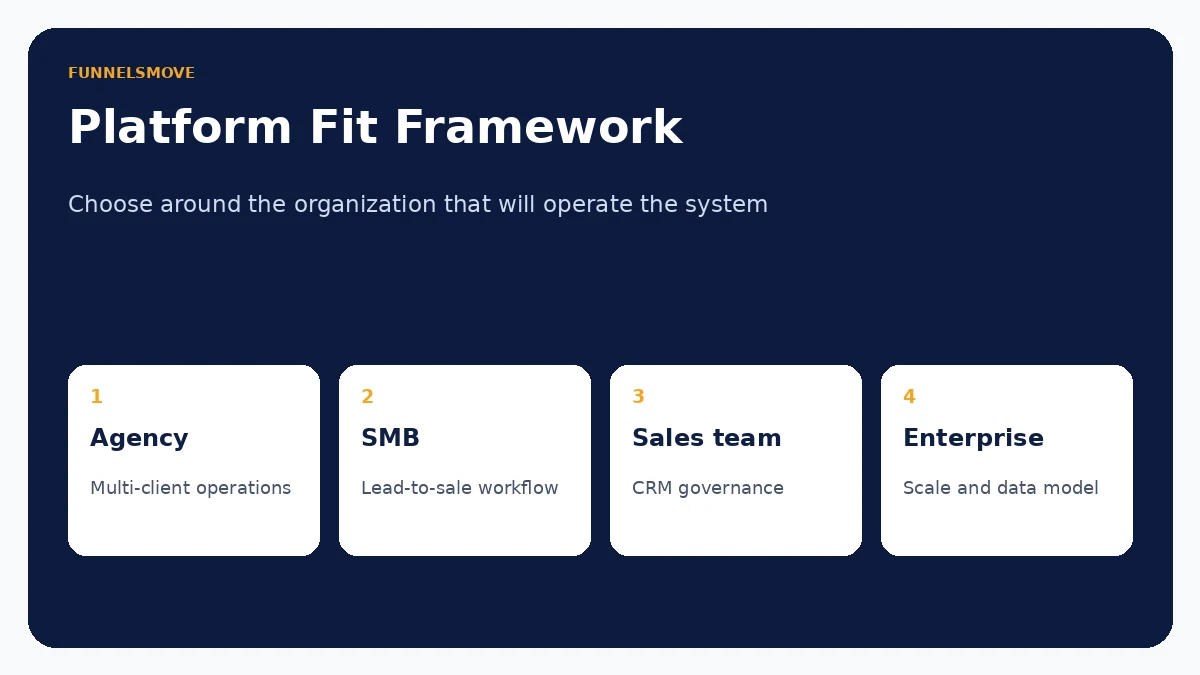
Which platform fits which buyer?
| Buyer | Usually start with | Why |
|---|---|---|
| Marketing agency managing many SMB clients | HighLevel | Sub-accounts, snapshots, CRM/automation and SaaS-oriented agency tooling. |
| Small service business | HighLevel or HubSpot | HighLevel fits appointment/lead automation; HubSpot fits teams wanting a CRM that can expand across functions. |
| Dedicated sales team | HubSpot | Sales Hub provides deeper sales-engagement, forecasting and team capabilities at higher tiers. |
| Larger organization | HubSpot | Broader governance, custom data, departmental Hubs and enterprise CRM architecture. |
| Advanced CRM/data requirements | HubSpot | Custom objects, data products and cross-functional customer-platform design. |
| Funnels + agency operations | HighLevel | Lead pages, conversations, appointments and automation are packaged around client operations. |
If your team is genuinely between the two, run one real customer journey in each: capture a lead, assign ownership, automate follow-up, book a meeting, move the opportunity and report the outcome. Measure setup effort and ongoing administration—not just feature availability.
Important limitations on both sides
HighLevel’s all-in-one approach can mean a broader learning surface and usage-based costs beyond the subscription. Its CRM and reporting may not match every enterprise governance requirement. HubSpot’s modular model can become expensive as a company adds Hubs, seats, marketing contacts, onboarding and usage-based features; advanced capabilities are frequently tier-gated.
Migration also matters. If one platform already contains years of clean history, workflows, reporting and trained users, the switching cost can outweigh an attractive feature difference. Treat migration as an operating project, not a software checkout decision.
Evaluate HighLevel against your operating model
If agency sub-accounts, lead response and automation are central to the decision, test HighLevel with one real workflow and compare the result with the CRM depth and governance your organization requires.
Visit HighLevel (opens in a new tab)Frequently asked questions
Is HighLevel better than HubSpot for agencies?
HighLevel is usually more purpose-built for agencies that manage many client sub-accounts and want repeatable CRM, automation and SaaS-style delivery. HubSpot can be excellent for agencies serving clients that already use HubSpot, but its core account model is different.
Is HubSpot more expensive than HighLevel?
It can be, especially when multiple paid Hubs, seats, marketing contacts, onboarding and credits are required. But HubSpot also has free and lower-cost entry options. Compare the configuration your organization actually needs.
Which has the stronger CRM?
HubSpot generally has the deeper CRM and data-governance architecture for larger sales and cross-functional teams. HighLevel’s CRM is tightly integrated with agency, appointment, conversation and lead-automation workflows.
Which is better for funnels?
HighLevel is usually the more natural fit when funnels, forms, calendars and lead automation are central. HubSpot also has landing pages and forms, but its broader strength is the connected customer platform.
Sources checked
Research and time-sensitive product facts were reviewed on September 14, 2026.
- HighLevel pricing (opens in a new tab)
- HighLevel CRM (opens in a new tab)
- HubSpot Product & Services Catalog (opens in a new tab)
- HubSpot pricing (opens in a new tab)
- HubSpot Smart CRM (opens in a new tab)
- HubSpot forms documentation (opens in a new tab)
- HubSpot pipelines documentation (opens in a new tab)
- HubSpot seat management (opens in a new tab)