HighLevel vs Kajabi: CRM, Funnels and Courses Compared
HighLevel starts from CRM and service-business operations; Kajabi starts from creator products, courses and audience monetization. Their overlap is real, but their centers of gravity differ.
HighLevel vs Kajabi: the short answer
HighLevel is usually the closer fit for agencies and service businesses that need CRM pipelines, appointments, conversations, lead follow-up and multi-client operations. Kajabi is usually the closer fit for creator-led businesses whose core products are courses, memberships, communities, coaching and digital offers.
Both can build pages, send email, automate customer journeys and sell digital products. The decision is therefore about operating model, not a simple feature checklist: do you primarily manage leads and service workflows, or primarily create, sell and deliver knowledge products?
Who each platform is built around
HighLevel’s current pricing and product structure explicitly addresses small businesses, marketers and agencies, with higher plans supporting unlimited sub-accounts and SaaS-oriented agency features. Kajabi’s current plans are organized around creator-business capacity such as products, contacts, websites, communities and admin users.
For a coach, either can work. A coach with a sales team, appointment setters, pipelines and heavy SMS follow-up may lean toward HighLevel’s operating model. A coach whose business revolves around polished courses, memberships, community and creator commerce may prefer Kajabi’s product-centered model.
Courses, memberships and communities
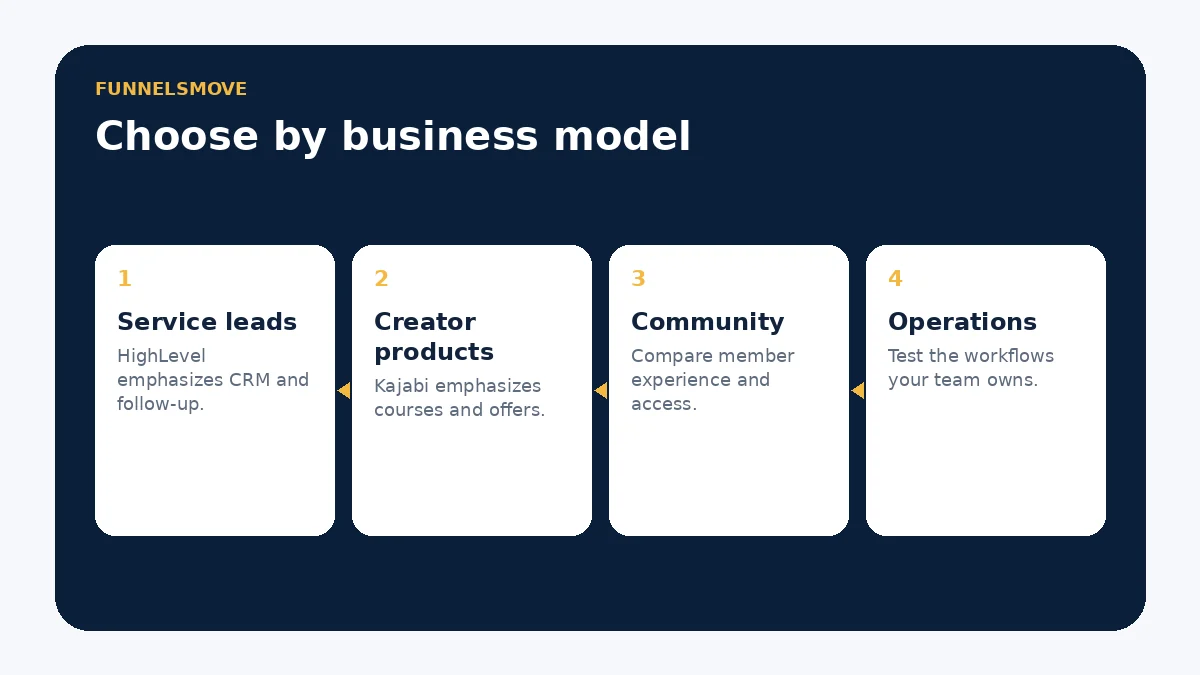
Kajabi treats digital products and learning as core platform experiences. Its current course pages emphasize course delivery, email automation, funnels, checkout and community around the creator business. Kajabi Communities connect spaces, offers, memberships and member access.
HighLevel also supports courses, offers and Communities, including paid courses and multiple access models. Its advantage is that learning can sit alongside the same CRM, workflows and service-business tools used before and after the sale. Read the HighLevel courses and memberships guide for the implementation details.
CRM, pipelines and appointment operations
HighLevel has a stronger CRM-first operating model: opportunities, pipelines, conversations, calendars and workflows are central to the platform. That is useful when a lead must be assigned, called, texted, booked and moved through a sales or service process.
Kajabi manages contacts and customer activity around creator products, but it is not positioned as a multi-client agency CRM. If a complex sales pipeline, call workflow or client sub-account model is essential, test those requirements before choosing a creator platform for its course experience alone.
Funnels, pages and email automation
Both platforms can support landing pages, funnels and automated email. Kajabi’s course product pages describe built-in broadcasts, automated sequences, behavior-based triggers, lead-capture forms and landing pages. HighLevel combines funnels and websites with CRM-triggered workflows that can also use SMS, phone and appointment events.
Creators should test the authoring experience they will use weekly. Service teams should test the operational handoffs they will use daily. A platform can technically contain both features while still being optimized around a different job.
Payments and commerce
Both platforms support selling offers, but the surrounding commerce model differs. Kajabi packages creator products, checkout and monetization around its product ecosystem. HighLevel can connect payments to funnels, forms, invoices, subscriptions, calendars and course offers depending on the payment provider and surface.
Do not compare “transaction fees” without reading the payment-provider terms. Kajabi’s current pricing page notes that processing fees apply and vary by country/payment provider. HighLevel likewise separates its subscription from processor fees and certain usage/service charges.
Pricing-model context
HighLevel currently lists Starter at $97/month, Unlimited at $297/month and Agency Pro at $497/month. Kajabi currently lists Basic, Growth and Pro plans with different product, contact, website, community and admin-user limits; the displayed price also differs between monthly and annual billing.
The raw subscription price does not answer which is cheaper for your business. Model contact growth, admin seats, product limits, client accounts, communications usage, payment processing and any external tools that remain necessary.
Comparison table
| Priority | HighLevel | Kajabi |
|---|---|---|
| Agency/client accounts | Core strength | Not the primary model |
| CRM pipelines and lead operations | Core strength | More creator/customer oriented |
| Courses and creator products | Supported and integrated | Core platform focus |
| Community | Communities + courses | Core creator ecosystem |
| Funnels/email | CRM/workflow centered | Creator-product centered |
Choose HighLevel if…
- You run an agency or service business with lead pipelines and appointments.
- SMS, phone, CRM and workflow automation are central.
- You need repeatable client sub-accounts.
- Courses support the business but are not the only operational requirement.
Choose Kajabi if…
- Your main business is creating and selling knowledge products.
- Course, membership and community experience is the center of the offer.
- You want creator commerce, email and funnels organized around products and members.
- You do not need HighLevel’s agency/sub-account operating model.
Switching considerations
Before migrating, inventory course media, lesson structure, member access, payment subscriptions, email automations, forms, domains, analytics and consent records. Test the member experience and payment/access handoff before moving live customers.
For a broader HighLevel evaluation, use the HighLevel review and pricing guide. If email automation is the deciding factor rather than courses, compare HighLevel vs ActiveCampaign.
Creator experience versus service operations
Kajabi’s product model starts with what a creator sells and delivers: courses, memberships, communities, coaching and related digital products. The surrounding website, checkout, email and automation features support that creator journey. HighLevel starts closer to a CRM/contact journey: capture a lead, communicate, book, move an opportunity, collect payment and automate follow-up, with courses and communities available inside that wider operating system.
This difference affects everyday administration. A creator may spend most of the week editing lessons, offers and member experiences. An agency may spend most of the week reviewing pipelines, conversations, appointments and client accounts. Choose the interface and data model that match the work your team performs most often.
Email marketing and audience management
Kajabi includes email broadcasts and automated sequences as part of its creator platform, with behavior-based automation connected to product and member activity. HighLevel email can be combined with CRM events, appointments, opportunities, forms and multichannel workflows.
Neither platform can guarantee inbox placement. Authentication, consent, list quality and sending practices still matter. If advanced email automation is the main buying criterion rather than courses or CRM consolidation, include a specialist marketing-automation platform in the evaluation rather than forcing a two-product choice.
Websites, landing pages and publishing
Both products can build web and landing-page experiences, but businesses with an established content site should inventory SEO-critical URLs, blog archives, navigation and editorial workflows before migrating. Moving a course checkout is different from moving an authority content site.
A hybrid setup can be sensible: keep a dedicated content site while using the chosen platform for offers, courses or CRM workflows. The goal is not to minimize the number of domains or tools at any cost; it is to keep the customer journey maintainable and measurable.
Reporting, administration and team structure
Kajabi’s plan limits include products, contacts, websites, communities and admin users, so a growing creator team should model those constraints. HighLevel’s higher plans emphasize sub-account scale and agency controls, while usage-based services can add costs outside the base subscription.
For either platform, test role access, reporting and the tasks an assistant or team member must perform. A founder-friendly interface can become awkward if multiple departments need distinct permissions and reporting responsibilities.
Scenario comparison
Solo course creator: Kajabi is a natural starting point when course delivery, offers, community and creator marketing are the business itself. HighLevel becomes more compelling if the creator also runs a substantial appointment-led sales process or wants a broader CRM/communications stack.
Coaching company with setters and closers: HighLevel may fit the pipeline, calendars and messaging operation more directly, while Kajabi may provide the preferred learning/member experience. Test whether one platform can satisfy both sides or whether a deliberate two-system architecture is cleaner.
Marketing agency selling training to clients: HighLevel can be attractive because courses can sit inside the same broader client-management ecosystem. Kajabi can still be appropriate if the training product has a distinct creator brand and member experience independent of agency CRM operations.
How to compare them in a trial
- Build one real lead-capture page and offer in each platform.
- Create a short course or member area with the same content.
- Test purchase, access, cancellation and support flows.
- Recreate one sales or nurture automation.
- Have the actual administrator update a lesson, contact and automation.
- Calculate first-year subscription, payment, communications and migration costs.
Do not migrate production customers because one demo screen feels easier. Test the complete revenue and delivery path your business depends on.
Coaching businesses: the overlap is real
Coaches are the audience most likely to find both products plausible. Kajabi can package coaching alongside courses, communities, email and digital offers. HighLevel can manage lead capture, qualification, appointment booking, sales pipelines, messaging and post-sale automation, while also delivering courses and communities.
The deciding question is where complexity lives. If complexity is in content, member access and creator products, Kajabi’s center of gravity is relevant. If complexity is in lead response, appointment setting, sales ownership and client communication, HighLevel’s CRM center of gravity is relevant. A larger coaching company may deliberately integrate a sales CRM with a separate learning platform rather than asking one product to optimize both jobs.
Community and retention workflows
Community is more than a checkbox. Test how members discover content, receive announcements, manage access and move between paid offers. Kajabi positions Communities as an integrated part of the creator business. HighLevel Communities can connect learning with the broader CRM and workflow environment.
For retention, decide what signals matter: course progress, community participation, appointment attendance, subscription state, support requests or sales opportunities. Then verify which signals can trigger the follow-up you actually need without fragile manual work.
Agency and multi-brand considerations
HighLevel’s sub-account architecture is a major difference for agencies serving multiple independent businesses. Kajabi’s current plans specify limits for websites, communities and admin users, but it is not designed around the same agency-client sub-account model.
A creator company with several brands should still compare Kajabi’s higher plan limits and operating model with the cost of separate environments elsewhere. An agency should test client isolation, permissions, templates and billing before assuming a creator platform can be stretched into agency infrastructure.
Important limitations on both sides
HighLevel’s all-in-one breadth means more operational settings and usage-based services to manage. Its course experience may not be the preferred fit for every creator. Kajabi’s creator focus may leave sales teams wanting a different CRM or more specialized service-business communication workflow.
Neither platform removes payment-processor rules, consent obligations, email deliverability work or migration risk. Product limits and pricing can also change. Use current vendor documentation and a test account for any requirement that would block launch.
Questions to answer before choosing
- Is the core revenue engine a sales pipeline or a catalog of creator products?
- How important are appointments, SMS and phone workflows?
- How sophisticated must the course and community experience be?
- Do you manage multiple client businesses or one creator brand?
- How many products, contacts, sites, communities and admins will you need?
- Which existing content URLs and subscriptions must survive migration?
- Who owns CRM hygiene, course updates and member support after launch?
Primary sources
- HighLevel pricing (opens in a new tab)
- HighLevel course launch guide (opens in a new tab)
- Kajabi pricing (opens in a new tab)
- Kajabi online courses (opens in a new tab)
- Kajabi Communities (opens in a new tab)
Time-sensitive product and pricing context was checked on September 19, 2026. Verify current plan limits and configured payment costs before purchase.
Evaluate HighLevel for your workflow
Use the current plan and product details to test the workflows that matter before committing production data.
Explore HighLevel (opens in a new tab)