Simvoly vs 10Web: AI Builder and Funnel Fit
Simvoly vs 10Web: AI Builder and Funnel Fit. Compare key features, practical workflows, costs, limitations and who each option fits.
Overview
10Web focuses on AI-assisted WordPress website creation, managed hosting, and related agency or ecommerce workflows. Simvoly is a hosted site, funnel, CRM, and commerce platform.
What differs
10Web projects can involve WordPress and its plugin ecosystem, bringing extensibility alongside plugin and maintenance decisions. Simvoly bundles more customer and conversion tools in one hosted environment.
What to test
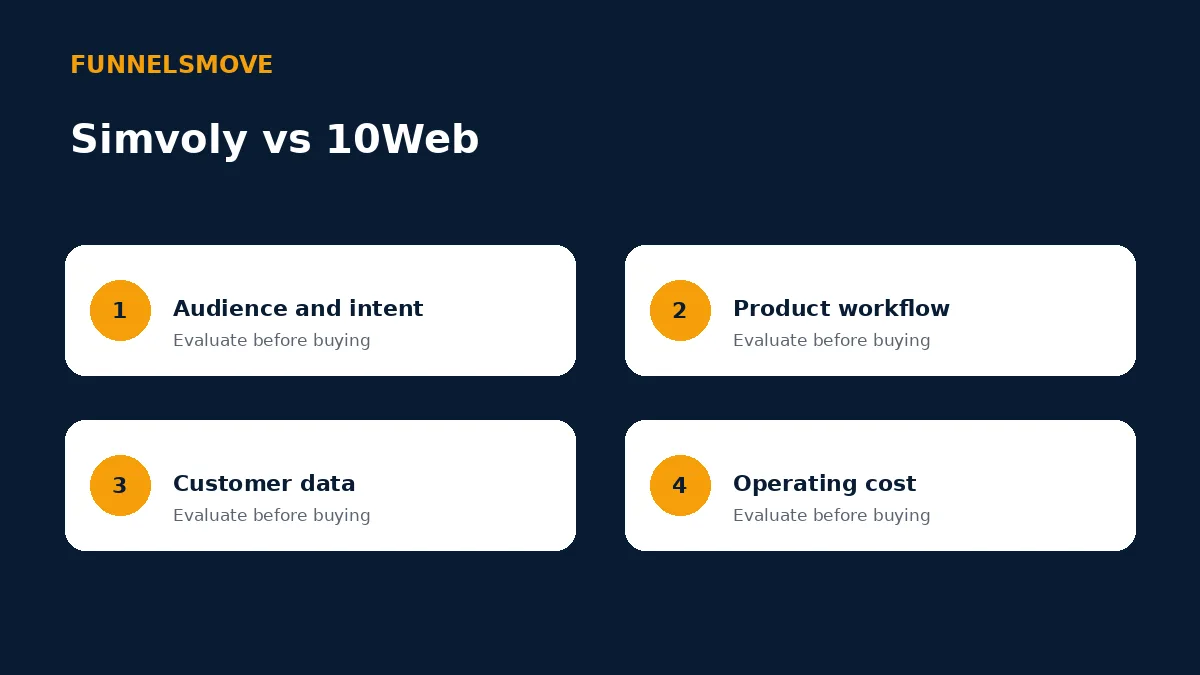
Compare AI generation quality, editing after generation, plugin requirements, hosting, funnels, checkout, customer records, and recurring support responsibilities.
AI-generated WordPress sites
10Web positions its product around AI-assisted website generation, WordPress-based editing and managed hosting. That can be attractive to teams that want a fast starting point with WordPress extensibility. Simvoly instead integrates websites with native funnels, CRM, marketing and commerce workflows.
WordPress flexibility and responsibility
WordPress can be extended through themes and plugins, but extension also creates compatibility, security and maintenance work. Confirm exactly which plugins, hosting resources and AI credits a 10Web plan includes. Avoid comparing an unconfigured WordPress site with a complete Simvoly project.
Builder and content workflow
Create a page from the same brief, then revise its layout, metadata, navigation and mobile presentation. AI output quality matters less than whether the final result is accurate, maintainable and accessible. Test handoff to the staff who will publish content after launch.
Funnel and CRM requirements
If the project requires lead nurturing, sales pipelines or custom checkout offers, compare Simvoly’s built-in tools with the WordPress plugins and external services needed in 10Web. Record integration cost and data ownership for each workflow.
Pricing and plan eligibility
10Web markets different AI builder, ecommerce, hosting and agency packages. Prices and included AI allowances vary, so confirm the exact current plan and billing term before purchase. Simvoly uses a different bundle of projects, funnels, subscribers and business tools.
How to evaluate the fit
Start by identifying the one customer journey that creates revenue. Include the entry page, signup or purchase, follow-up, fulfillment and reporting. Score tools against that journey rather than counting every advertised feature. The winner is the platform your team can operate reliably with acceptable costs.
Website and design workflow
Build a representative homepage, service or product page, contact form and mobile layout. Test global styling, editing speed, responsive behavior, navigation and SEO metadata. Ask a second team member to make routine updates without assistance. A polished demo is not evidence that everyday maintenance is easy.
Lead generation and conversion
Test the visitor journey from a campaign link to a form, booking or checkout. Record whether leads arrive in the expected contact database, whether consent is captured, and whether the next communication is triggered correctly. Inspect analytics using controlled test submissions rather than trusting an empty dashboard.
Customer management and follow-up
Map where contact records live, who owns them, which fields are stored and how duplicates are resolved. If the business needs segmentation, reminders, email sequences or sales pipelines, build those workflows in the trial. A platform can offer forms without replacing a full CRM or automation system.
Ecommerce and delivery
Create a representative product or service, then test payment, confirmation, access and refund or cancellation handling. Digital downloads, appointments, courses, memberships and physical goods have different operational needs. Do not assume the presence of a buy button proves the complete workflow is supported.
Integrations and portability
List every external service needed for payments, accounting, analytics, CRM, calendars and messaging. Check whether each connection is native, API-based or dependent on a third-party automation service. Confirm what can be exported if you change vendors and whether customer history or automation state requires manual rebuilding.
Pricing and total ownership cost
Compare the configuration that supports actual traffic, contacts, products, staff and sites. Add transaction fees, email capacity, extensions, hosting, integrations, renewal pricing and time spent administering the stack. Vendor pricing changes frequently, so verify the checkout price and term before buying.
SEO and migration risks
Inventory URLs, page titles, redirects, blog content, product pages and analytics before migration. Rebuilding a website on a different platform may change URL structure and require redirect mapping. Check canonical tags, mobile usability, metadata and internal links before sending production traffic.
Security and operational ownership
Decide who controls domains, payment accounts, integrations, access permissions and backups. Hosted products reduce some maintenance tasks but do not remove the need for good account security and documented workflows. Where plugins or external services are involved, assign an owner for updates and troubleshooting.
Agency and multi-client use
If you manage client projects, test account separation, staff roles, client access, template reuse, support and billing. Simvoly offers a dedicated white-label model, but another product may be stronger for a narrower service. Agency economics depend on repeatable onboarding and support load, not just the subscription price.
A practical trial checklist
Build one real offer using the same copy and assets in both candidates. Submit a test lead, complete a test purchase when appropriate, inspect customer records, edit a page and verify reporting. Repeat the hardest workflow on mobile and ask someone else to maintain the result. Record every workaround.
Questions to ask before deciding
Which function is non-negotiable? What does the business sell? How many sites and users will it need in twelve months? What marketing stack already works? Which customer records must be preserved? How costly would migration be? Write down these answers before the trial to avoid a decision based on visual preference.
Making a low-risk choice
Start with a contained campaign or pilot before migrating an established site. Define acceptance criteria for forms, checkout, customer access, redirects and analytics. Keep exports of important data, assign a cutover owner and establish a rollback process where practical. Review real support effort after launch.
What happens after AI generation
The initial generated page is only a draft. Test replacing copy, rearranging sections, updating global styles and maintaining responsive behavior after publication. A builder that generates an attractive page quickly may still require technical work to keep it accurate and consistent as the business changes.
Plugin and compatibility risk
WordPress extensibility can solve specialized requirements, but each additional plugin introduces updates, support responsibilities and potential compatibility issues. Create a list of plugins required for checkout, forms, funnels, CRM and analytics before comparing the price of the WordPress-based configuration with Simvoly.
Agency delivery
Agencies should test how a second staff member can take over a site, whether reusable designs are straightforward, and how permissions, domains and client support work. AI generation can speed initial production without eliminating revision, approvals or ongoing client maintenance.
Performance and SEO checks
Build a realistic page with actual images, scripts and forms, then test mobile performance and search metadata. Do not treat vendor performance marketing as independent evidence. Measure the deployed configuration because plugin choices, third-party scripts and page design can materially affect results.
Official sources
Simvoly pricing (opens in a new tab) · 10Web (opens in a new tab)
Explore Simvoly
Check current features, eligibility and pricing before making a decision.
Explore Simvoly (opens in a new tab)