Simvoly Alternatives: Compare Platforms by Use Case
The right Simvoly alternative depends on what you are replacing: a funnel builder, website platform, CRM, course stack, ecommerce tool or agency operating system.
Start with why you want an alternative
Searching for Simvoly alternatives only becomes useful after you identify the constraint. Simvoly combines websites, funnels, CRM, ecommerce, marketing, appointments, courses, communities and white-label capabilities, so a replacement can be broader or more specialized.
Write down the workflow that matters most, the tools you must integrate, who maintains the system and which capabilities are genuinely required. A lower subscription price is not automatically cheaper if it adds several external services or creates migration work.
This guide compares categories and practical trade-offs rather than declaring one platform best for everyone.
How we compare Simvoly alternatives
Use a consistent checklist: website and funnel flexibility, CRM and automation depth, ecommerce requirements, course or membership needs, integrations, team permissions, agency or white-label requirements, and total operating cost.
Separate must-haves from preferences. If a client-facing white-label platform is essential, that requirement can eliminate otherwise capable website builders. If advanced CRM automation is the core need, a marketing platform may deserve more weight than design flexibility.
Recheck current pricing and plan limits before switching because SaaS packaging changes.
A practical alternative-selection framework
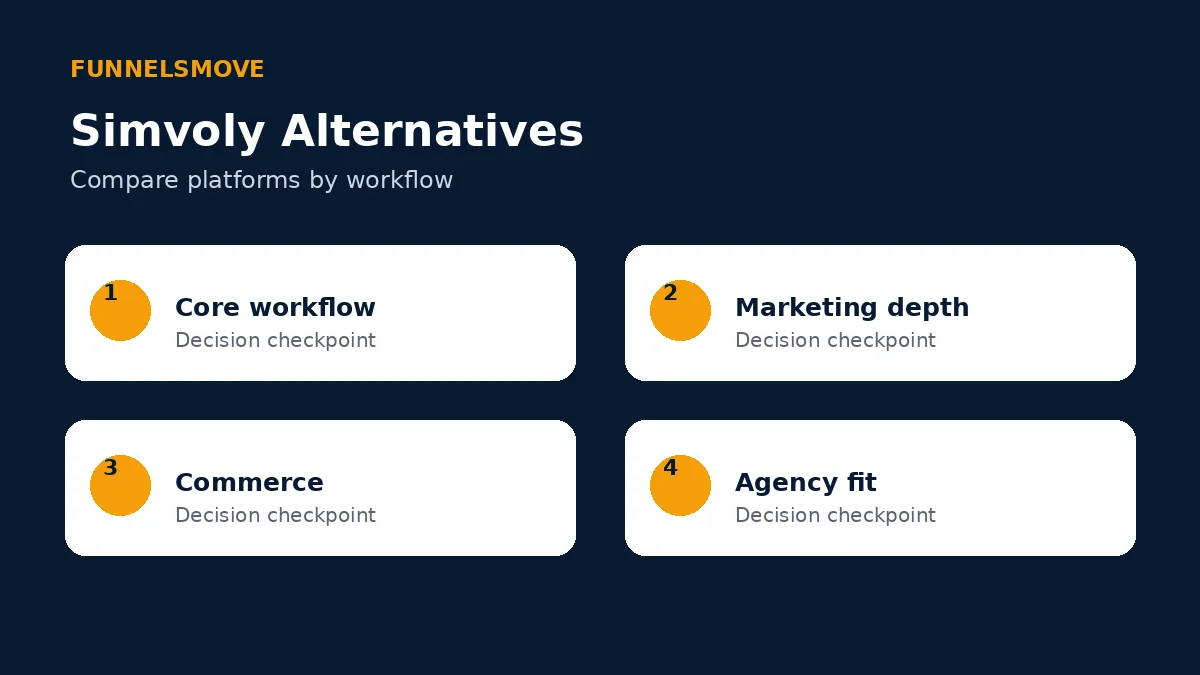
First define the primary workflow, then shortlist platforms that can perform it without fragile workarounds. Next compare the surrounding stack and migration effort. Finally, run a small proof of concept using a representative page, automation or checkout before committing.
A proof of concept should test the difficult parts, not just the homepage. Include integrations, forms, payment flow, permissions and reporting that matter to daily operations.
ClickFunnels: funnel-first alternative
ClickFunnels is a natural comparison when the priority is direct-response funnels, offers and sales journeys. It has expanded beyond its original funnel-builder identity, but funnel strategy remains central to how many buyers evaluate it.
Compared with Simvoly, assess how much you value funnel-specific workflows versus Simvoly’s combination of websites, funnels, ecommerce and white-label capabilities. Existing FunnelsMove research covers the products directly in our Simvoly vs ClickFunnels comparison.
Choose based on the workflow you will actually operate, not brand familiarity. Rebuilding a mature funnel library can be a significant switching cost.
HighLevel: CRM and agency-automation alternative
HighLevel is especially relevant to agencies and service businesses that prioritize CRM pipelines, lead follow-up, automation and client-account operations. It overlaps with Simvoly in funnels, websites and agency use cases but approaches the stack from a CRM and automation direction.
If you manage many service-business clients, compare sub-account operations, messaging, workflow depth and reporting with the design and white-label experience you need. The right choice can depend more on agency process than on page-builder features.
For broader context, FunnelsMove maintains a dedicated HighLevel platform hub.
Systeme.io: streamlined all-in-one alternative
Systeme.io is another all-in-one option aimed at combining funnels with email marketing, automation, courses and selling tools. It is relevant when simplicity and a consolidated creator stack matter more than reproducing every Simvoly capability.
Compare website flexibility, ecommerce requirements, agency/white-label needs and the exact marketing workflow you use. Do not assume two products described as all-in-one contain the same depth in each module.
Our Systeme.io platform hub links to pricing, review and implementation guides for a closer evaluation.
Website-first builders
A website-first platform can be a better alternative when content publishing, visual design or a large traditional website is the primary job and funnel logic is secondary. Examples in the broader market include hosted site builders and CMS platforms.
The trade-off is stack fragmentation. You may need separate CRM, email, appointment, checkout or automation products. That can be perfectly reasonable when specialist tools are important, but compare total cost and maintenance rather than the website subscription alone.
If your site is already established and performs well in search, migration risk should be part of the decision. Preserve URLs, redirects, structured data and analytics during any move.
Ecommerce-first platforms
An ecommerce-first platform deserves consideration when catalog management, inventory, fulfillment, complex product variants or retail operations dominate the business. Simvoly includes ecommerce, but a specialist commerce platform may provide a deeper ecosystem for stores with demanding operational requirements.
Map the entire order lifecycle: product data, payments, tax, shipping, inventory, customer service, subscriptions and reporting. A polished landing page does not compensate for a weak back-office fit.
If funnels are still important, verify how the commerce platform handles landing pages, upsells and campaign tracking or what integrations are required.
What about a cheaper Simvoly alternative?
The keyword “cheaper” needs context. Compare the cost of the complete working stack, not just the entry plan. A lower-priced tool may require paid email, CRM, automation, hosting or checkout services that Simvoly combines.
Also include labor. Connecting and maintaining several tools can cost more than the subscription difference, while a specialized stack can still be worthwhile when it delivers capabilities your team genuinely needs.
Use current official pricing pages for the finalists because promotional prices and plan limits can change.
Switching considerations
Before migrating, inventory domains, pages, funnels, forms, products, contacts, automations, email assets, integrations, analytics and redirects. Identify which data can be exported and which elements must be rebuilt.
Run old and new systems in parallel only where necessary and safe. Test forms, payments, notifications and analytics before changing production DNS. Keep backups and a redirect map for public URLs.
Switching cost is part of product fit. A modest feature advantage may not justify disruption if the current system already supports the business reliably.
Bottom line on Simvoly alternatives
There is no universal replacement for Simvoly because the product spans several categories. Funnel-focused teams may compare ClickFunnels, automation-heavy agencies may examine HighLevel, creators may consider Systeme.io, and website- or ecommerce-first businesses may prefer specialist platforms. Start with the workflow, then compare the whole operating stack.
Official sources checked
Compare by the job you need to get done
If your primary job is lead generation, compare landing-page speed, form flexibility, routing, CRM capture and follow-up automation. If the primary job is selling products, put checkout, product management, taxes, shipping, subscriptions and reporting higher on the list. If you run an agency, add account management, permissions, reusable assets, client onboarding and branding.
A platform can look strong in a generic feature table and still be awkward for your dominant workflow. Ask each vendor to demonstrate the exact sequence your team performs weekly. That is more revealing than counting features that may never be used.
Also distinguish buyer needs from operator needs. A marketer may care about campaign speed, while an administrator cares about permissions and data quality. A sustainable choice has to work for both.
CRM and automation depth
Simvoly includes CRM and marketing automation in its wider platform. If you are considering an alternative because you need more complex lead routing, multi-channel communication or deeply branched automation, document those requirements as actual scenarios before comparing products.
List triggers, conditions, actions, delays, ownership rules and reporting requirements for several representative workflows. Then verify whether each candidate handles them natively, through an integration or only through custom development.
Native is not automatically better. A specialist CRM connected cleanly to a website can be the right architecture when sales operations are sophisticated. The trade-off is additional integration ownership.
Agency and white-label requirements
Simvoly’s white-label offering is a significant part of its agency proposition, so an alternative should be evaluated differently when your business resells software under its own brand. Check custom branding, domains, client provisioning, pricing-plan controls, permissions, billing, template reuse and the support model.
Some agencies only need client workspaces, not a fully rebranded SaaS experience. In that case, paying for deep white-label capabilities may be unnecessary. Conversely, an agency whose product is the branded platform should not treat white labeling as a cosmetic feature.
Model the customer lifecycle from signup through cancellation. The best-looking sales page tells you little about how account provisioning, failed payments, upgrades and support escalations work.
Integrations and data portability
Before switching, identify every system that exchanges data with your current Simvoly setup: payment processors, email tools, analytics, calendars, CRM destinations, automation middleware and internal reporting. For each candidate, verify the connection method and who owns troubleshooting.
Ask how contacts, orders, products and other business records can be exported. Data portability matters most when you need it, and discovering limitations after a migration decision can be expensive.
Where an integration depends on middleware, include that subscription and operational dependency in your comparison. A workflow that requires three services is different from one handled inside a single platform.
A simple shortlist method
Create a scorecard with five to eight criteria that reflect your business, then assign weights before you look at vendor demos. For example, an agency might weight client management and automation heavily, while a creator might prioritize course delivery, email and checkout simplicity.
Score only capabilities you can verify. Mark unknowns as unknown instead of giving a platform the benefit of the doubt. Keep notes and source links so the decision can be revisited when pricing or features change.
After narrowing the list to two or three products, build the same representative workflow in each. The time and friction required to complete that exercise are useful evidence alongside the feature checklist.
Questions to answer before you migrate
Who owns the current Simvoly account, domains and connected payment services? Which pages generate leads or sales? Which automations are business-critical? Which contacts, products and order records must be retained? Answering these questions turns a vague software switch into a controlled project.
Document dependencies that are easy to overlook: embedded forms on third-party sites, links in advertising campaigns, webhook endpoints, calendar connections, email authentication records and staff bookmarks. A migration can technically succeed while breaking one of these peripheral workflows.
Set acceptance criteria for the new system. Examples might include a successful test purchase, a correctly assigned CRM lead, preserved search redirects and verified analytics events. Do not switch production traffic until the criteria are met.
When staying with Simvoly may make more sense
An alternatives search does not always end in a migration. If your main complaint can be solved by a configuration change, integration or better process, staying can be less disruptive than rebuilding a working stack.
Existing content, domain authority, trained staff, reusable templates and established automations all have switching value. Include those assets in the decision instead of comparing only subscription fees.
Revisit the decision when a real constraint appears: missing capability, unacceptable operating cost, reliability issue or strategic requirement that the current platform cannot meet. Switching because another dashboard looks newer is rarely a strong business case.
How to compare total cost of ownership
Add subscription fees, required add-ons, transaction-related costs where applicable, middleware, email infrastructure, migration labor, staff training and ongoing administration. Use the same time horizon for every candidate so the comparison is fair.
Then estimate the cost of complexity. A modular stack can provide excellent specialist tools, but every connection needs monitoring and ownership. An all-in-one platform can reduce integrations, yet it may require compromises in specialist depth.
The right answer is the architecture your team can operate reliably at an acceptable cost. Treat price as one decision input rather than the conclusion.
Build a decision record, not just a shortlist
For each finalist, save the official pages that support important claims and note the date checked. Record unresolved questions separately. This prevents a confident-looking spreadsheet from hiding assumptions about features, limits or pricing.
Include the people who will operate the platform in the evaluation. A founder may focus on price and breadth, while a marketer notices publishing friction and a salesperson notices CRM limitations. Short hands-on trials can expose these differences before a contract or migration creates lock-in.
Finally, define what would cause you to reconsider the choice six or twelve months later. Growth in contacts, clients, products, traffic or automation complexity can change which platform is economical. A good decision record gives you a baseline for that future review instead of restarting research from memory.
Do not overlook support and documentation
When two products appear similar, compare the quality of current documentation, onboarding material and support channels available on the plans you are considering. Your team will eventually troubleshoot a domain, payment, automation or permissions issue. Clear documentation and an escalation path can reduce downtime and dependence on one internal expert.
For agency use, also ask who supports the end client and what happens when a problem crosses from your configuration into the vendor platform. That operating boundary should be understood before you promise service levels to customers.
Explore Simvoly
Review the current product and plan details directly before deciding whether Simvoly fits your workflow.
Explore Simvoly (opens in a new tab)