Simvoly vs Stan Store: Creator Store or Website?
Simvoly vs Stan Store: Creator Store or Website?. Compare key features, practical workflows, costs, limitations and who each option fits.

Overview
A creator selling a small number of offers may prioritize link-in-bio checkout, booking, and quick product setup. A business building multi-page websites, funnels, CRM, and memberships may prefer Simvoly.
What differs
Stan Store is focused on a creator storefront and monetization, while Simvoly connects sites, funnel journeys, ecommerce, CRM, and communities. Neither category is universally superior.
What to test
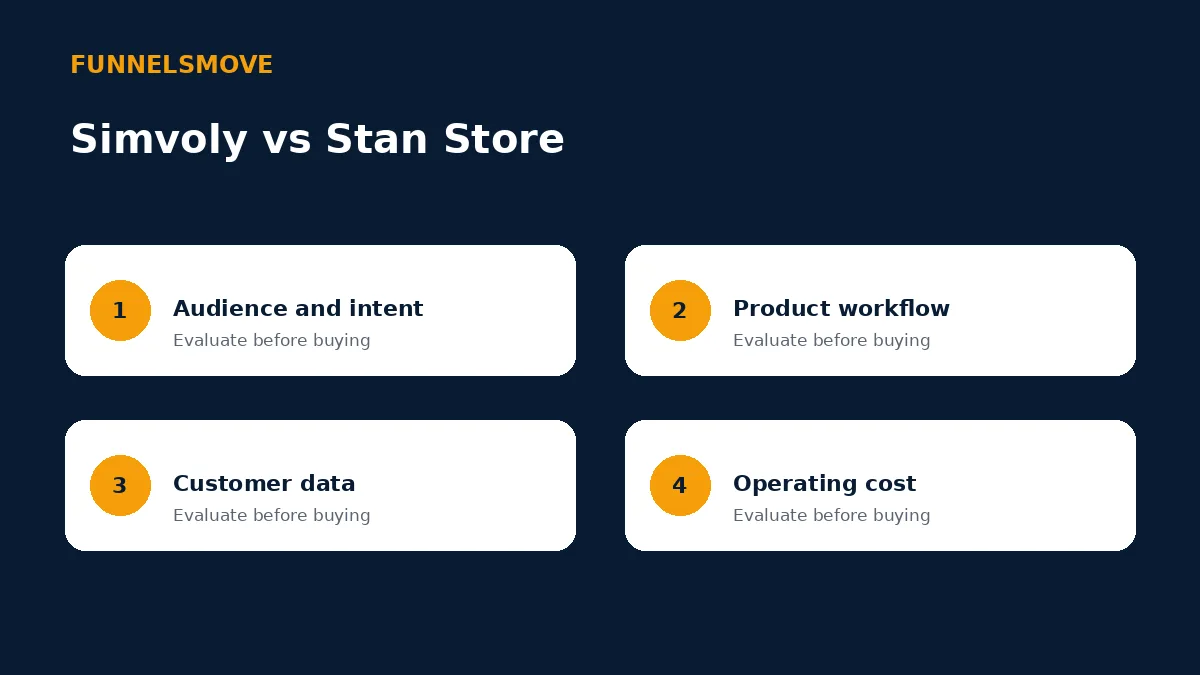
Compare the checkout path, digital delivery, lead capture, customer record, mobile storefront, and whether your brand needs a full website. Test one real product from discovery to fulfillment.
Who should consider each platform
Stan Store is oriented toward creator monetization through a compact storefront and social traffic. Simvoly is more appropriate to evaluate when the business requires a complete site, multi-step funnels, CRM, communities and ecommerce together. A creator with only one paid offer may not need a full website platform.
Storefront versus complete website
A link-in-bio creator store emphasizes quick discovery and checkout from social profiles. A full website can support deeper navigation, service pages, evergreen content and more varied customer journeys. Decide whether visitors need a catalog of creator offers or a broader web presence.
Digital products and bookings
Test delivery for a digital download, session or course, including the confirmation email, access instructions and customer support. Do not assume identical behavior merely because both tools support monetization. Check booking changes and refunds before selling time-sensitive services.
Pricing and transaction considerations
Stan Store publicly markets creator plans and optional higher-tier marketing tools; confirm current prices and applicable payment processing directly at checkout. Simvoly standard and white-label tiers use different resource limits. Model expected sales, email requirements and external services, not only the lowest plan.
When a creator should keep the simpler stack
If the audience arrives almost entirely from social media, buys one or two offers and needs little site content, a specialized storefront may minimize setup. Moving to a more comprehensive suite makes sense only when new workflows justify the added complexity.
How to evaluate the fit
Start by identifying the one customer journey that creates revenue. Include the entry page, signup or purchase, follow-up, fulfillment and reporting. Score tools against that journey rather than counting every advertised feature. The winner is the platform your team can operate reliably with acceptable costs.
Website and design workflow
Build a representative homepage, service or product page, contact form and mobile layout. Test global styling, editing speed, responsive behavior, navigation and SEO metadata. Ask a second team member to make routine updates without assistance. A polished demo is not evidence that everyday maintenance is easy.
Lead generation and conversion
Test the visitor journey from a campaign link to a form, booking or checkout. Record whether leads arrive in the expected contact database, whether consent is captured, and whether the next communication is triggered correctly. Inspect analytics using controlled test submissions rather than trusting an empty dashboard.
Customer management and follow-up
Map where contact records live, who owns them, which fields are stored and how duplicates are resolved. If the business needs segmentation, reminders, email sequences or sales pipelines, build those workflows in the trial. A platform can offer forms without replacing a full CRM or automation system.
Ecommerce and delivery
Create a representative product or service, then test payment, confirmation, access and refund or cancellation handling. Digital downloads, appointments, courses, memberships and physical goods have different operational needs. Do not assume the presence of a buy button proves the complete workflow is supported.
Integrations and portability
List every external service needed for payments, accounting, analytics, CRM, calendars and messaging. Check whether each connection is native, API-based or dependent on a third-party automation service. Confirm what can be exported if you change vendors and whether customer history or automation state requires manual rebuilding.
Pricing and total ownership cost
Compare the configuration that supports actual traffic, contacts, products, staff and sites. Add transaction fees, email capacity, extensions, hosting, integrations, renewal pricing and time spent administering the stack. Vendor pricing changes frequently, so verify the checkout price and term before buying.
SEO and migration risks
Inventory URLs, page titles, redirects, blog content, product pages and analytics before migration. Rebuilding a website on a different platform may change URL structure and require redirect mapping. Check canonical tags, mobile usability, metadata and internal links before sending production traffic.
Security and operational ownership
Decide who controls domains, payment accounts, integrations, access permissions and backups. Hosted products reduce some maintenance tasks but do not remove the need for good account security and documented workflows. Where plugins or external services are involved, assign an owner for updates and troubleshooting.
Agency and multi-client use
If you manage client projects, test account separation, staff roles, client access, template reuse, support and billing. Simvoly offers a dedicated white-label model, but another product may be stronger for a narrower service. Agency economics depend on repeatable onboarding and support load, not just the subscription price.
A practical trial checklist
Build one real offer using the same copy and assets in both candidates. Submit a test lead, complete a test purchase when appropriate, inspect customer records, edit a page and verify reporting. Repeat the hardest workflow on mobile and ask someone else to maintain the result. Record every workaround.
Questions to ask before deciding
Which function is non-negotiable? What does the business sell? How many sites and users will it need in twelve months? What marketing stack already works? Which customer records must be preserved? How costly would migration be? Write down these answers before the trial to avoid a decision based on visual preference.
Making a low-risk choice
Start with a contained campaign or pilot before migrating an established site. Define acceptance criteria for forms, checkout, customer access, redirects and analytics. Keep exports of important data, assign a cutover owner and establish a rollback process where practical. Review real support effort after launch.
Social traffic and discoverability
A creator store is often the destination of a social-profile link, so test how quickly a mobile visitor understands the offer and checks out. A full website can also support evergreen articles, service descriptions and search discovery. If search traffic matters, compare the content workflow and URL structure rather than focusing solely on the link-in-bio appearance.
Email list and follow-up
The creator should decide whether collecting email addresses is primarily for selling a product or developing a long-term audience. Test opt-in consent, tags, purchase history and follow-up sequences. If the store requires an outside email platform, include that subscription and integration in the total cost.
Scaling beyond one creator
A solo creator may operate a small catalog with minimal staff. A team adding courses, community access, multiple offers and service appointments will need clearer permissions, customer records and support workflows. Test those future needs only when growth is credible; avoid paying for an agency stack before it is useful.
Refunds and customer support
Before launch, run a test purchase and document how a buyer receives access, requests help, changes a booking and obtains a refund when appropriate. These moments affect trust more than the visual storefront. Confirm who owns the customer relationship and which vendor controls transaction records.
Official sources
Simvoly pricing (opens in a new tab) · Stan Store (opens in a new tab)
Explore Simvoly
Check current features, eligibility and pricing before making a decision.
Explore Simvoly (opens in a new tab)