Systeme.io Pricing: Free, Startup, Webinar and Unlimited
Systeme.io has a permanent free starting point and three paid tiers. The right plan depends on the capacity and workflow your business actually needs.
Systeme.io pricing: the short answer
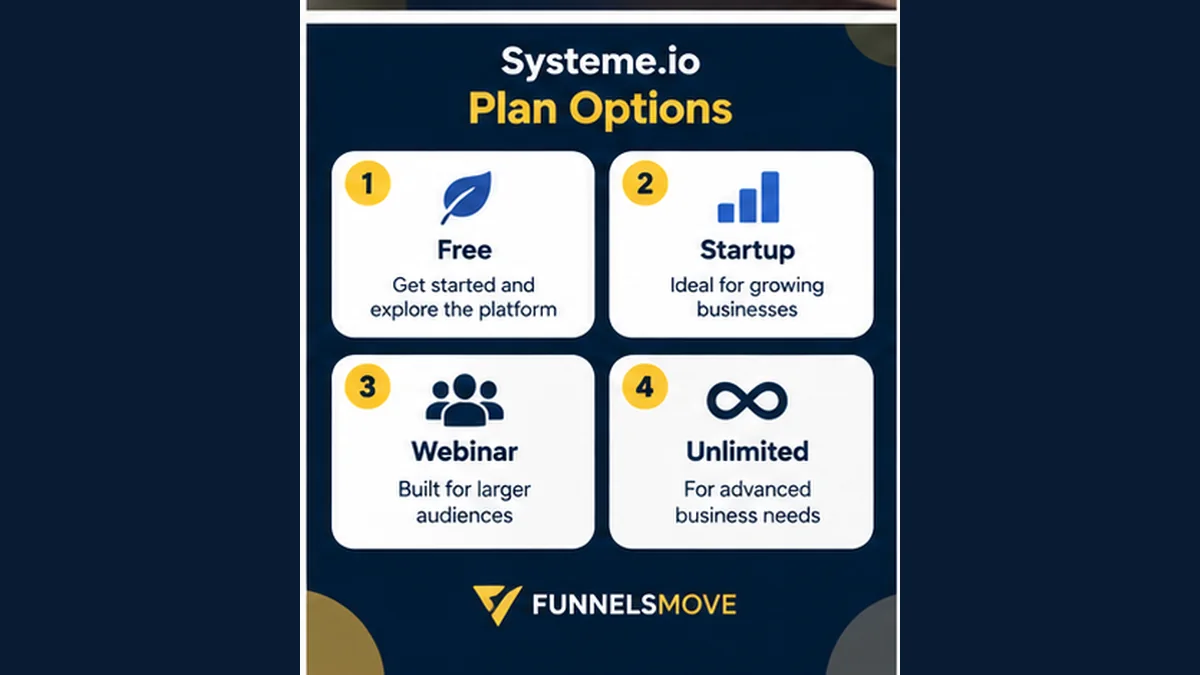
Systeme.io currently offers Free, Startup, Webinar and Unlimited plans, with the main limits increasing as your contact base and usage grow. The free tier is a genuine starting point rather than a short trial, making it practical for testing a real funnel before committing to a paid plan.
Pricing pages can change, and Systeme.io has multiple campaign pages online with different historical offers. For deployment decisions, treat the main official pricing page (opens in a new tab) as the source of truth and confirm the checkout price before paying.
How the four plans differ
The current official pricing page describes a Free tier for up to 2,000 contacts, followed by Startup, Webinar and Unlimited. Higher tiers raise limits for funnels, courses and other resources; Webinar adds capacity for evergreen webinars, while Unlimited is designed for users who need the broadest limits.
Do not choose only by headline price. List the contacts, funnels, courses, domains and workflows you expect to operate over the next 6–12 months, then compare those requirements with the current plan matrix.
What can you do on the free plan?
The free plan is most useful as a proof-of-work environment: build an opt-in or sales funnel, connect email follow-up, test a product or course workflow and decide whether the editor fits how you work. Systeme.io's main pricing page currently states that the free plan does not require a credit card.
The constraint is capacity rather than the basic idea of the platform. If your list, funnel count or course needs exceed the free limits, the decision becomes whether a paid Systeme.io tier still costs less—in money and operational complexity—than the alternatives you would otherwise combine.
When Startup makes sense
Startup is the natural step when the free tier is working but its capacity limits become restrictive. Before upgrading, identify the specific limit you are hitting. Paying because the dashboard suggests an upgrade is less useful than paying because you need more contacts, funnels, courses or operational headroom.
Also compare annual and monthly billing on the official page. Annual offers can change, so this guide avoids turning a temporary discount into a permanent assumption.
When the Webinar plan matters
The Webinar tier is relevant when evergreen webinars are part of the acquisition or sales process or when its higher usage limits match your business. If you do not need webinar functionality, compare the other capacity differences before assuming this tier is automatically the best middle option.
A useful test is to sketch the actual funnel: registration, reminders, webinar delivery, offer, checkout and follow-up. Confirm that each step can be implemented the way you need before upgrading for the feature name alone.
When Unlimited can be economical
Unlimited can make sense for a business with enough contacts, funnels, domains or campaigns that lower-tier limits create ongoing friction. The value is operational headroom, not simply owning the highest plan.
Calculate total stack cost as well. If Systeme.io replaces several paid tools you genuinely use, the comparison differs from a business that only needs a landing page and a basic email sequence.
What else affects the real cost?
Software subscription price is only one cost. Include payment-processing fees charged by your payment provider, domain costs, migration time, any external integrations, team training and the opportunity cost of rebuilding established automations.
Systeme.io advertises 0% platform transaction fees on its current pricing material, but payment processors can still charge their own fees. Verify processor pricing separately for your country and payment mix.
A practical plan-selection checklist
Choose the smallest tier that supports the workflow you can describe today, with reasonable near-term headroom. Record your contact count, number of active funnels, courses, domains, automation needs and webinar requirements. Then validate those numbers against the live pricing table.
If you are still deciding whether the platform itself fits, read the Systeme.io platform overview. If your concern is connecting existing tools, see Systeme.io integrations.
Check current Systeme.io plans
Verify today's prices and limits on Systeme.io before choosing a tier.
Explore Systeme.io (opens in a new tab)Pricing scenarios to model before upgrading
A new creator with one offer should first model the free tier against the complete workflow, not just contact capacity. A growing course business should estimate list growth, the number of active funnels and courses, custom-domain requirements and whether evergreen webinars are part of acquisition. A multi-brand operator should pay particular attention to account structure and the current limits shown on the live pricing page.
These scenarios matter because the cheapest plan can become expensive if it forces a workaround, while a higher tier can be economical if it replaces several subscriptions you would otherwise keep. Conversely, “all-in-one” savings are imaginary when the business continues paying for the same external tools after upgrading.
Monthly versus annual billing
Annual billing can reduce the effective monthly cost when an annual offer is available, but it also increases commitment. Test the workflow on the free plan or a monthly paid tier before prepaying solely for a discount. Confirm renewal terms and the current annual price at checkout rather than relying on a screenshot or an older review.
For budgeting, separate recurring software cost from one-time migration work. Rebuilding pages, cleaning a contact list, authenticating a sending domain and testing automations can require more effort than the first subscription payment.