Systeme.io vs ClickFunnels: Which Fits Better?
Both platforms can run funnels, email and digital-product workflows. The better fit depends on budget, funnel complexity, capacity limits and how much specialist depth you need.
Systeme.io vs ClickFunnels: the short answer
Systeme.io is the stronger fit when low-cost consolidation and a permanent free entry point matter most; ClickFunnels is the more funnel-centric choice for businesses that want its dedicated funnel ecosystem and can justify the higher starting cost. Both now cover more than page building, so the decision should be based on your operating workflow rather than an outdated “cheap tool versus funnel tool” stereotype.
Systeme.io combines funnels, email, automation, courses and other creator tools. ClickFunnels combines funnels with landing pages, email, courses, stores and related selling tools. The overlap is substantial; the differences are in product emphasis, limits, pricing and how each workflow feels to operate.
Pricing and entry cost
Systeme.io's official pricing page (opens in a new tab) currently offers a Free tier plus paid plans. ClickFunnels' official pricing page (opens in a new tab) currently lists Launch at $97/month on monthly billing, with higher Scale and Optimize tiers and annual discounts.
That makes Systeme.io easier to test without a paid commitment. But price should be compared at the capacity you actually need: contacts, funnels, courses, domains, team access and email volume can change the practical cost of either platform.
Funnel building and conversion workflow
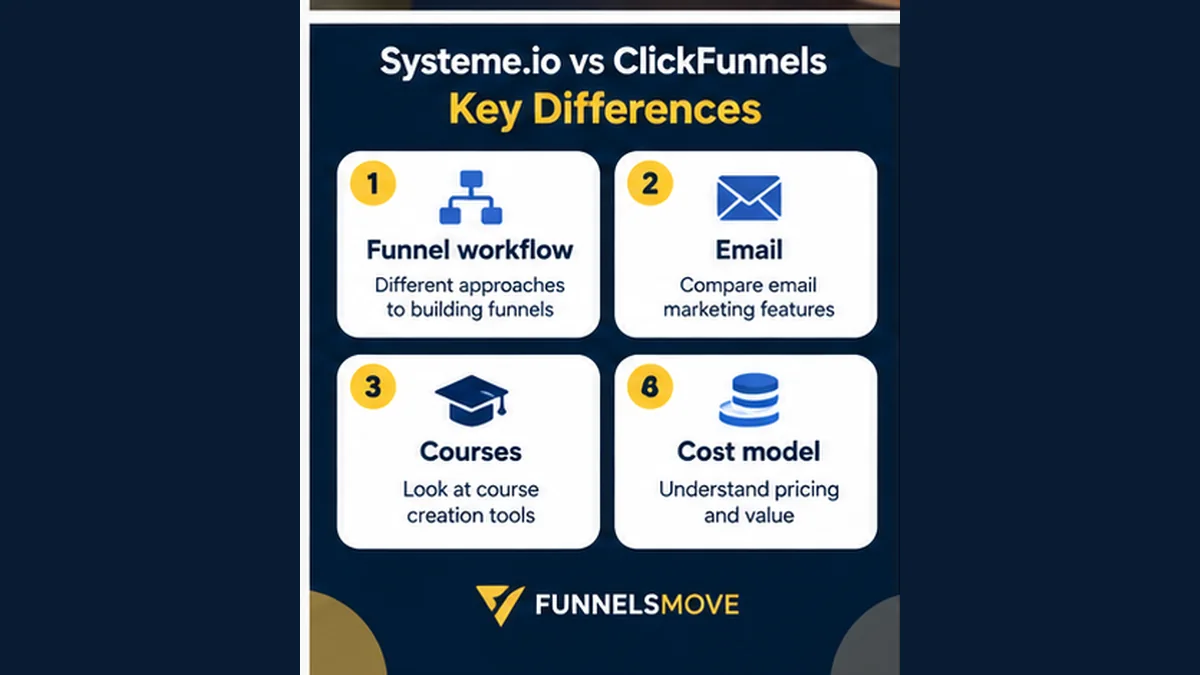
Both platforms can build multi-step funnels, landing pages and sales flows. ClickFunnels' product identity remains strongly funnel-first, with a large portion of the experience organized around building and optimizing customer journeys. Systeme.io also provides a drag-and-drop funnel builder, templates, order bumps, upsells and connected automation.
For a buyer, the useful test is to rebuild the same representative funnel in each platform: opt-in, sales page, checkout, upsell and follow-up. Compare editing speed, reusable elements, checkout requirements and the effort needed to change the funnel later.
Email marketing and automation
Systeme.io integrates email campaigns and automation directly with its funnels and contact data. ClickFunnels also includes email capabilities, with plan limits for contacts and monthly email volume shown on its current pricing matrix.
If email is strategically important, go beyond “included.” Compare segmentation, triggers, branching, reporting, deliverability operations and the exact sequences you already run. A bundled email tool saves money only when it can support the lifecycle logic you need.
Courses and digital-product delivery
Both platforms support course delivery, making each a candidate for creators who want the marketing and fulfillment stack in one account. Systeme.io positions courses as a core part of its all-in-one creator toolkit; ClickFunnels lists course and community allowances by plan.
Course creators should evaluate the student experience as carefully as the sales funnel. Test lesson organization, access rules, drip requirements, community needs and how purchase events grant access.
Integrations and extensibility
Neither platform should be evaluated in isolation if your business already depends on external systems. Systeme.io offers native payment and Google Sheets connections, external form embedding, webhooks and a public API. ClickFunnels exposes integrations and, on higher current plans, webhooks/full API access.
List the systems you cannot replace—payment processors, CRM, analytics, fulfillment or specialist email—and verify those connections before migration. Our Systeme.io integrations guide covers this decision in more detail.
Choose Systeme.io when…
- You want to validate a funnel or creator business with a permanent free starting point.
- You value having funnels, email, courses and automation in one relatively simple environment.
- Your workflows fit within its native tools and current integration options.
- Keeping subscription overhead low matters more than adopting a funnel-specialist ecosystem.
Choose ClickFunnels when…
- Your business is organized primarily around sophisticated funnel building and offer flows.
- You already use ClickFunnels assets, workflows or team processes and migration would add little value.
- The current plan limits and higher entry price fit your economics.
- You prefer its funnel-first product model after testing both editors with the same use case.
How to run a fair comparison
Create the same small project in both tools. Use one lead magnet or offer, one checkout path, one follow-up sequence and one delivery workflow. Record how long setup takes, where you need workarounds and which limits you encounter.
Then compare the 12-month cost at your expected contact and usage levels. This is more reliable than comparing the longest feature list.
Explore Systeme.io
Use a real funnel workflow to decide whether its lower-cost all-in-one model fits your business.
Explore Systeme.io (opens in a new tab)Pages, websites and publishing workflow
Both products extend beyond isolated funnel pages. When comparing them, test the parts of publishing that create recurring work: global styling, mobile adjustments, custom domains, page duplication, reusable sections and the path from draft to live traffic. A faster editor can be worth more than an extra feature you rarely use.
If organic search is important, keep the main content site requirements separate from the funnel requirement. Many businesses use a dedicated content site alongside a funnel platform. The comparison should therefore include how comfortably each tool coexists with the website you already operate.
Contacts, data and reporting
Marketing platforms become harder to replace as they accumulate contact history, tags, purchases and automation logic. Before choosing either product, list the data fields you need, how contacts enter the system, what segmentation drives follow-up and which reports actually inform decisions.
Systeme.io emphasizes an integrated creator stack, while ClickFunnels publishes contact and email allowances by plan. In either case, confirm how your expected database size affects cost and how you would export essential data if you later change platforms.
Migration and switching costs
A subscription comparison can understate the real cost of switching. Pages may need rebuilding, domains and DNS may change, email authentication may need to be configured, payment flows must be retested and automation logic needs to be recreated. Existing customers also need a safe transition plan.
If you already run a stable ClickFunnels business, Systeme.io's lower entry price is not by itself a reason to migrate. Estimate the hours required to reproduce your current system and the revenue risk of mistakes. If you are starting from scratch, the equation is different because there is less legacy work to preserve.
Support, documentation and operational fit
Documentation quality matters because funnel software touches revenue-producing workflows. During a trial, search the help center for the exact tasks you expect to perform: connecting domains, configuring payments, authenticating email, exporting contacts and troubleshooting automations. Notice whether the instructions match the current interface.
Team fit matters too. A solo creator may value simplicity and low overhead, while a larger marketing team may value permissions, repeatable workflows and deeper controls. The platform that looks more powerful in a feature matrix can still be the poorer operational choice if the team struggles to maintain it.