Simvoly Ecommerce: Stores, Checkout and Funnel Fit
Explore Simvoly ecommerce for products, services, digital goods, checkout, subscriptions, upsells, inventory, analytics and connected sales funnels.

What does Simvoly ecommerce include?
Simvoly combines online-store functionality with sales funnels. Current official pages describe selling physical products, services, digital products and memberships, along with product variations, inventory, tax and shipping rules.
The platform also emphasizes custom checkouts, subscriptions, one-click upsells, downsells and bump offers. This makes ecommerce relevant both to a traditional storefront and to focused funnel-based sales journeys.
The decision should start with your catalog and operations. A small digital-product business has different requirements from a store with complex inventory, fulfillment and tax workflows.
Products, services and digital goods
Simvoly’s online-store page currently supports physical goods, services, digital products and membership access. Define product types before building the storefront because fulfillment and customer expectations differ.
For physical goods, document SKUs, variations, inventory, shipping and returns. For digital goods, focus on delivery and access. For services, clarify scheduling or fulfillment and what the buyer receives after payment.
Use categories and product information that help customers decide rather than copying a generic template structure.
A practical ecommerce launch framework
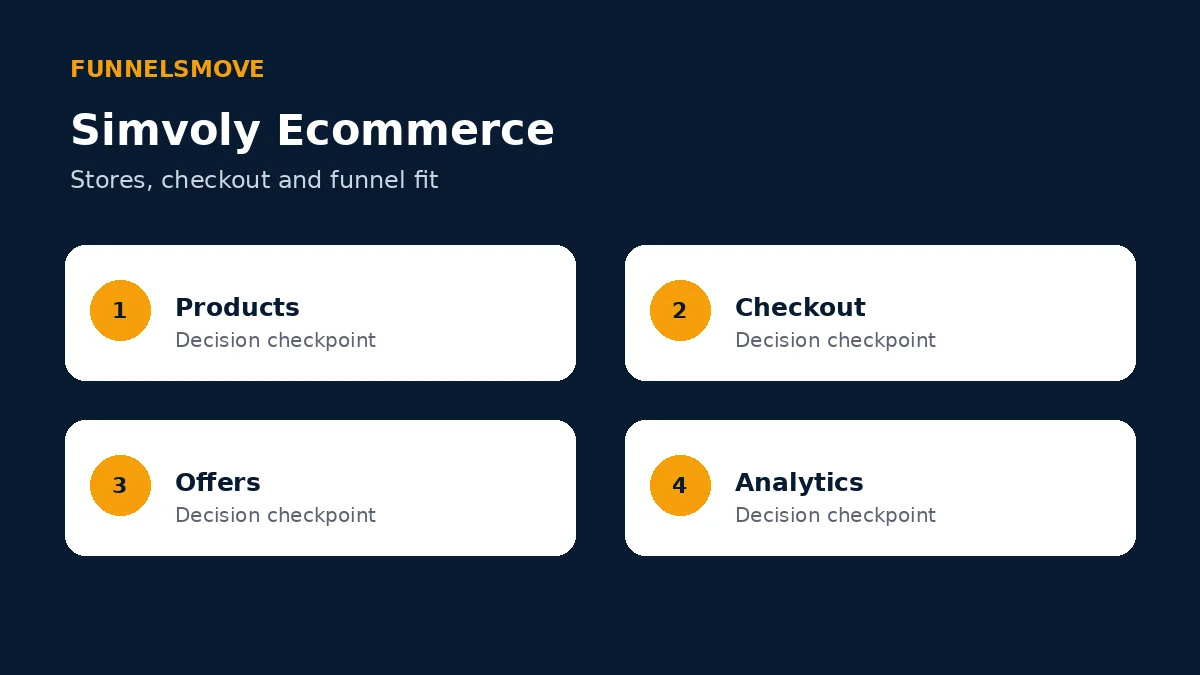
Use four checkpoints: organize products and operations, configure checkout and payment, add relevant offers or funnels, then verify analytics and post-purchase workflows.
Run test orders for representative product types before launch. Confirm payment status, inventory behavior, confirmation messaging, CRM records and any access or delivery automation.
Storefront, variations and inventory
Simvoly documents store layouts, product variations, inventory tracking, SKUs, filtering and quick product views. These are useful building blocks for a conventional online catalog.
Design the catalog around how customers shop. Variations should be understandable, filters should reflect meaningful attributes, and unavailable combinations should not create confusion.
Inventory accuracy is an operational responsibility. If stock is managed elsewhere, verify how the systems synchronize before treating Simvoly as the source of truth.
Checkout and payment flow
Current ecommerce materials promote customizable one-step checkouts and integrations with payment processors. Keep checkout focused: collect the information required to complete the order without adding unnecessary friction.
Verify tax, shipping, currency and payment settings for the markets you serve. These are business and compliance decisions, not merely design settings.
Test declined and successful payment paths where possible, and confirm customers receive accurate confirmation and access information.
Upsells, downsells and bump offers
Simvoly supports one-click upsells, downsells and bump offers in its sales ecosystem. These can increase order value when the additional product genuinely complements the original purchase.
Do not let optional offers obscure the core transaction. Make price, billing terms and what the customer receives clear at each step.
For the broader campaign workflow, see our Simvoly funnel builder guide.
Subscriptions and memberships
Simvoly’s ecommerce and membership materials describe recurring payments and membership purchases. Subscription products require clear billing intervals, cancellation expectations and access rules.
Test what happens when a subscription starts, renews, changes or ends. The customer experience after a payment event matters as much as the checkout itself.
If the product includes protected content or community access, our communities and memberships guide covers that layer.
Sales analytics and abandoned-cart automation
Simvoly promotes ecommerce analytics for sales, customers and revenue sources, and its ecommerce page describes abandoned-cart automation flows. Use analytics to identify where the buying journey needs attention rather than assuming every drop-off is a design problem.
Verify tracking before relying on reports. Place test orders, check traffic attribution and make sure funnel and store transactions appear where expected.
Abandoned-cart messages should be relevant and appropriately consented. Review timing and frequency so recovery automation does not become unwanted messaging.
White-label ecommerce considerations
The approved keyword plan consolidates “Simvoly White Label E-Commerce” into this page rather than creating a competing article. Simvoly currently markets ecommerce as part of its white-label platform for agencies and SaaS operators.
Agencies should evaluate more than the storefront: client provisioning, branding, support responsibilities, project pricing and who manages payment or commerce configuration all affect the service model.
For the wider reseller proposition, see our Simvoly white-label guide.
Who is Simvoly ecommerce suited to?
Simvoly ecommerce is most compelling when stores and focused sales funnels need to coexist with websites, CRM, marketing or memberships. It can suit digital products, services and conventional catalogs that fit the documented feature set.
A specialist commerce platform may be more appropriate for organizations with highly complex inventory, fulfillment, marketplace or enterprise requirements. Compare the complete operational lifecycle rather than only page design.
Before choosing, build a representative product and test the hardest checkout, fulfillment and reporting requirements your business expects.
Bottom line on Simvoly ecommerce
Simvoly connects storefront commerce with funnel-style checkout and offer tools. That integration can reduce stack complexity, but product operations, payment configuration, fulfillment, analytics and customer support still determine whether the ecommerce setup is sustainable.
Official sources checked
Simvoly ecommerce (opens in a new tab) · Simvoly online store (opens in a new tab) · Simvoly white-label ecommerce (opens in a new tab)
Ecommerce operations checklist
Document who owns catalog changes, inventory, refunds, fulfillment questions and payment troubleshooting. Even a small store benefits from clear responsibility when an order needs manual attention.
Test representative orders on desktop and mobile, including variations, discounts or subscription behavior you intend to use. Verify the customer-facing confirmation and the internal order record rather than stopping when the payment screen succeeds.
Keep a change log for checkout, payment and automation updates. When revenue tracking or fulfillment breaks, knowing what changed recently can shorten diagnosis.
Explore Simvoly
Review the current product and plan details directly before deciding whether Simvoly fits your workflow.
Explore Simvoly (opens in a new tab)