ClickFunnels vs ActiveCampaign: Funnels vs Marketing Automation
ClickFunnels centers the acquisition and sales funnel. ActiveCampaign centers sophisticated marketing automation, segmentation and integrated customer data. The overlap is real, but the operating priorities differ.
ClickFunnels vs ActiveCampaign: the short answer
Choose ClickFunnels when you want to build the page-to-offer-to-checkout journey in a funnel-first environment. Choose ActiveCampaign when sophisticated email marketing, segmentation, behavioral automation and integration with an existing stack are the primary requirements.
ActiveCampaign also offers CRM capabilities and landing pages, while ClickFunnels includes email and automation. So the comparison should focus on which system becomes the operational center, not on a simplistic “funnels versus email” label.
Marketing automation
ActiveCampaign’s current automation platform supports branching and conditional actions, behavioral triggers, segmentation, site/event tracking and cross-channel capabilities that vary by plan or add-on. Its 2026 plan matrix distinguishes Starter’s five actions per automation from unlimited actions on Plus, Pro and Enterprise.
ClickFunnels can automate follow-up around funnel and customer events. That can be simpler when the business wants pages, offers and follow-up in the same environment. A team with complex lifecycle logic should recreate a representative ActiveCampaign automation before assuming consolidation will preserve it.
Funnels and acquisition pages
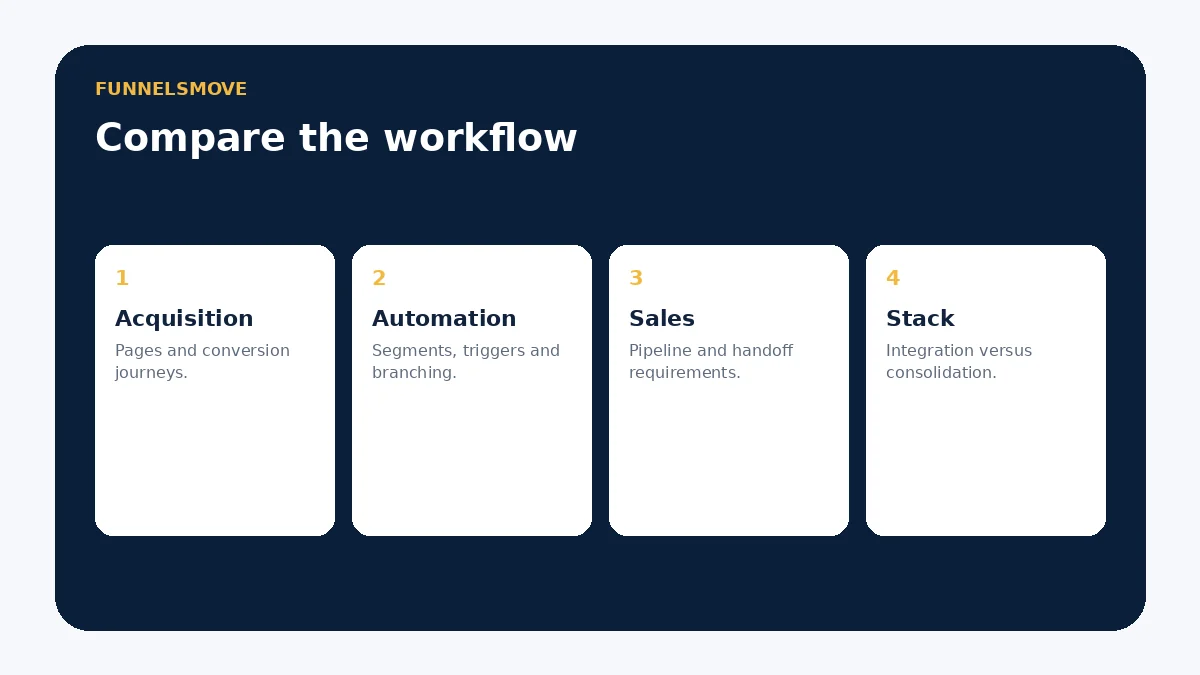
ClickFunnels is purpose-built for multi-step conversion paths such as lead capture, sales pages, order forms, upsells and confirmation. Current plans also package stores, courses and email capabilities around those journeys.
ActiveCampaign includes landing pages on current plans, but its strategic center is marketing orchestration around customer data. If a separate CMS, ecommerce store or page builder already works well, that integration-first model can be an advantage rather than a limitation.
Segmentation and contact data
ActiveCampaign emphasizes segmentation as a core marketing capability. Its current plans move from limited segmentation on Starter through standard, advanced and premium levels. Contact profiles, custom fields, tags and lists sit beside automation and reporting.
ClickFunnels contact data is closely connected to funnel and sales activity. A small business may prefer fewer systems. A marketing team with detailed lifecycle segments should inventory every field, tag, trigger and suppression rule before migrating.
CRM and sales workflow
ActiveCampaign’s current pricing architecture treats enhanced CRM capabilities such as pipelines and sales engagement as add-ons on eligible plans. Its CRM supports pipelines, stages, deals, tasks, routing and sales automation. Exact packaging should be verified because plan/add-on combinations change.
ClickFunnels has expanded its broader business-app environment, but buyers should test the exact opportunity, appointment and sales handoff workflow they need. If CRM is central, compare ownership, task management, pipeline reporting and permissions—not only whether a “CRM” label appears on a feature page.
Email and deliverability operations
ActiveCampaign is deeply email-centric, with campaign design, segmentation, automation and reporting in the same marketing system. ClickFunnels includes email capacity within its broader sales platform. Neither vendor can guarantee inbox placement.
Authentication, consent, list quality, complaints and sending behavior still matter. During a migration, preserve suppression records and test unsubscribe handling, bounce behavior and domain authentication before sending at production volume.
Integrations and stack strategy
ActiveCampaign currently promotes hundreds of integrations and is often used as the automation layer around an existing website, ecommerce platform and CRM stack. ClickFunnels can replace more of the acquisition and selling layer itself while also connecting outward.
The trade-off is consolidation versus specialization. Fewer systems can reduce handoffs, but greater platform dependence raises migration cost. A modular stack preserves specialist tools, but every integration becomes another dependency to monitor.
Pricing context
ActiveCampaign pricing is contact-based and plan-dependent, with optional add-ons for capabilities such as enhanced CRM, SMS, transactional email or custom reporting. Its current public pricing interface requires configuration to show exact amounts, so this comparison does not freeze a headline price that may not match your contact count.
ClickFunnels pricing is organized around platform plans and their included limits. Model your expected contacts, email volume, CRM requirements, SMS usage and the software each platform would actually replace.
Comparison table
| Priority | ClickFunnels | ActiveCampaign |
|---|---|---|
| Multi-step sales funnels | Core focus | Usually paired with existing web stack |
| Advanced marketing automation | Evaluate for required journey | Core focus |
| Segmentation | Useful within funnel stack | Tiered, deep marketing emphasis |
| Sales CRM | Broader platform apps/workflows | Enhanced CRM add-ons available |
| Existing best-of-breed stack | May consolidate it | Integration-oriented fit |
Choose ClickFunnels if…
- Funnels and offer journeys are the primary unit of work.
- You want to consolidate pages, checkout and related sales tools.
- Your team values fast campaign-page deployment over highly specialized lifecycle automation.
- You sell through webinars, applications, direct-response pages or upsell sequences.
Choose ActiveCampaign if…
- Email lifecycle automation and segmentation are the primary requirements.
- You intend to keep your existing website, store or other specialist systems.
- You need sophisticated behavioral triggers and marketing reporting.
- You are comfortable configuring the appropriate plan and add-ons for CRM or channels.
Run a fair trial
- Map one real customer journey from source to sale.
- Build its landing page and lead capture.
- Recreate its segmentation and automation branches.
- Test sales handoff and reply handling.
- Include unsubscribe, duplicate and failed-integration cases.
- Compare reporting and annual total cost.
Related: ClickFunnels email marketing, integrations and ClickFunnels vs GetResponse.
Reporting and attribution
ActiveCampaign’s current plan matrix includes campaign, automation, contact/subscriber and site/link reporting, with attribution and conversion tracking on higher tiers. ClickFunnels reporting is more naturally evaluated around funnel traffic, conversion events and sales. Define the attribution question before choosing the dashboard.
If paid traffic, ecommerce and email all contribute to a sale, neither platform should be treated as an unquestionable source of truth without checking event definitions. Preserve UTM parameters, transaction identifiers and CRM stages where possible.
Common business scenarios
Marketing team with an established website and store: ActiveCampaign may fit as the automation layer without forcing a site migration. Consultant launching a high-ticket funnel: ClickFunnels may reduce the number of page and checkout tools required. Sales team with complex lifecycle marketing: ActiveCampaign deserves close evaluation, including the appropriate enhanced CRM add-on. Small creator business: compare operating simplicity before paying for capabilities the team will not maintain.
Important limitations
ActiveCampaign’s depth creates configuration work, and current CRM/channel packaging can require add-ons. ClickFunnels’ broader all-in-one approach can create platform dependence and may not match specialist automation requirements. Neither platform fixes poor contact data or an unclear customer journey.
Primary sources
- ActiveCampaign pricing and feature matrix (opens in a new tab)
- ActiveCampaign marketing automation (opens in a new tab)
- ActiveCampaign Sales CRM (opens in a new tab)
- ClickFunnels pricing (opens in a new tab)
Product details were checked September 19, 2026. ActiveCampaign packaging and add-ons should be verified for the exact contact tier.
Evaluate ClickFunnels for your workflow
Test the actual workflow, plan limits and integrations your business needs before moving production traffic.
Explore ClickFunnels (opens in a new tab)