ClickFunnels for Real Estate: Funnels, Leads and Follow-Up
ClickFunnels can support focused buyer, seller and investor lead journeys, but it does not replace every real-estate website, MLS, transaction or CRM function.
Is ClickFunnels useful for real estate?
Yes, when the job is a focused lead-generation journey. A real-estate agent or investor can use ClickFunnels to create landing pages, capture contact details, present a lead magnet or property-related offer, route prospects toward an appointment and automate parts of the follow-up.
It is less suitable as a blanket replacement for every real-estate system. MLS/IDX search, transaction management, brokerage compliance, property databases and mature real-estate CRM functions may still require specialist tools. Treat ClickFunnels as the conversion layer when that is the job it performs best.
Choose one audience and one conversion goal
Real estate has multiple audiences with different intent: homeowners considering a sale, motivated sellers, buyers, investors, landlords, renters and referral partners. A generic “real estate funnel” that speaks to all of them usually creates a weak message.
Start by defining one audience and one next action. Examples include requesting a home-value consultation, downloading a neighborhood guide, registering for an open house, asking about an investment property, or booking a seller strategy call. The page promise, form fields and follow-up should all support that action.
A practical real-estate funnel workflow
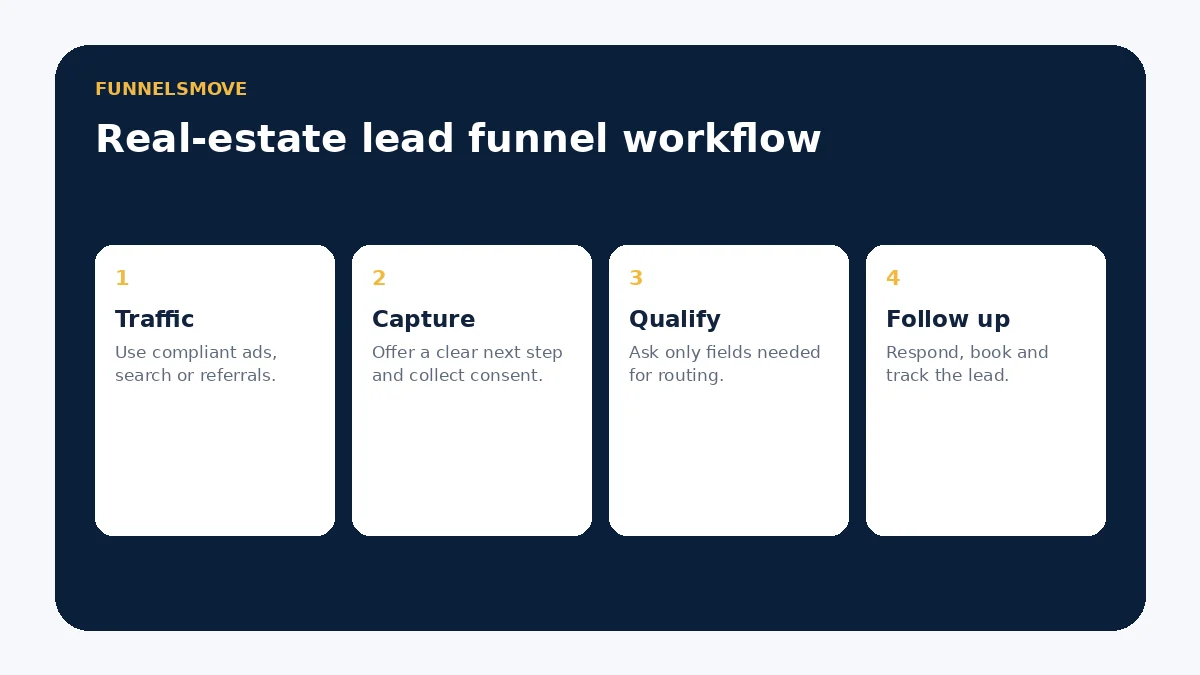
A simple workflow is traffic → focused landing page → lead capture → qualification → follow-up or appointment. ClickFunnels’ own real-estate funnel guidance describes a squeeze-page pattern for generating leads, and its current platform provides landing pages and funnel-building capabilities that can support that structure.
Keep the first form proportional to the offer. A neighborhood PDF may need only an email address and optional name; a seller consultation may justify property address, timing and contact preference. Every extra field should have a clear routing or service purpose.
Seller-lead funnel example
A seller funnel can begin with a specific promise such as a home-value review or selling-plan consultation. The landing page should explain what the visitor receives, what happens after submission and whether the response is automated or handled by a person.
After capture, route the lead based on information you genuinely need: property location, expected selling timeframe or preferred contact method. High-intent leads can move toward an appointment. Lower-intent leads may receive useful educational follow-up. Avoid implying that an automated valuation or marketing estimate is a formal appraisal unless it actually is one.
Buyer and open-house funnels
Buyer funnels can focus on a neighborhood, property type, open house or consultation rather than a broad “find your dream home” message. For an open house, the funnel may capture registration, provide event details and send reminders. For a buyer consultation, it can collect the minimum information needed to prepare for a call.
If live property search is central, a dedicated real-estate website or IDX solution may still be the better browsing experience. ClickFunnels can then handle campaign-specific landing pages and conversion journeys while the property platform handles inventory.
Real-estate investor funnels
Investors often need a different flow from traditional agents. A motivated-seller campaign may focus on property condition, timing and the type of solution the business offers. Be precise about what your company does and avoid guarantees about offers, closing timelines or outcomes that depend on property review and local rules.
Investor funnels also benefit from clear routing. A form submission should create an identifiable lead, trigger the appropriate notification and enter a follow-up process. Test duplicate submissions, invalid phone numbers and leads outside the service area.
Follow-up, appointments and CRM handoff
Speed and consistency matter operationally, but automation should support—not disguise—the human process. Define who owns a new lead, when the first response occurs, when an appointment link is appropriate and when the lead moves into the CRM or transaction system.
If ClickFunnels is not your system of record, use a supported integration, API/webhook path available on your plan, or an automation platform to pass the data onward. Document the fields and consent status that move between systems. Our ClickFunnels integrations guide covers the broader connection strategy.
Compliance, privacy and advertising considerations
Real-estate marketing can involve fair-housing rules, advertising-platform restrictions, brokerage requirements and privacy/communications laws. FunnelsMove is not providing legal advice. Use audience targeting, claims, forms and follow-up that comply with the rules applicable to your market and brokerage.
Do not add someone to promotional SMS or email merely because you obtained a phone number for another purpose. Explain what the person is requesting, capture consent where required and honor opt-outs. Avoid collecting sensitive information unless it is genuinely necessary and appropriately protected.
When ClickFunnels is a good fit
| Situation | Fit | Why |
|---|---|---|
| Paid campaign to seller consultation | Strong | Focused landing page and appointment journey |
| Open-house registration | Strong | Simple capture and reminder flow |
| Large IDX property portal | Limited | Specialist property-search software is usually more appropriate |
| Transaction management | Limited | Not the core ClickFunnels job |
| Campaign landing pages beside an existing site | Strong | Lets the main website and conversion pages do different jobs |
Implementation checklist
- Pick one audience and conversion goal.
- Write a specific, supportable offer.
- Build the shortest page sequence that can complete the task.
- Collect only fields needed for service or routing.
- Connect lead ownership, CRM and appointment steps.
- Test email/SMS consent and opt-out handling.
- Test mobile layout, form errors and thank-you routing.
- Measure source, submission and booked-appointment events without promising results.
For the broader software decision, see sales funnels for small business, ClickFunnels landing pages and tracking setup.
Landing-page content for real-estate campaigns
A real-estate landing page should answer the visitor’s immediate question before asking for contact information. For sellers, that may be what the consultation or valuation process includes. For buyers, it may be what properties, neighborhood information or planning help they will receive. Avoid vague claims such as “best price guaranteed” unless they are supportable and permitted.
Use local detail where it genuinely improves relevance, but do not create dozens of near-duplicate city pages with only the place name changed. A campaign page should have a distinct offer, audience or service area reason to exist.
Tracking the funnel without overstating performance
Track the stages you can observe: landing-page visit, form submission, qualified lead, booked appointment and downstream business outcome if your systems can connect them reliably. Those stages help distinguish a traffic problem from a page problem or a follow-up problem.
Do not assume a high form conversion rate means high-quality real-estate opportunities. Lead quality depends on targeting, offer, market and qualification. Our ClickFunnels tracking guide explains how to structure measurement without promising a particular result.
Primary sources
- ClickFunnels real-estate sales-funnel guide (opens in a new tab)
- ClickFunnels current pricing and platform limits (opens in a new tab)
Product details were checked on September 19, 2026. Real-estate legal and advertising requirements vary by jurisdiction and should be verified separately.
Evaluate ClickFunnels for your workflow
Use the current plan details and test the complete journey that matters to your business before moving production traffic.
Explore ClickFunnels (opens in a new tab)